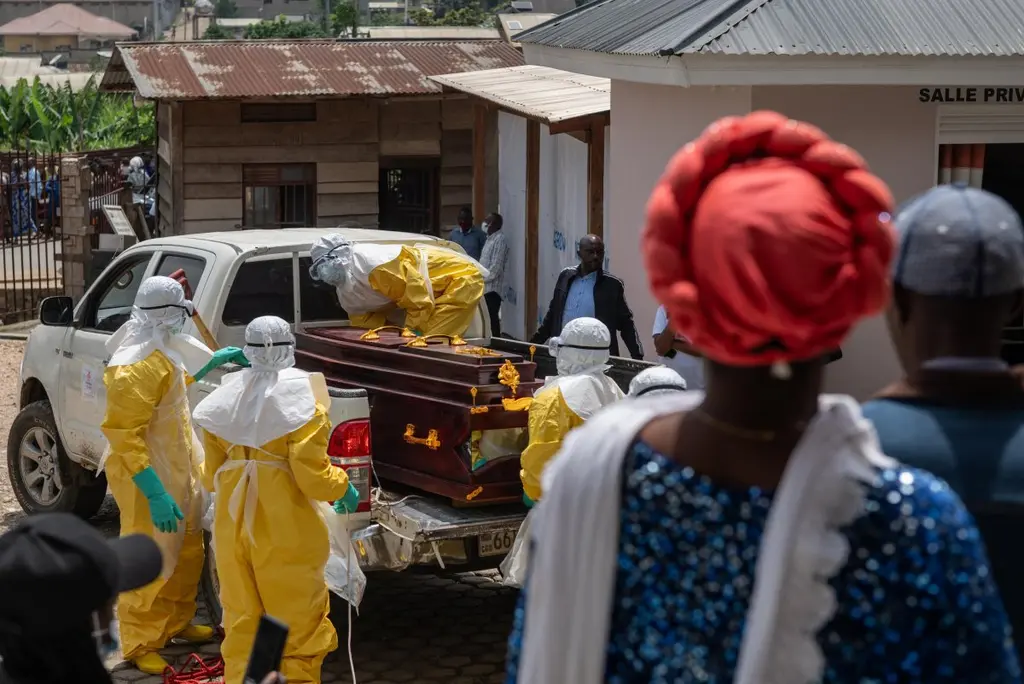

Officials: Ebola cases pass 12,000 in DR Congo, deaths rise to 5,900
The total number of Ebola cases in the Democratic Republic of the Congo has surpassed 12,000, national health officials reported this week.
Nov. 26 (UPI) -- The number of confirmed cases Ebola cases in the Democratic Republic of the Congo has surpassed 12,000 since the current outbreak began six months ago amid renewed armed clashes in the territories most heavily affected.
The DR Congo's National Institute of Public Health also reported this week that just over 5,900 deaths have now attributed to the deadly outbreak.
Even so, the response to crisis is "showing encouraging progress," health officials said, marked by a decline in new confirmed cases to 66 on Tuesday -- down from 69 the previous day and 109 a week ealier.
Deaths also decreased to 18 on Tuesday, compared to 22 the previous day and 34 on Nov. 17, while 25 people were reported as recoveries and no new geographical zones have been affected outside of the core outbreak area in the four eastern provinces of North Kivu, Ituri, Haut-Uélé and Tshopo.
Ituri remains the epicenter of the epidemic, accounting for 67.7% of cumulative cases, and even as United Nations officials reported that armed fighting there is once again hampering efforts aid workers to confront the outbreak.
The UN mission in the country, MONUSCO, reported Wednesday that security has "significantly deteriorated" in several areas due to clashes between Congolese forces and the Convention for the Popular Revolution, which is just one of dozens of armed groups in the resource-rich east.
They said the fighting has displaced thousands of people and is threatening access to essential health services at a major displacement camp amid the outbreak.
"The violence has triggered further population displacement, including among people who had already fled insecurity," the UN mission said.
The Bangladeshi Rapid Deployment Battalion is working to help both civilians and healthcare workers escape the fighting, officials said. Their efforts included the successful Tuesday evacuation of 10 health workers from a hospital where they had been sheltering for over three days.
"These healthcare workers, who are actively involved in the response to the Ebola outbreak, play a vital role in assisting communities already weakened by violence and displacement," MONUSCO said.
Although surveillance, laboratory capacity and contact tracing have been strengthened, "important gaps persist" in the fight against the DR Congo outbreak, the World Health Organization said in an update issued Wednesday.
"More than 80% of newly reported infections continue to be detected outside known contact lists, while insecurity, population movement, community mistrust, health-system constraints, shortages of infection prevention and control supplies, and funding gaps continue to hamper response efforts," it warned.
Thus the overall Ebola risk remains "very high" in the DR Congo and "high" in Kenya and Nigeria, which have reported cases without documented community transmission, the agency assessed.