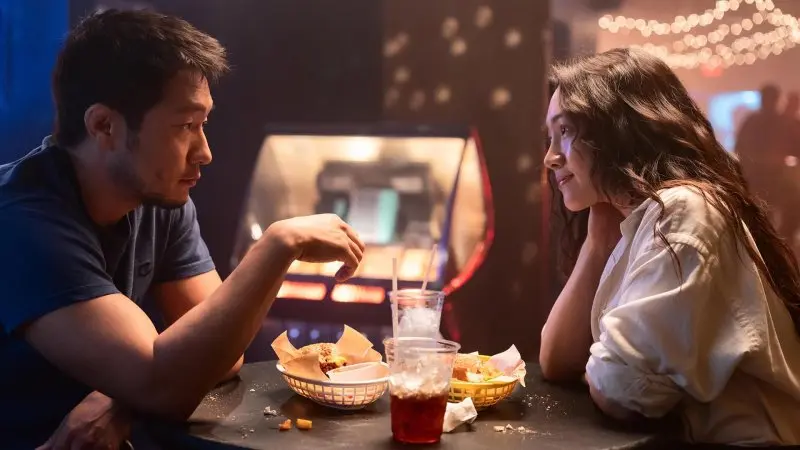

Korean American filmmaker Stephanie Ahn's "Bedford Park," which screened at the Busan International Film Festival, is a movie that reflects the deeper details of her own experiences.

Eli (Son Sukku, R) and Audrey (Moon Choi) get to know each other in director Stephanie Ahn's "Bedford Park." Photo courtesy of Busan International Film Festival UPI Director Stephanie Ahn speaks during a group interview Thursday at the Busan International Film Festival. Photo by Thomas Maresca/UPI UPI "Bedford Park" tells a story of identity and connection that director Ahn said is "universal." Photo courtesy of Busan International Film Festival UPI Son Sukku's Eli sits on the floor of his apartment in "Bedford Park." Photo courtesy of Busan International Film Festival UPI
BUSAN, South Korea, Oct. 12 (UPI) -- As the tidal wave of Korean culture washed over global audiences and Asian American stories gained greater visibility in Hollywood in recent years, Korean American filmmaker Stephanie Ahn felt that something was missing: a movie that reflected her own experiences.
The first-time feature director's response was Bedford Park, a bruising yet tender romantic drama that won the U.S. Dramatic Special Jury Award for Debut Feature at Sundance earlier this year. The film screened last week at the Busan International Film Festival, with Ahn in attendance.
"There are so many Korean American or Asian American stories that have been made that I so admire, and they have certainly opened doors for me as well, but I felt they touched upon the Korean or Asian American experience in sort of a surface level," Ahn told reporters in a group interview Thursday in Busan.
"There wasn't a story that made me feel like I was seen personally deep inside," she said. "I always craved stories that I felt reached deeper details."
...
"Bedford Park" follows two struggling Korean Americans in their 30s, Audrey (Moon Choi) and Eli (Son Sukku), whose paths collide after Eli is involved in a car accident with Audrey's mother (Won Mi-kyung).
Audrey, a physical therapist in Brooklyn, temporarily moves back to her parents' New Jersey home to help as her mother recovers from a wrist injury caused by the crash. There is little keeping her in the city: an outburst at work has earned her a suspension, and her personal connections seem limited to app-enabled hookups.
Eli's not doing much better. He's taking classes at a community college and working as a security guard at a mall, a routine punctuated by occasional trysts with a younger classmate. He has a daughter he doesn't see, an adoptive mom in Pennsylvania asking him for financial help, and a stepbrother leaning on him to return to a shady job he left behind in Miami.
An attempt to settle the accident's damages outside the insurance system brings Audrey to Eli's ramshackle apartment in a meet-cute that goes awry, leaving both of them throwing fruit from a gift basket.
When a subsequent encounter turns into a medical emergency for Audrey, Eli steps up to help. A carpool arrangement follows, giving the mismatched pair time to begin opening up to each other as they reveal both literal and figurative scars.
Their complex, messy lives sit uneasily alongside the glossy imagery of the global Korean culture boom. In one scene, Audrey is dragged to a Korean spa by her cousin but protests at the K-beauty treatments, saying she doesn't want that "creepy glass-skin look."
...
Ahn said the global appetite for Korean culture might attract attention to her project, but it did not help the film get made.
"I didn't get financing because suddenly there were Korean pop stars and films that were more mainstream," she said.
Even within its central relationship, Bedford Park presents sharply different Korean American experiences. Audrey grew up with immigrant parents whose disappointments with their lives in the United States weigh heavily on their expectations for their children, while Eli was adopted into a white family.
Ahn said she wanted to explore how people are affected by the "cognitive dissonance" of living with contradictory belief systems, an experience she felt audiences could understand regardless of their cultural background.
"I feel that the stories that I'd like to tell are very not trendy," she said. "They're more human stories ... I'd like to think that our film is something that is universal in a way that is also timeless."
South Korean stars Choi (Anarchist from Colony) and Son (D.P., My Liberation Notes) anchor the film's stop-and-start movement from hostility toward intimacy. Through car rides, hesitant conversations and small acts of care, the pair tentatively find sanctuary in each other, even as family obligations and past wounds threaten their connection.
Ahn said Bedford Park's screening in Busan carried its own emotional resonance -- it was the first time her parents saw the film, and she hadn't been sure what to expect.
"They're not film lovers and they would be honest with me if there were things they didn't understand or if they didn't find it appealing," she said.
Instead, they connected deeply with the film.
"They found it very moving," Ahn said.