
Editorial: Data centers should lower homeowners’ property taxes, not raise them
More people would accept a nuclear power plant in their community than a data center, according to recent Gallup polling. Who would have predicted that even five years ago? The facilities needed to power the rise of artificial intelligence as well as to allow us to continue our collective smartphone addiction are wildly unpopular. And yet even as they draw bipartisan ire, data centers are a ...
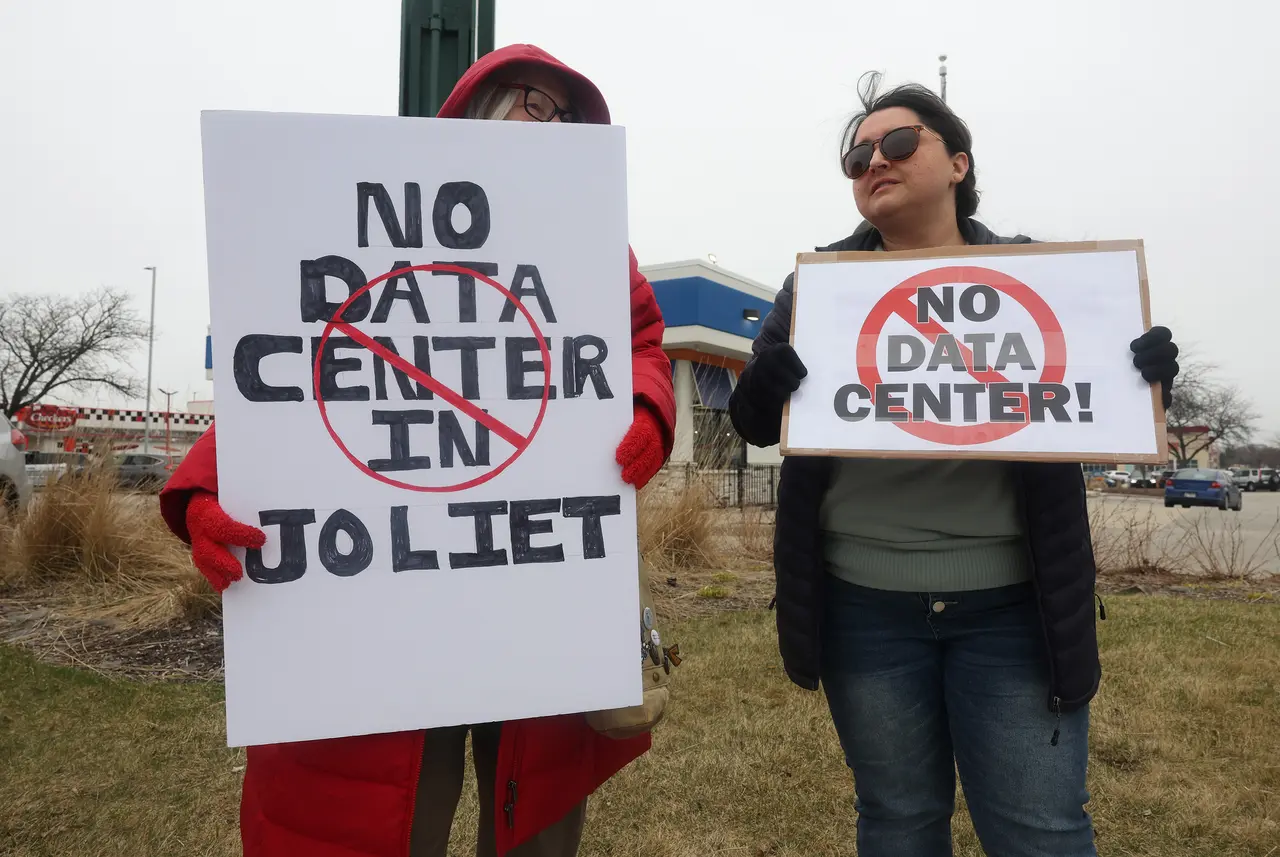
Linda Atkinson, left, and Michelle Secor hold signs while demonstrating at the intersection of Jefferson Street and Larkin Avenue to protest the proposed construction of a multi-structure, 795- acre data center Saturday, March 14, 2026, in Joliet, Illinois.
John J. Kim/Chicago Tribune/TNS
More people would accept a nuclear power plant in their community than a data center, according to recent Gallup polling. Who would have predicted that even five years ago?
The facilities needed to power the rise of artificial intelligence as well as to allow us to continue our collective smartphone addiction are wildly unpopular.
And yet even as they draw bipartisan ire, data centers are a fact of modern life. Given that, it’d be best for the public to make — and get — the most of them.
The trouble is, while data centers elsewhere have led to property tax relief, in Cook County we’ve been giving many of them preferential tax treatment even as homeowners’ bills continue to go up.
Consider the headlines on data centers and property taxes in Loudoun County, Virginia, versus Cook County.
In Loudoun County, referred to sometimes as “Data Center Alley” as a nod to its more than 250 data centers, the industry is expected to generate $1.3 billion in tax revenue next year. With this boon has come a downward trajectory of residential property tax bills, which have fallen by about 30% over the past decade, according to The New York Times.
You can argue about the tradeoffs, but you can’t argue with the math.
Loudoun has found a way for a huge data-center industry to generate enormous local revenue and homeowner tax relief; Cook County should examine why its own structure is producing such a different outcome.
Cook County is much larger than Loudoun County in both population and land. We have far fewer data centers — just over 100, with more planned.
That’s not nothing.
Northlake, a small western suburb, is home to multiple data centers, including the largest such facility in the whole state. That burg’s experience, however, is nothing like Loudoun County’s.
Northlake’s total residential property tax bill went up 13.3% in tax year 2025 compared with the previous year, according to a new report from Cook County Treasurer Maria Pappas.
It didn’t have to be this way. Tribune and Illinois Answers Project found that the average Northlake homeowner would save more than $2,000 on their annual tax bill — a difference of almost 30% — if local data centers did not receive valuation reductions and incentives, according to their analysis.
It’s true that data centers in Cook County still pay property taxes. But while homeowners are watching their bills climb, many of these data centers enjoy tens of millions of dollars in property tax savings. Tribune and IAP reporting found that data centers received nearly $100 million in combined property-tax savings from two sources: county tax incentives and reductions in their assessed valuations upon appeal.
One of those incentives is Cook County’s Class 6b program, a decades-old economic-development tool intended to encourage industrial investment. Class 6b allows the county to offer qualifying industrial properties substantial property tax relief by reducing assessments over a 12-year period. Data centers have been allowed to qualify for that industrial subsidy.
Cook County thankfully now appears to recognize that its incentive system needs updating, and there’s a natural deadline for doing so: The provisions governing Class 6b and several other county incentives expire at the end of 2027 unless the Cook County Board renews them. The county has commissioned independent studies of its economic development incentives and signaled interest in reform; its own analysis found that these incentives remove 11% of Cook County’s commercial and industrial property value from taxation.
That brings us to the obvious question: Why are we using a decades-old industrial-development subsidy to discount the property taxes of one of the hottest and wealthiest industries of 2026 while homeowners’ bills keep rising?
At the state level, Gov. JB Pritzker in June announced a pause on new state tax-incentive agreements for data centers. The county should take a page out of the governor’s book.
Pappas pointed out that “residential taxes in the north and northwest suburbs increased at a pace more than triple that of the inflation rate.” Some of this comes from referendums “approved in off-year elections by an average of one in five eligible voters,” as Pappas puts it.
But that hardly accounts for the entire increase; not every municipality approved tax-hike referendums. Given that overall property taxes in Cook County have risen for 32 years straight, according to Pappas, it behooves local officials to make sure the pain is divided equally. (It also behooves them to figure out ways to cut costs, but that’s another story.)
We live in a state in which lawmakers balked at giving the Chicago Bears “property tax certainty.”
Why, then, are local officials handing over tens of millions of dollars in incentives to data centers?
Of course, it’s obvious why local officials felt compelled to make this decision. It’s the same reason the Bears called for property tax relief as part of the deal to come to Arlington Heights.
They argue that because of Illinois’ extraordinarily high property taxes, these developments never would’ve happened without subsidies.
But some commercial developments are of greater public value than others. There are some investments — particularly those that create family-sustaining jobs over the long haul — for which tax incentives are well justified.
As we’ve stated more than once, states live in a competitive world. In cases where an impactful new factory or business is being wooed by multiple jurisdictions, Illinois and its local governments absolutely should seek to put competitive packages on the table.
Data centers simply aren’t in that category. Not anymore. A few years ago, the data center industry could effectively pit states against each other and thereby win incentives. Now they are anathema in many parts of the country. We’re seeing localities that open their doors to data centers experience intense blowback from constituents, in Republican as well as Democratic areas.
Parts of Chicagoland are attractive to data center developers due to their access to broadband, water and energy resources, among other attributes. These projects should be considered on their merits. And, at a bare minimum, they should alleviate the tax burden where they’re located, not exacerbate it.
_____