
Artist's ‘Other Washingtons’ monument asks, ‘Who should be remembered?’
CHICAGO — Amanda Williams has been coloring the Chicago-area landscape for years. She’s painted condemned homes in areas long disinvested in, in hues that resonate with Black culture (like the bluish-green of Johnson Products’ Ultra Sheen conditioner and a prussian blue of George Washington Carver’s 1927 patent). Williams’ public installations have brought attention to the inequity and ...
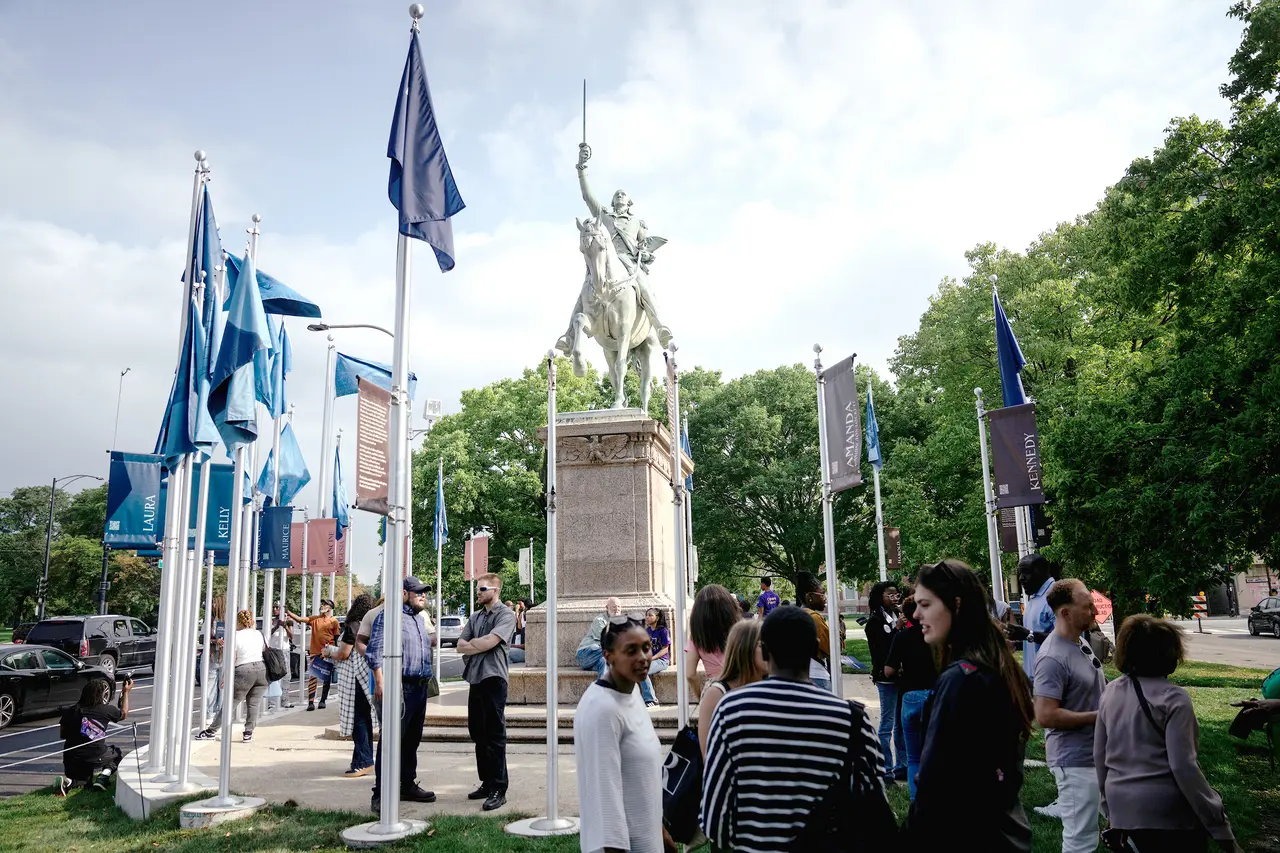
People attend the unveiling of Amanda Williams' installation“ Other Washingtons” at the site of the 1902 George Washington statue on the South Side, Aug. 6, 2026.
E. Jason Wambsgans/Chicago Tribune/TNS
CHICAGO — Amanda Williams has been coloring the Chicago-area landscape for years. She’s painted condemned homes in areas long disinvested in, in hues that resonate with Black culture (like the bluish-green of Johnson Products’ Ultra Sheen conditioner and a prussian blue of George Washington Carver’s 1927 patent). Williams’ public installations have brought attention to the inequity and injustice built into the built environment, as well as the ingenuity and joy therein.
Then she showed the world the depths of Blackness on social media during the pandemic in solidarity with #BlackLivesMatter to let Black viewers confront whether a Black image represents “your Black” or not. And in 2022, Williams “redefined redlining” with the planting of 6 acres of red tulips to call attention to the ongoing effects that systematized discrimination and forced segregation caused due to racially restrictive covenants marking certain areas undesirable if people of color lived there.
Now, Williams is focusing her artistic lens on local monuments, asking what it might look like to tell different types of stories and to have monuments that look different than what we would think of historically. The work, “Other Washingtons,” exists on the site of the 1902 George Washington statue in Washington Park and asks the public: Who is your favorite Washington?
“Color(ed) Theory was about the injustice, George gets to be about the reparations,” Williams said. “It’s in line with telling Chicago stories — this one ties them to a national story, a more historic story.”
The public artwork is one of flags, flagpoles and banners that encircle the existing statue of George Washington, much like monuments in Washington, D.C. According to Williams, depending on where you are as you walk or drive past the flags, you can either see portions of Washington or he is completely obscured. The banners and flags tell the stories and carry the names of other Washingtons — the everyday, historic and cultural Washingtons.
In relationship to the Washington statue, names like educator Booker T. Washington, scientist George Washington Carver, musicians Dinah Washington, Grover Washington Jr., and locals like the late mayor Harold Washington, early childhood educator Candice Washington, and Benjamin Washington, band director at Dr. Martin Luther King Jr. College Preparatory High School. The stories and images are of present-day people and those who have died — all of whom had an impact on their family, their community, Williams said. The biographies will be written by those named Washington or by someone who has a connection to them.
“It’s a beautiful interweaving of people that have ties directly to this name because it’s their surname, and people that feel their lives have been impacted by people that have had this last name,” Williams said. “It’s a way to really help people reimagine what they think a monument should be — who should be monumentalized, who should be honored, who should be put on a pedestal.”
“Other Washingtons” is part of the Chicago Monuments Project, an initiative the City of Chicago launched in 2020 to review public art and statues, focusing on controversial figures, historical reckoning and funding new inclusive memorials. The Department of Cultural Affairs and Special Events, Chicago Parks District and Monument Lab (part of the Chicago Monuments Project) collaborated to commission several new monuments funded through a partnership between DCASE and the Andrew W. Mellon Foundation. In researching for “Other Washingtons,” Williams learned that the majority of those carrying the surname Washington in the U.S. identify as African American.
“The relevance of George to the present-day neighborhood is very different than what was going on in 1902 in that same area,” Williams said. “The lineage of what he represents in the mythology of the country is directly the reason that the neighborhood has so many of the challenges that it has.”
Williams said the concepts of self-determination, democracy, freedom and independence, terms written when the nation was formed, were not written with people of color in mind. The history of redlining, segregation and the lack of generational wealth shows how decisions made by the founding fathers created the landscape that exists for Black people in present day.
“It’s not an accident,” Williams said. “The lineage of things that happened under his (George Washington’s) watch brings us to where we are today. That’s why the decision to make this intervention into the monument is really important. It’s really important to have a deeper history. This is an engagement that helps tell a fuller story.”
A website for “Other Washingtons” will co-exist with the project, serving as an ongoing repository of stories of Washingtons “who deserve recognition for impacting Chicagoans or the nation as a whole” — famous or unknown, personal or historic. Visitors to the website can share names and stories about the Washington who impacted their lives and see extended versions of the banner excerpts. Contributors can choose to add their submission to a living archive (stories added as flags are changed out as they weather).
Williams hopes an institution will partner with the monument to house the archive permanently. In that way, “Other Washingtons” becomes a counter to the erasure of history and pushback on inclusion that is taking place under the current presidential administration.
“We have to counter that by protesting those things, but also generating more. This becomes a new archive of Washingtons,” she said. “You can see the system building itself and the people getting motivated to counter erasure and racism.”
Candice Washington, writer, creative, early childhood educator, and founder of local nonprofit Brown Books and Paint Brushes, is the educator in residence for “Other Washingtons.” She will create a curriculum for youth to interact with the public art Williams says “invites other people to be inspired to do their thing.”
In that vein, Williams hopes students from schools around Washington Park will get involved in the ongoing storytelling of “Other Washingtons,” with community members slotting in their histories, adding images, turning them into flags and banners. Washington’s youth work is helping children understand that their own families and communities are already part of history, so she envisions expanding the reach of “Other Washingtons” throughout Chicago and beyond.
“I want children to understand that history is not just something handed to them. They can question it, add to it and can help decide who should be remembered,” Washington said. “Why is one Washington carved in stone while so many other Washingtons who helped raise families, educate children, carry art and build communities remain unnamed? ‘Other Washingtons’ is not asking us to forget histories, it’s asking us to remember more of those who make it.”