
What does the March heat wave mean for California's fire season?
SAN JOSE, Calif. — The five-day heat wave that broke records across California and the West this week is winding down, with temperatures in the Bay Area forecast to fall from the 90s to the 70s in many places over the weekend. But the effect of the overall hot, dry month of March is likely to be felt all summer, experts say, through increased fire risk around the state. “Much of the West is ...
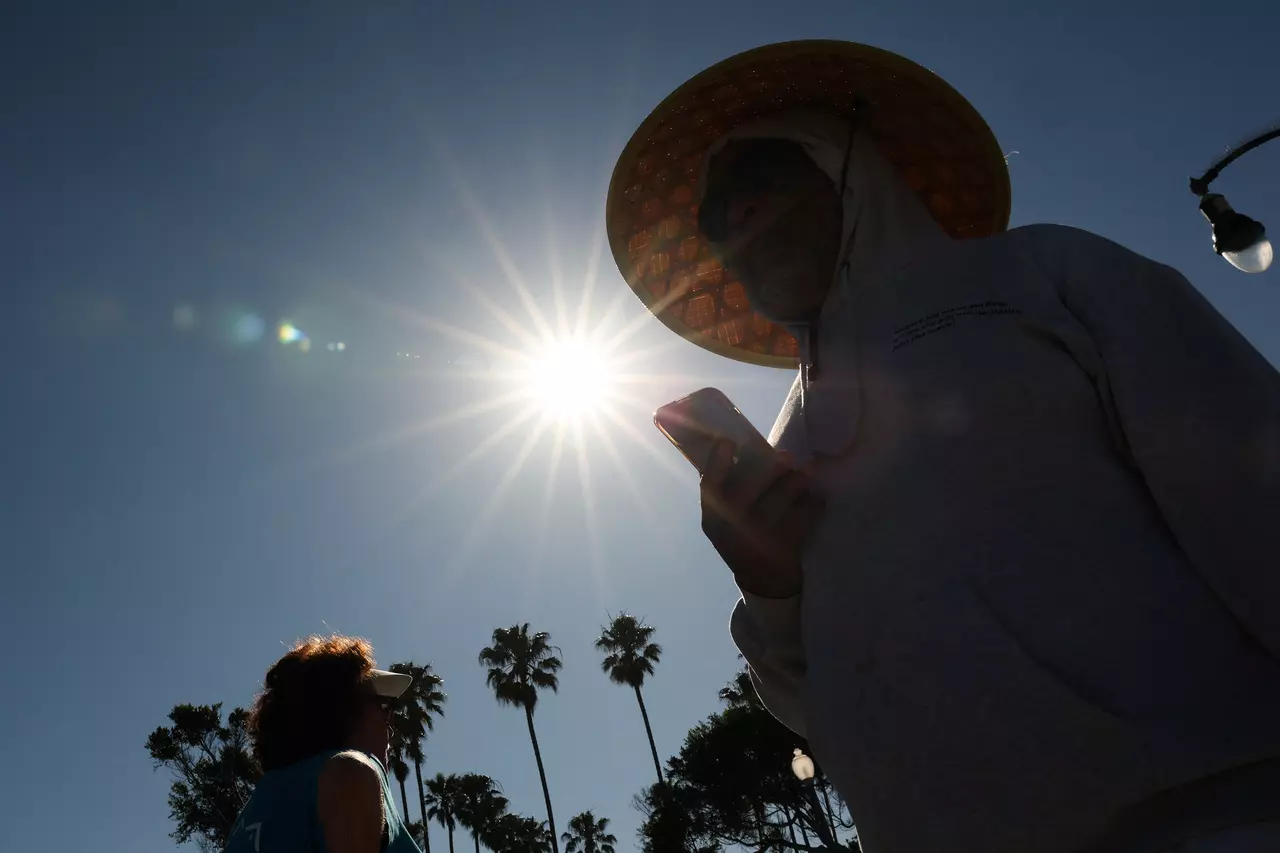
A person wears a hat for shade under the morning sun while walking along The Strand in Redondo Beach, California, on Friday, March 20, 2026, during a heat wave.
Patrick T. Fallon/AFP/Getty Images North America/TNS
SAN JOSE, Calif. — The five-day heat wave that broke records across California and the West this week is winding down, with temperatures in the Bay Area forecast to fall from the 90s to the 70s in many places over the weekend.
But the effect of the overall hot, dry month of March is likely to be felt all summer, experts say, through increased fire risk around the state.
“Much of the West is experiencing the warmest temperatures ever recorded in March,” said Daniel Swain, a climate scientist with the University of California Agriculture and Natural Resources division. “It’s really just kind of mind-boggling.”
“A lot of folks say ‘it gets hotter in July,'” he added. “Typically, though, we don’t consider summer weather to be normal in winter.”
The record heat this month has accelerated the drying of grasses and other vegetation around the state.
“The hills are starting to turn brown,” said Craig Clements, director of the San Jose State University Fire Weather Laboratory. “Vegetation will dry further and quicker because of the heat. It’s almost like we’re in the middle of May, but we’re in March.”
The heat has also decimated the Sierra Nevada snowpack, causing ski resorts like Dodge Ridge, Homewood, Badger Pass, and Sierra-at-Tahoe to close early for the season.
On Friday, the statewide Sierra snowpack, the source of nearly one-third of California’s water supply, was at 36% of its historical average — down from 76% on Feb. 20.
“We’re seeing an incredibly fast melt,” said Andrew Schwartz, director of the University of California Central Sierra Snow Lab, near Donner Summit in the Lake Tahoe area. “The snow pack is leaving the hills really quickly. Stream flows are increasing. It’s looking like we might melt out before April 1.”
State officials warned this week that the upcoming April 1 snowpack reading is likely to be the second-lowest since the 1920s, after only April 1, 2015. That year, it was 5% of normal, and former Gov. Jerry Brown famously held a news conference in a bare Sierra meadow and announced sweeping statewide water restrictions amid the third dry year in a row.
This year, California is not in a drought. On Thursday, the U.S. Drought Monitor, a weekly federal report, showed none of the state in drought conditions, following three wet winters. But the heat wave means that there won’t be four wet winters in a row.
A month ago, the snow was 8 feet deep around Schwartz’s lab, which sits at 6,894 feet elevation just off Interstate 80. On Friday, it was just 2 feet deep, with patches of bare ground visible. Temperatures all week in the Sierra have been above freezing, even at night, with daytime highs in the 70s.
“It’s been nice having the warm temperatures up here,” Schwartz said. “People have been outside enjoying it. But the thing hanging over everyone’s head is fire season.”
After those wet years, which led to fewer-than-normal acres burning statewide, fire experts are eyeing this upcoming summer season nervously, noting that unless California gets lucky with some late-season storms in April, this year’s fire season will be longer and potentially more dangerous than usual.
“Fire risk has been low across the state,” Clements said. “This will start to change it.”
The rains and healthy snow during the winters of 2022-23, 2023-24, and 2024-25 had profound benefits. They ended the previous drought and filled reservoirs around the state.
Full reservoirs mean water restrictions are not expected in California cities this summer.
But they don’t do much for fire risk.
“We could very well see a situation in parts of California with extreme wildfire risk conditions later this summer, especially in the forests, with above-average reservoir levels,” Swain said.
The Cal Fire Santa Clara Unit, which oversees wildfire response in Santa Clara, Alameda, Contra Costa, western Stanislaus and San Joaquin counties, has already begun boosting staffing levels, said Chelsea Burkett, a Cal Fire spokeswoman.
“It hasn’t been as wet of a winter as we would have liked,” she said. “That means we could start seeing fires occur sooner.”
This winter has been an all-or-nothing affair. After a dry start, big storms pounded California between Christmas and New Year’s. Then there was another dry period in January, followed by a second round of big storms in mid-February. And although rainfall levels in the Bay Area are close to normal, it hasn’t rained in the Bay Area in three weeks, since March 2. The forecast calls for next week to be warm and dry also, although not as hot as this past week.
The latest heat wave was caused by a very strong high-pressure system that emerged along the West Coast. It formed a heat dome, where a stagnant lid of hot air sank and was trapped near the surface.
California has always had heat waves. On Thursday, Napa hit 92 degrees, breaking a record set in 1914, and SFO reached 85, breaking a record from 1952. But climate change, caused by the burning of fossil fuels whose gases trap heat in the atmosphere, is making heat waves and droughts more intense, scientists say.
The 10 hottest years on record globally since 1850 all have occurred since 2015, according to NOAA, the National Oceanic and Atmospheric Administration. On average, temperatures have warmed about 2.4 degrees globally compared to 1850-1900.
When the Sierra snowpack melts early, not only do the plants and soils dry out faster, but the reservoirs, once drawn down, aren’t steadily replenished by snow that melts through the late spring and summer.
“This type of winter is what we are going to see more of,” Schwartz said. “We have had plenty of precipitation this year. But we have been in a snow drought. We can expect more years like that with climate change. A year like this was going to happen anyway, but climate change has made it worse.”
After record fires in 2020 and 2021, Gov. Gavin Newsom and state lawmakers have nearly doubled Cal Fire’s fire protection budget from $2 billion to $3.8 billion since 2019, and increased staffing from 5,829 to 10,741 positions. They purchased helicopters that can drop water at night, added huge C-130 Hercules air tankers, and, with the Univrsity of California, San Diego, have built a network of more than 1,200 remote cameras on hilltops across the state to spot smoke and automatically notify dispatchers.
“We plan for every year like it is going to be the worst year,” Burkett said. “You never know what is going to happen. We need to be prepared.”