
Why ‘Moneyball’ analytics, tactical spending work for Hurricanes
RALEIGH, N.C. — For years, the Carolina Hurricanes were cheap — in a bad way. Following the Canes’ appearance in the NHL’s 2009 Eastern Conference final, the team began pinching pennies, maintaining a low-budget, internal ceiling that saw the team rank consistently among the league’s bottom third in cash spending with respect to the salary cap. By 2017-18, the NHL salary cap had risen to $75 ...
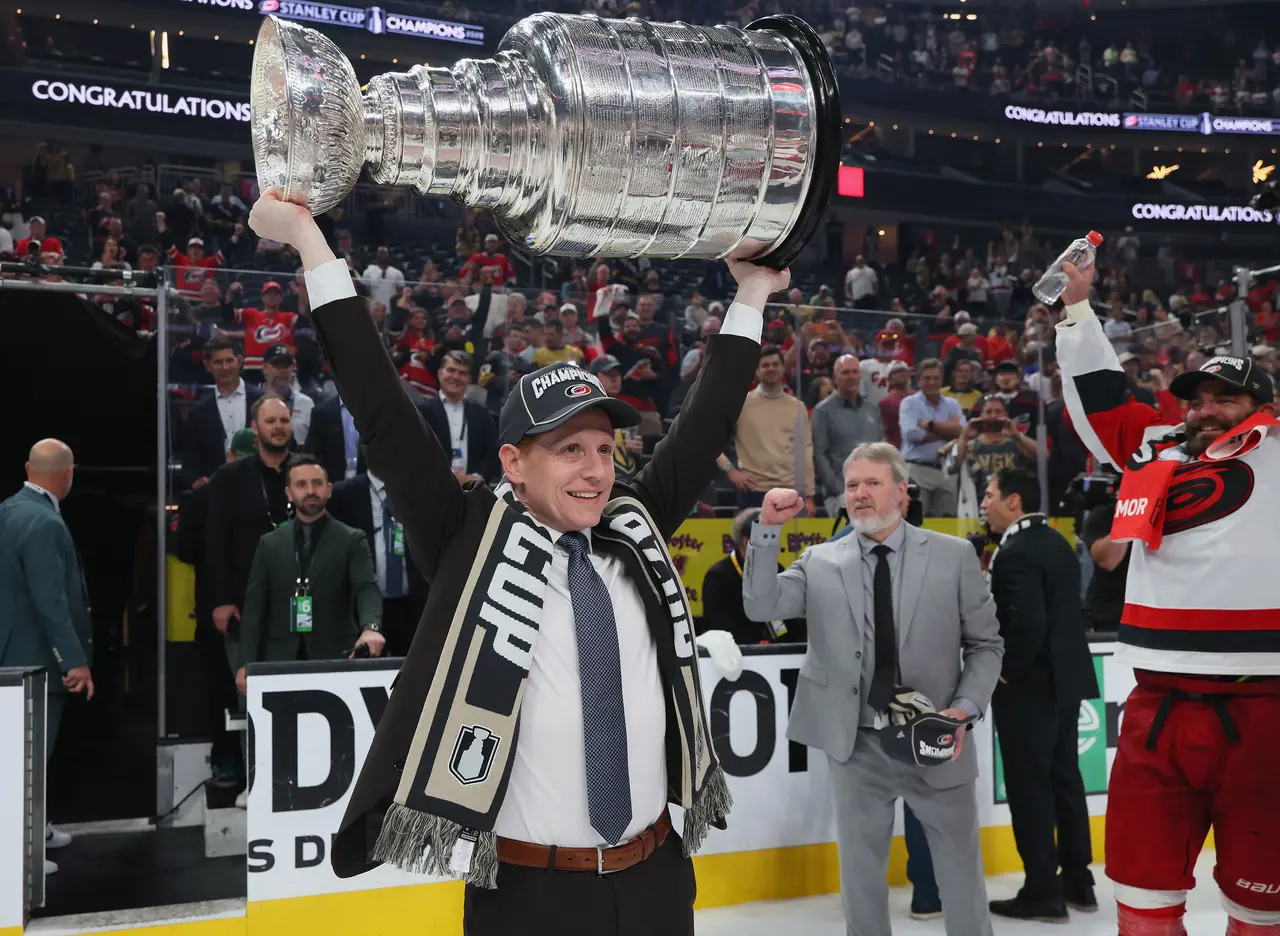
Carolina Hurricanes general manager Eric Tulsky lifts the Stanley Cup after a series-clinching Game 6 win in the Stanley Cup Final against the Vegas Golden Knights at T-Mobile Arena on June 14, 2026, in Las Vegas.
Bruce Bennett/Getty Images North America/TNS
RALEIGH, N.C. — For years, the Carolina Hurricanes were cheap — in a bad way.
Following the Canes’ appearance in the NHL’s 2009 Eastern Conference final, the team began pinching pennies, maintaining a low-budget, internal ceiling that saw the team rank consistently among the league’s bottom third in cash spending with respect to the salary cap.
By 2017-18, the NHL salary cap had risen to $75 million. The Canes spent less than $62 million — and they never sniffed the playoffs during that stretch
Then, Tom Dundon purchased the team.
After another season of minimal spending on players — and a first playoff appearance in 10 years despite that lower payroll in Rod Brind’Amour’s first year as head coach — the Canes jumped from a bottom-three-spender into the league’s top 10 payroll teams.
Since then, the Hurricanes have spent to or nearly to the cap line in each season, but that increase hasn’t been frivolous.
Now, the Canes are cheap — in a good way.
Carolina, with Eric Tulsky leading the way first in the analytics department and now as the team’s general manager, has calculatedly spent its money on not just talent, but the right talent.
Think Billy Beane and Moneyball, but with an owner willing to spend money; a confluence of analytical tactics with an old-school desire to assemble a hard-nosed, tough-to-play-against roster.
A post-Stanley Cup victory analysis outlined how the Canes won last season, leaning heavily into the team’s roster construction and salary cap manipulation as the primary reasoning.
“This team has been built the right way for a long time, and just gotten better and better year after year, and we finally got where we wanted to be,” Tulsky told the News & Observer on the ice at T-Mobile Center in Las Vegas, as the team celebrated all around him.
A recent study that analyzed player salaries and their value relative to individual and team point production agreed. The Casino Guru USA effort “identified the league’s most overpaid and most valuable players through analysis of 2026/27 salary cap hits and 2025-26 Point Shares (PS), assigning each one a final score out of 100.”
The Hurricanes overall roster graded out at 41/100 — best in the NHL — and the Canes’ Sean Walker is the team’s best value player, posting a PS of 5.8 and a cap hit of $3.6 million. Walker had nine goals and 22 assists for 31 points in 2025-26 regular season, and was a steadying force on the blue line in the playoffs, recording a plus-11 with three assists in 19 games.
Casino Guru USA’s methodology
According to Casino Guru USA, in August 2026, the company gathered the following metrics on every NHL player:
— 2026/27 cap totals, sourced from Spotrac — players with a cap hit of less than $3 million were excluded
— 2025/26 Point Shares (PS) sourced from Hockey Reference — PS is the one metric that spans every position, ensuring a fair cross-position comparison
— Cost per PS — cap hit divided by PS, to demonstrate a simple cross-position check on what each point cost
Players who appeared in fewer than 49 games of the 2025-26 season, or a goaltender who appeared in fewer than 33 games, were not included in the final rankings, as well as players with no 2025-26 PS. Additional statistics on performance were sourced from Hockey Alchemy, ESPN, and StatMuse.
What this means for the Hurricanes — and Alexander Nikishin
In short, it’s quantifying with real numbers what many have suspected all along: Tulsky, Brind’Amour, and, credit where credit is due, former GM Don Waddell, knew what they were doing with Dundon’s money.
And they still do.
The biggest brouhaha so far this offseason for the Canes has been the status of restricted free agent Alexander Nikishin, a defender who last season was named to the NHL’s All-Rookie team after an 11-goal, 22-assist regular season.
Nikishin also appeared to draw the ire of the Canes’ coaching staff with some suspect play in his own end at times. His average ice time dropped from more than 18 minutes per game in the regular season, to fewer than 15 minutes per game in the playoffs. He also only put up one assist in 17 playoff games.
But the young Russian has also been vocal — through his agent — in his salary demands, reportedly seeking a new deal, with term, at around $8 million per season. This has led to speculation — smoke with a hint of flame — that the Hurricanes are shopping the raw but obviously talented defenseman.
True to the Hurricanes’ established fiscally responsible identity, there is no way the team will make Nikishin its highest paid defenseman. K’Andre Miller holds that distinction at $7.5 million per season. All-World defender Jaccob Slavin makes a team-friendly $6.396 million per season.
Canes’ salary cap mastery
And Slavin’s deal resembles a lot of the Canes’ deals, particularly among the forward group. Thirteen of the Hurricanes’ 14 rostered forwards in the Stanley Cup Final, five of the seven defensemen and two of the three goalies were already under contract for 2026-27. That’s a far larger percentage of players returning than most Cup-winning teams face in the offseason following a title run, and it’s mostly because Tulsky chose not to complete a major trade at last year’s deadline. No expiring contracts allows for continuity.
But it’s not just that they have the players locked up. The players who are locked up are on longer term, team-friendly contracts — like Slavin’s — as the NHL salary cap continues to incrementally climb. For 2026-27, the cap ceiling jumped to $104 million from $95.5 million, allowing for the expansion of player salaries as league revenue increases.
Half of the league’s 32 teams have at least one player making more than one-tenth of the team’s total salary allowance, more than $10 million.
The Canes are not one of them, though they are spending to the cap limit. Sebastian Aho is Carolina’s highest paid player at $9.75 million, followed by Nikolaj Ehlers at $8.5 million, and Andrei Svechnikov at $7.75 million.
Aho is locked into that salary until 2032, Ehlers through 2031, Svechnikov through 2029, even as the cap rises, allowing the Canes more room under the cap to sign other players that fit their system, including younger players like Jackson Blake and Logan Stankoven and Seth Jarvis.
Each of those players are also on deals with Carolina through at least 2032, creating a pack of five forwards and two defenders — K’Andre Miller and Jaccob Slavin — who are contracted to spend the next five or six seasons in Raleigh.
With 20 players under contract through 2027, and 15 through 2028, the Hurricanes are in no hurry to “rebuild.”
But, “no hurry” doesn’t mean “standing still,” as Dundon made perfectly clear as the champagne flowed on June 14:
“We’ve been working for next year for a long time,” Dundon quipped amid the postgame festivities.
That work continued this summer, and continues as the preseason approaches more quickly for the Canes than for any other NHL team, after their late playoff run just two months ago.
Are the Canes done making moves? Maybe, but probably not, given Nikishin’s situation. And while we don’t know the final outcome there, we can say with certainty how the team will arrive at its decision: analytically, calculatedly, and free of frivolity.