
Illinois Senate race: Republican Don Tracy, a onetime Democrat, makes long-shot bid against Juliana Stratton
Addressing supporters at an evening fundraiser off Lake Decatur in July, Republican U.S. Senate nominee Don Tracy offered one reason he thinks he has a shot in the general election, despite Democrats winning every statewide contest for more than a decade. “I hear this question up and down the state, ‘Don, who is your opponent?'” Tracy said. “I answer that, and I say, ‘Well, my opponent is the ...
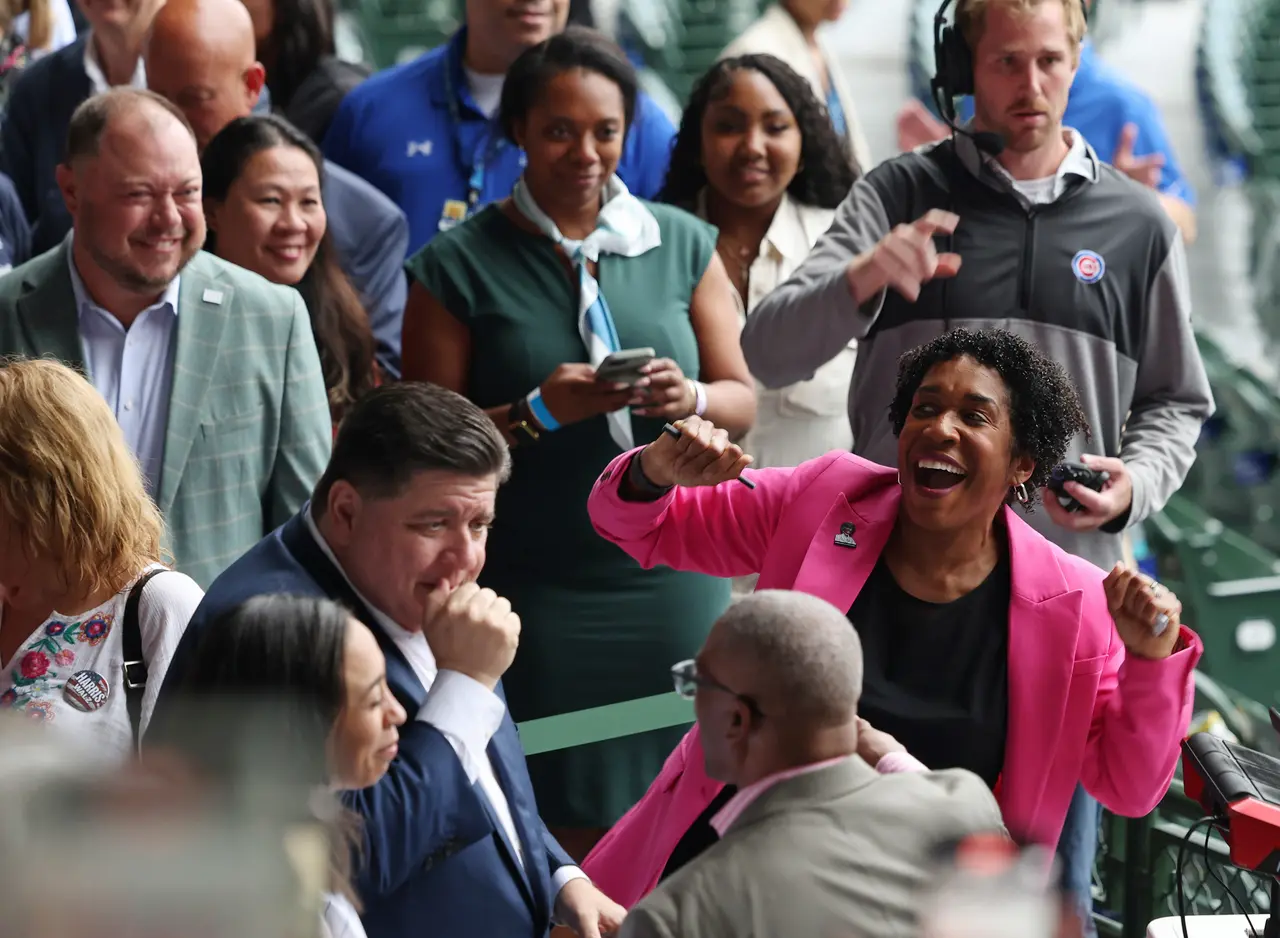
Julianna Stratton dances to music as Gov. JB Pritzker talks with Ald. Walter Burnett, 27th, during the Democratic National Convention’ s Volunteer Appreciation Rally at Wrigley Field, Aug. 15, 2024.
John J. Kim/Chicago Tribune/TNS
Addressing supporters at an evening fundraiser off Lake Decatur in July, Republican U.S. Senate nominee Don Tracy offered one reason he thinks he has a shot in the general election, despite Democrats winning every statewide contest for more than a decade.
“I hear this question up and down the state, ‘Don, who is your opponent?'” Tracy said. “I answer that, and I say, ‘Well, my opponent is the lieutenant governor. Do you know his or her name?’ Nobody knows.”
But then he pivoted almost immediately.
“Granted, she has more name ID than I do, so far,” Tracy said. “But it’s not that much more.”
Such is the political challenge for Tracy, a candidate for a statewide office with a unique background — a onetime Democrat who became chair of the Illinois Republican Party, a position he later left amid party turmoil. Nonetheless, he has taken up the GOP mantle to make a long-shot Senate bid.
The 76-year-old attorney and eldest son of the founders of one of the state’s largest family-owned businesses faces Democratic nominee Juliana Stratton, Illinois’ lieutenant governor. While Tracy notes she may not be a household name, Stratton is one of the top officials in the state’s dominant party and No. 2 to billionaire Gov. JB Pritzker, who has long supported her politically and financially.
The race to replace retiring Democratic U.S. Sen. Dick Durbin is the first open Senate contest in Illinois since 2010, when Republican Mark Kirk beat Alexi Giannoulias, now secretary of state and a candidate for Chicago mayor. Since then, Illinois Republicans have suffered a string of statewide defeats as the national party has moved further right under President Donald Trump, who has endorsed the GOP nominee for governor, Darren Bailey, but not Tracy.
Tracy said his own candidacy will help other Illinois Republicans.
“We don’t have a strong bench in the Republican Party,” Tracy said in a September interview with the Tribune. “I (was) state party chair. I know the players. And I think this is an opportunity to begin to make it a two-party state again.
“I happen to think I’m, for better or for worse, the best-qualified Republican to win that seat.”
Long odds, less cash
Tracy faces a two-headed challenge: Pritzker’s vast resources behind Stratton and “the Trump factor,” said Kirk Dillard, a former Republican state senator and former chair of the Regional Transportation Authority. Dillard has known Tracy for decades and ran for governor in 2014 with Tracy’s sister-in-law, Jil Tracy, as his running mate.
“For anyone that is scared off by Darren Bailey — and that would especially probably be suburban women — Don Tracy needs to differentiate himself from that, as well as letting people know that he clearly understands the importance of the city of Chicago,” Dillard said. “Having Don Tracy be the standard-bearer of the Republican Party … it should reassure regular traditional establishment Republicans that there is still a place for them in the Republican Party.”
Tracy said it was an easy decision to skip the Trump-led GOP midterm convention in Dallas last month, deciding instead to campaign in Illinois and sit down with the Tribune at a downtown Chicago coffee shop to discuss his priorities.
“I’m just 100% focused on winning this campaign, and I just didn’t see how going out, going to Dallas was going to be as important as, say, sitting with you or speaking in Evanston tonight, being on Polish radio earlier today or attending the joint meeting of the German American Police Association, Polish American Police Association and Emerald Society last evening, and whatever else I did yesterday,” he said.
Still, Tracy repeatedly declined to say whether running alongside Bailey, with Trump leading the national party, made it harder to win over independent Illinois voters.
Then there’s money. Tracy is a scion of a large family business, but says he doesn’t have “Pritzker bucks,” a reference to the governor’s status as a billionaire member of one of the wealthiest families in the country.
Tracy, who previously lent his campaign $2 million, said early this month he had lent his campaign another $1 million-plus. He didn’t immediately share how much he raised this summer, and the deadline to report fundraising activity is weeks away. Stratton’s campaign said it raised $1.53 million across multiple campaign funds this summer, though it also had not yet formally filed its reports.
Tracy raised about $133,000 from April through June and spent more than he brought in, according to federal campaign finance records filed in July. By comparison, Stratton raised more than $1.1 million, and Bailey raised $1.33 million.
It’s hard to raise “big money” as a Republican running statewide in Illinois, Tracy said. “In Illinois, money still gravitates to the power. Illinois Republicans have very little power in this state.”
Tracy also hasn’t gotten much free media attention.
The general election campaign for the U.S. Senate seat representing Illinois has been far quieter than the blockbuster races in competitive states around the nation where control of the Senate hangs in the balance. It hasn’t even generated the same interest seen in the primaries earlier this year, with Democrats so highly favored statewide.
Tracy and Stratton are scheduled to appear together just once, on WTTW in late October, according to the campaigns. The Tracy camp blames that on the Democrat’s lack of engagement.
Even so, Tracy has continued to appear on TV, including a mid-September Fox 32 interview that he said was supposed to be a debate with Stratton. He is running digital ads pitching himself as someone who can “keep it simple,” while also trying to tie Stratton to socialism. As he introduces himself to more voters in Chicago and the suburbs, he has often stayed in a city condo he bought last fall
Opposing ‘socialism’ and ‘extremes’
To understand how high Tracy thinks the stakes are, look up at his campaign billboards, like the one looming over the junction of the Dan Ryan and Stevenson expressways.
“SOCIALISM DESTROYS LIVES,” it reads. “VOTE DON TRACY FOR US SENATE.”
Stratton doesn’t identify as a socialist. But she carved out a lane in the Democratic primary by taking progressive positions, campaigning to abolish U.S. Immigration and Customs Enforcement and to raise the federal minimum wage to $25 — positions that helped her stand out in the primary earlier this year.
Tracy calls Stratton’s positions radical and is campaigning against “extremes” in energy, business regulation and resistance to immigration enforcement.
Also central to his campaign is a call for geographic balance. Illinois, he says, shouldn’t be represented in the Senate by two Cook County Democrats, as it would be if Stratton wins. U.S. Sen. Tammy Duckworth, a Democrat, lives in Hoffman Estates, and Stratton lives in Chicago; Durbin lives in Springfield.
“Most of the Democrats in charge of the state and the city are career politicians, or career government workers,” Tracy said. ”They’ve never had to make a payroll like I had to make a payroll. So we need someone from a more conservative basis with a business background to be involved, and I think I’m it.”
But to win in heavily blue Illinois, Tracy will need to win over independents and even some Democrats. And in his Tribune interview, he took several stances that seem unlikely to appeal to Democrats, including defending a position he took in a primary campaign appearance on CBS Chicago when asked whether he agreed with Trump’s immigration enforcement tactics.
“In sanctuary cities, immigration law enforcement is more of a challenge because of massive resistance,” Tracy said in the CBS interview. “Much like the resistance to civil rights in the South.”
Asked whether he was comparing Chicagoans resisting federal immigration enforcement to white Southerners resisting integration during the Civil Rights Movement, Tracy said he was, “in a sense.”
“A lot of the elected officials in the South and their supporters were opposed to that federal law, and they were in open defiance of a federal law. And in sanctuary cities, particularly … relative to the enforcement of federal immigration law, have been in open defiance of federal immigration law,” Tracy said. “There’s no civil rights law that says you cannot enforce federal immigration law.”
Tracy said he wants to see greater cooperation between local law enforcement and federal immigration authorities, a practice that is largely barred under Illinois law.
...