

Darts is experiencing a huge surge in popularity globally, transforming from a traditional pub pastime into a high-energy spectator sport and a rapidly growing recreational activity.
Swipe through to learn the words you gotta know to play the game.
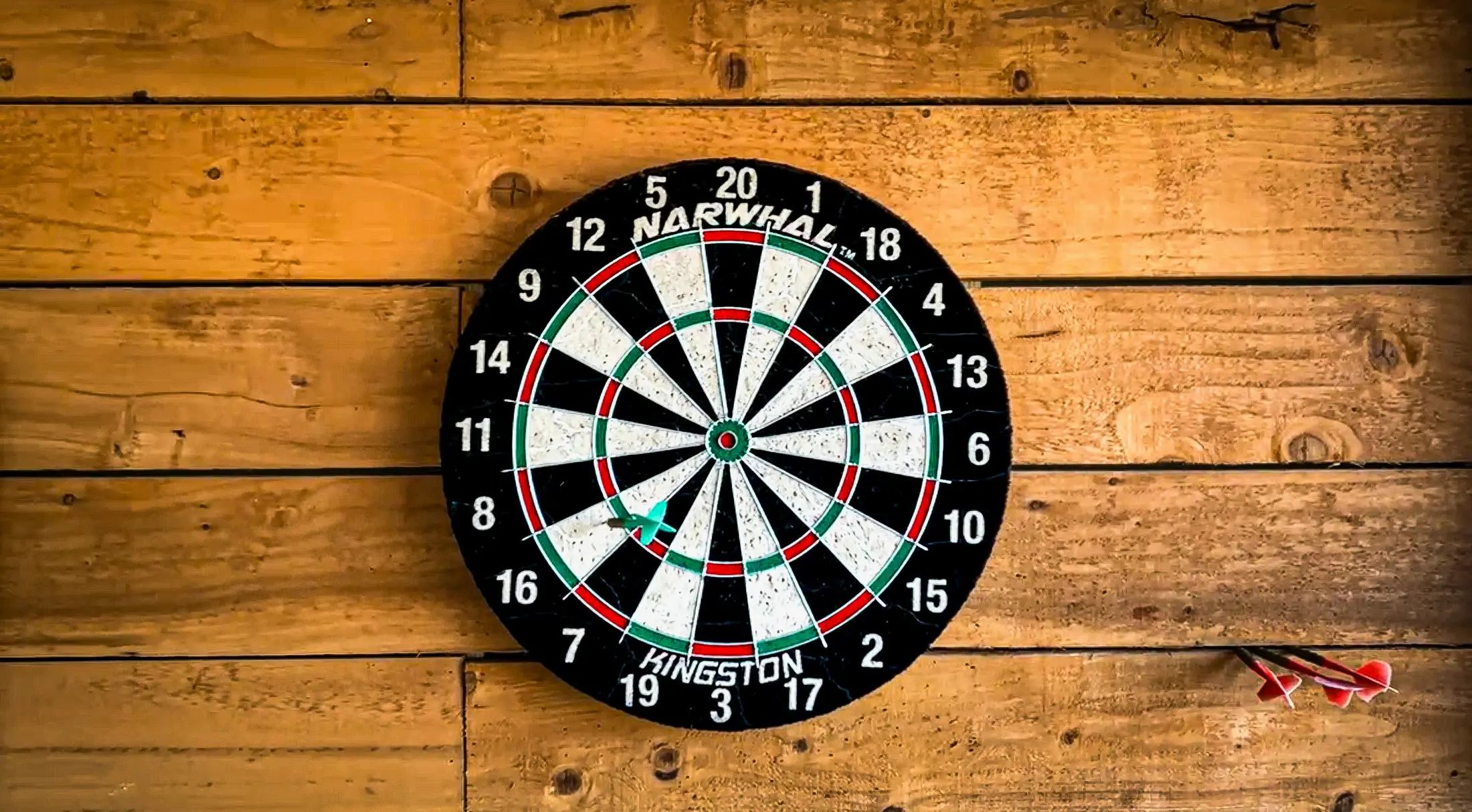
Let’s start with the game itself. Standard 501 is the most popular form of darts. Each player starts with 501 points and subtracts the value of every dart thrown. The goal is to reach exactly zero, typically by finishing on a double or the inner bull. If a player scores more than needed, it’s called a bust and that turn doesn’t count.
The oche is the line behind which players must stand when throwing darts. It’s usually 7 feet 9¼ inches from the face of a standard dartboard. Players can’t step over the oche before the dart lands. The term is one of the most recognizable pieces of darts terminology and is pronounced “OCK-ee.”
Photography: Amazon
The bullseye is the center of the dartboard and consists of two scoring areas. The outer bull, sometimes called the single bull, is worth 25 points while the inner bull is worth 50. Hitting the inner bull can be especially valuable when finishing a leg or match. You may also hear it called the bull.
A treble is the narrow inner ring on the dartboard that triples the value of the number it surrounds. For example, hitting treble 20 scores 60 points, making it the highest possible score with a single dart, and the most frequently targeted treble. Players sometimes call it a “triple,” as well.
A checkout is the combination of darts a player uses to reduce their score to exactly zero and win a leg. In standard 501 play, the final dart usually must land in a double or the bull. Players talk about “checking out” when they successfully complete a finishing combination such as 100 with treble 20, double 20.
Achieving a nine-darter requires only nine darts to finish a standard 501 leg. It’s the equivalent of a perfect game and one of the sport’s most celebrated achievements. There are several possible routes to a nine-darter but the player must score exactly 501 and finish with a qualifying double or the bull.
A Robin Hood happens when a dart lands in the back of another dart already sticking in the board. The name comes from the legendary archer Robin Hood, who supposedly split another arrow with his own. Although impressive, a dart that sticks into another dart generally doesn’t score because it hasn’t landed directly in the board.
Photography: 2022Dirt via Pinterest
Bag of nails is old darts slang for scoring three ones with three consecutive darts. Since each dart scores just one point, it’s a particularly poor series of plays and the opposite of the coveted high-scoring turns players aim for. The phrase illustrates darts’ colorful vocabulary, where even terrible throws can have interesting names.