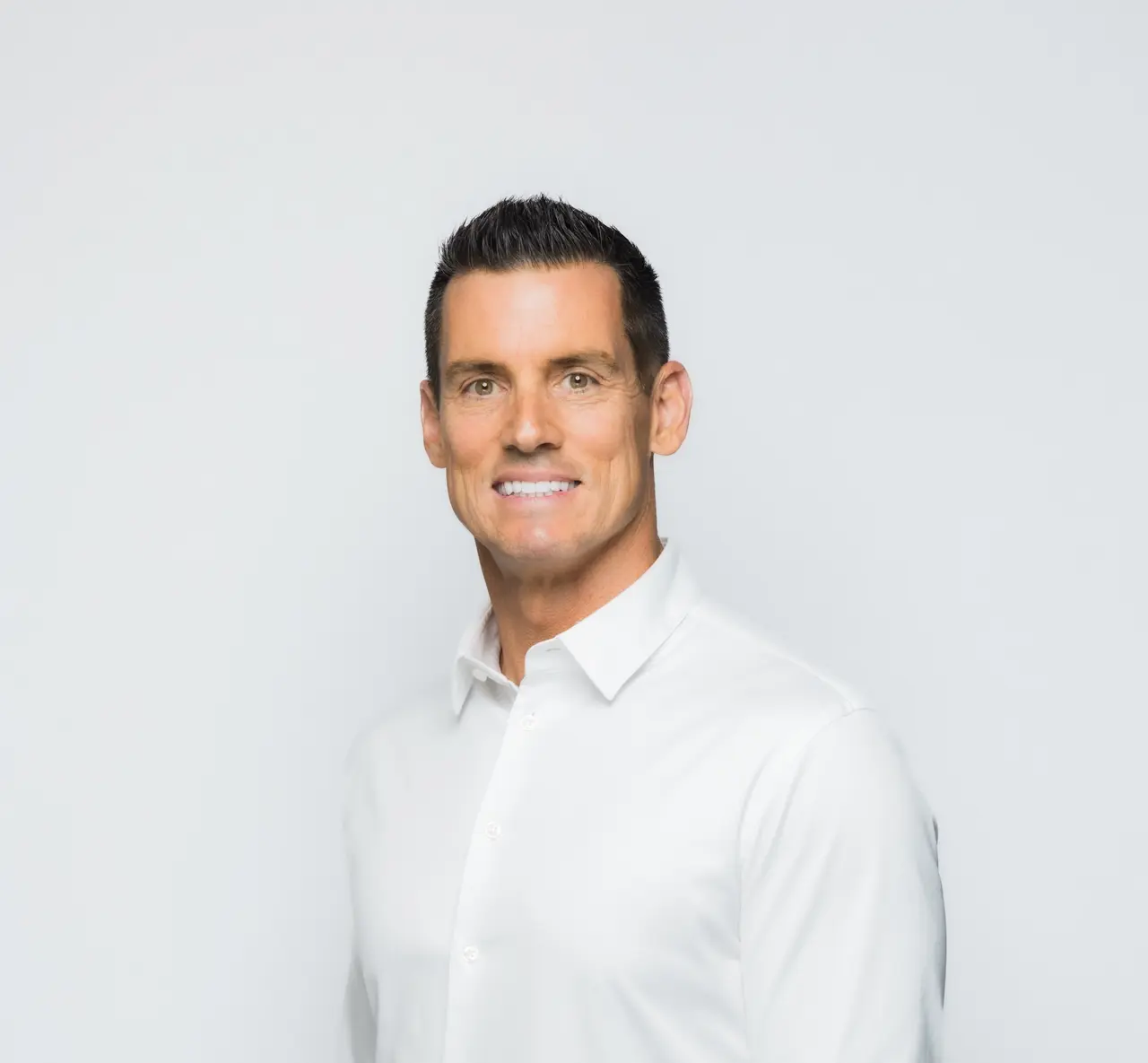

This Founder Sold His Company for $1.04 Billion and Planned to Take 2 Years Off. His Retirement ‘Lasted 7 Minutes’
Wesley Lones’s company Daybreak tackles sleep apnea entirely from home, replacing the CPAP mask with a custom-fit oral appliance.
Daybreak
Lones spotted a healthcare hole in treating sleep apnea. Daybreak offers an alternative to the unpopular CPAP machine. The business model limits inventory costs and allows the company to move quickly.
Here’s a statistic that might keep you up at night: As many as 83 million U.S. adults suffer from obstructive sleep apnea, a condition that causes them to stop breathing over and over again while they sleep, waking up dozens or even hundreds of times a night.
The standard treatment is a CPAP machine, a clunky device that keeps the airway open by delivering pressurized air through a mask. It works. But millions of people with sleep apnea remain untreated.
For entrepreneur Wesley Lones, the numbers didn’t add up.
“I spent two years looking over my shoulder thinking, how could the most advanced wealthy country in the history of the world have millions of people suffering from an ailment and not have a treatment,” Lones says. “I must be missing something.”
What Lones eventually realized was that the problem wasn’t the lack of an effective treatment. It was the treatment itself. Many patients simply hate sleeping with a mask strapped to their face while pressurized air blows into their nose or mouth.
He wasn’t looking to start a new business. After helping build Byte, which was acquired for $1.04 billion, Lones was in the fortunate position of not having to work. He planned to take a few years off. “That lasted about seven minutes,” he says.
The more he studied the problem of sleep apnea, the harder it became to ignore the opportunity. Lones founded Daybreak, a fully remote platform that takes patients from diagnosis through treatment at home and offers a custom-fit oral appliance as an alternative to CPAP. The company has treated more than 20,000 patients in roughly its first 28 months, according to Lones.
On a recent episode of One Day with Jon Bier, Lones talked about spotting a hole in a massive healthcare market, building Daybreak without outside funding and why his biggest challenge may be making millions of people aware they have sleep apnea and that an alternative treatment exists.
Sleep apnea isn’t what you think
One of the biggest misconceptions about sleep apnea is that it’s a weight problem. Lones points out that anatomy can play a major role. When you sleep, the muscles around the airway relax, and for some people their anatomy makes the airway more likely to narrow or collapse, interrupting their breathing. Weight can make the problem worse, but it isn’t necessarily the cause.
Lones has nothing against CPAP as a treatment. “It’s the gold standard,” he says. “I’m not here to demonize it.” But he also knows there are entire Facebook support groups devoted to coping with one.
One alternative is a custom-fit mouthguard that gently moves the lower jaw forward to help keep the airway open while you sleep. Oral appliance therapy wasn’t new. Dentists and sleep specialists have been using the devices for years. Most people just don’t know about them.
Getting the word out
Lones investigated why oral appliances weren’t reaching more patients. The problem, he concluded, was a lack of awareness.
“I have yet to interact with a person who has sleep apnea and hears about an oral appliance and says, ‘Wow, I would never try that,’” Lones says. “The universal, consistent answer is, ‘I had no idea that exists, and I would absolutely try it. How do I get started?’
The answer to that question became Daybreak. Patients are mailed a small wireless sleep-test device that wraps around a finger and tracks their sleep at home. The data is sent to a doctor for review and diagnosis. If they qualify for treatment, Daybreak sends them an impression kit used to create their custom-fit oral appliance. The entire process can be done without stepping into a doctor’s office.
Building without investors
Lones built Daybreak without outside funding. Part of the reason is that his previous exits gave him a head start. But the economics of the business also helped. Because every oral appliance is custom-made, Daybreak doesn’t have to manufacture large quantities of finished products and hope they sell. For cash customers, the company collects payment upfront and then sends the order to the manufacturer. “It’s a reverse sort of cash cycle where we don’t have to carry a bunch of inventory,” Lones says.
Bootstrapping has also allowed him to move quickly. “We have a lot of flexibility,” Lones says. “We have the ability to iterate, move very quickly, really compress the time between when we identify, learn there’s a problem, and then react to that problem and solve it.”
From problem to something more
As Daybreak began treating patients, Lones started seeing the impact firsthand. One of the stories that stuck with him came from a mother of three whose husband suffered from sleep apnea. After his first night using the device, she contacted Daybreak with a message: “Thank you. This is the first time my children have had a father and I have had a husband in three years.”
“That’s why I say that it started to me as a business problem. I thought, ‘I think I can solve this.’ Then it became a mission because I started to see the impact.”
Subscribe to the Entrepreneur Daily newsletter to get the news and resources you need today to help you build your business better.