
Trump approves death by firing squad for Fort Hood shooter Nidal Hasan
Nidal Hasan, who killed 13 people and wounded 32 others at Fort Hood in 2009 in the worst mass shooting ever on a U.S. military post, is to be executed by firing squad, U.S. military officials say. The Pentagon's chief spokesman Sean Parnell posted on social media that Hasan will face a firing squad in the killings of 12 soldiers, one of them a pregnant woman, as well as a civilian who tried ...
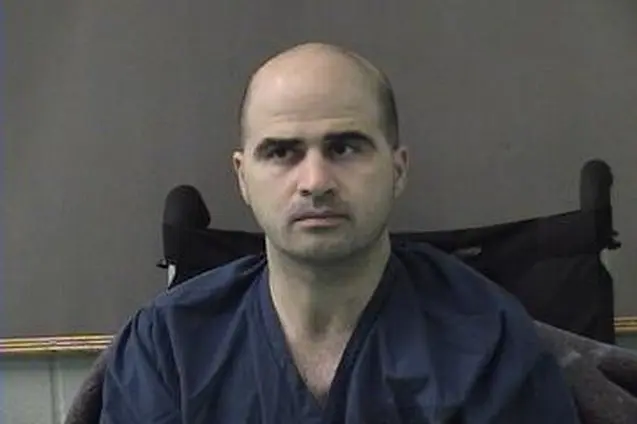
Nidal Hasan, the Army psychiatrist who is charged with murder in the Fort Hood shootings, is seen in a booking photo after being moved to the Bell County Jail on April 9, 2010, in Belton, Texas.
Handout/Getty Images North America/TNS
Nidal Hasan, who killed 13 people and wounded 32 others at Fort Hood in 2009 in the worst mass shooting ever on a U.S. military post, is to be executed by firing squad, U.S. military officials say.
The Pentagon's chief spokesman Sean Parnell posted on social media that Hasan will face a firing squad in the killings of 12 soldiers, one of them a pregnant woman, as well as a civilian who tried to stop the massacre.
"Secretary of War Pete Hegseth has recommended — and President Donald J. Trump has approved — death by U.S. Army firing squad for convicted terrorist Nidal Malik Hasan, the jihadist who opened fire on unarmed American soldiers at Fort Hood in 2009," Parnell wrote. "He killed 13 people and wounded 32 others while shouting 'Allahu Akbar' during the attack. The Secretary of the Army will set the time and place of the execution."
Hasan is out of appeals. The U.S. Supreme Court last year denied his final appeal, setting the stage for President Trump to sign a death warrant and for an execution date to be set. The high court denied a defense writ of certiorari, which is essentially a request that the justices review the case.
However, the man who prosecuted Hasan said Tuesday that the matter isn’t settled, and that it could be years before Hasan is executed, if it ever happens.
Retired Army Col. Mike Mulligan, the chief prosecutor in Hasan’s court-martial in 2013, said it remains to be seen if Hasan will fight the execution order or allow it to proceed, as did Timothy McVeigh, who was executed for the bombing of a federal building in Oklahoma City.
“The story for you is what is (Hasan) going to do?” Mulligan told the San Antonio Express-News. “Is he going to go the way of Timothy McVeigh and forgo any further appeals or does he intend to... file (a writ of) habeas corpus? The mere fact that the president approved it doesn’t mean he’s going to be executed in the next 30 days, but we are one step closer.”
Hasan, who was serving as an Army psychiatrist at the time of the killings, has previously indicated he would welcome execution. Hasan fired his attorneys during his lengthy trial at Fort Hood and told members of a board reviewing his mental fitness that dying in the course of the attack would have been an honor because it would signify that God had chosen him to be a martyr.
“When asked about being alive, he stated, ‘I’m doing my best. … I’m paraplegic and could be in jail for the rest of my life. However, if I died by lethal injection I would still be a martyr,'” the panel, known as a sanity board, said in its report.
A research paper by a terrorism scholar suggested that Hasan was not solely driven by a desire to wage jihad against infidels. Rather, his deeper motive was to rescue his mother’s soul from damnation.
Katharine Poppe argued in a paper published by George Washington University’s Program on Extremism that Hasan believed his mother would burn in a pit for eternity. Her perceived sin was selling liquor at a business she and her husband owned.
“After the death of his mother, Hasan was emotionally devastated and terrified of the eternal suffering he believed she would suffer for her perceived sins,” Poppe wrote in “Nidal Hasan: A Case Study in Lone-Actor Terrorism.”
According to Poppe, Hasan felt compelled to kill soldiers at Fort Hood to save her soul.
Before his trial, Hasan — who was 39 at the time of the shooting and is now 56 — told the sanity board that “he began to accept that he needed to do something to help the resistance efforts of his Muslim brothers,” Poppe wrote. She wrote that by then, “he had radicalized to the point that he had decided he was going to take action against the United States.”
The day of the shooting, Hasan was armed with two handguns, 420 rounds and 16 ammunition magazines. Hasan opened fire in the crowded Soldier Readiness Processing Center, a place where he knew hundreds of GIs were gathered for medical tests before deploying to Afghanistan.
In his trial, Hasan objected when audio was played of Pvt. Francheska Velez, a 21-year-old pregnant woman from Chicago, crying out "My baby! My baby!" as she lay dying. It was just one of two objections he made after firing his defense team and representing himself.
At one point during the trial, Hasan locked eyes with Alonzo Lunsford, a soldier he had shot seven times. The staring match lasted several minutes and riveted observers in the courtroom.
Lunsford said Tuesday that if Hasan is executed, "I'll be there without a shadow of a doubt."
"To be honest with you, I want that dude to look at me like the court martial. I want him to lock eyes with me again... I just want to see him and I want him to see me," said Lunsford, 59, a retired Army staff sergeant who now lives in Lillington, N.C.. "I want to ask him why. Man to man, why?"
_____