
Mac Engel: TCU’s men’s basketball team deserved better than to rank last in the Big 12 (*)
FORT WORTH, Texas — A team that finished sixth in the deepest league in college basketball should not rank last in attendance, but that’s what the Big 12’s box score reads. After being picked to finish 10th in the 16-team Big 12, TCU was the biggest surprise in the league by finishing with an 11-7 conference record. Even though TCU lost on Thursday night to Kansas, 78-73, in the Big 12 ...
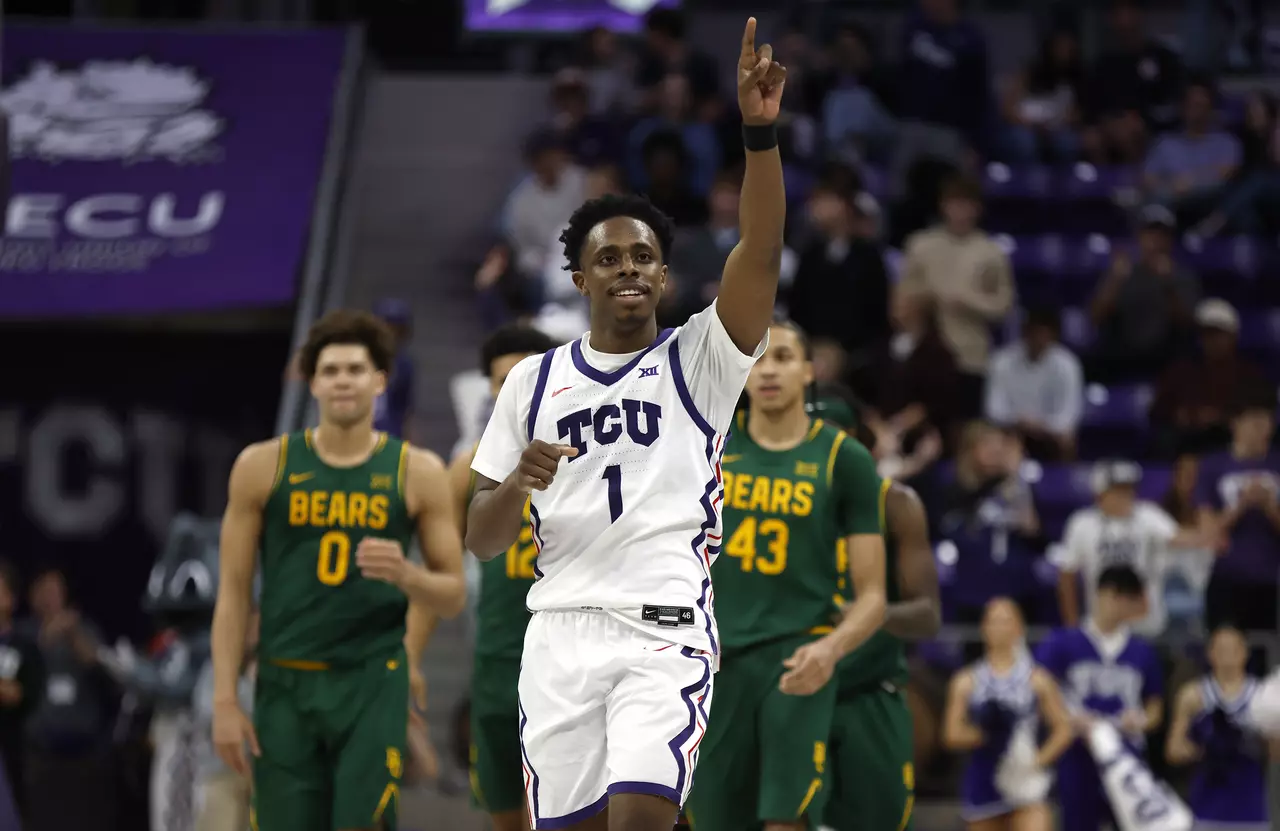
Jayden Pierre #1 of the TCU Horned Frogs celebrates in the final seconds of the game against the Baylor Bears on Jan. 3, 2026, in Fort Worth, Texas.
Ron Jenkins/Getty Images North America/TNS
FORT WORTH, Texas — A team that finished sixth in the deepest league in college basketball should not rank last in attendance, but that’s what the Big 12’s box score reads.
After being picked to finish 10th in the 16-team Big 12, TCU was the biggest surprise in the league by finishing with an 11-7 conference record. Even though TCU lost on Thursday night to Kansas, 78-73, in the Big 12 Tournament quarterfinals, it will make the NCAA Tournament when the bracket is released Sunday afternoon.
Despite such a nice, competitive season, it didn’t do much to motivate the masses. According to the Big 12’s stats, TCU finished 16th in the league in total attendance, home attendance and home average attendance. TCU’s home attendance ranked 90th in the nation.
As the smallest school in the Big 12, no one expects its basketball team to outdraw conference opponents such as Kansas, BYU or Arizona. To average an announced 5,350 per home game, though, is one of those stats that could force the powers that be to ask, “Is it really worth all of this money?”
Especially when that money is also needed for football, baseball and women’s basketball.
And that figure of 5,350 is not accurate; college sports teams historically use minor league baseball math to report attendance figures.
TCU’s rebound to relevance will have a price
A team that started the season 2-7 and finished 15-18 will forever have one victory, on the road, against a Big 12 school that will be in the NCAA Tournament. The New Orleans Privateers also collected a check “for their troubles“ from TCU when they upset the Horned Frogs in a season opener that feels like decades ago.
TCU handing a previously agreed-to appearance fee to a Southland Conference school was part of a budget that could be pushed to numbers the university has never experienced with its basketball team. It will also test the school’s interest level in trying to field a team that has potential to do something this school never has in a sport that is forever behind football.
It took a minute, or two, this season, but TCU coach Jamie Dixon built a solid team that, if it stays together, should be more than a headache for the rest of the Big 12 next season.
“Guess what? I said that a year ago; I said, ‘If we keep these guys together, we’re going to be pretty good,’ ” Dixon said last week, before the team headed to Kansas City to play in the Big 12 Tournament.
“I told our administration that we’re going to go young. I love our players, and I want them all to be back.”
It won’t be cheap.
TCU was one of the best ROI teams in the league, and the country. TCU’s “payroll” was in the bottom third of the conference, a stat that has little chance of remaining the same if the athletic department is able to retain the primary players.
Of TCU’s top seven players, one will run out of eligibility when the season ends — starting guard Jayden Pierre. The rest can all return. If they want. If TCU can pay them all.
Junior forward Xavier Edmonds, who came to TCU via junior college and averaged 12.6 points and 6.6 rebounds in his first year, would draw interest if/when he makes himself available in the transfer portal. The same for David Punch, and Micah Robinson.
Punch and Robinson are both “homegrown” players the program has invested in; it wants to keep them here to see this through.
TCU’s basketball decision
TCU is no different from so many schools in major Division I athletics that are burning up phones trying to find more money to offer student-athletes. All athletic departments learned that the “maximum” revenue-sharing figure of $20.5 million a school could disperse among all of its players is not enough.
A football roster alone costs in the area of $30 million. There are men’s basketball teams that feature rosters with a price tags of $10 million. The University of Kentucky’s basketball roster reportedly costs $22 million.
TCU athletics has money, but it doesn’t come out of a hose that draws from Fort Knox. The school has made competing in NCAA Division I sports a priority, but the price is much greater than originally budgeted.
Without “cost certainty” — i.e. a salary cap — not everyone is going to get what they want, so a few good players will leave over money.
Because everyone has to get in line behind football, which puts a solid men’s basketball team in a hard spot.