
Pentagon's cut to military faith codes sparks religious freedom debate
The Pentagon has decreased the number of recognized religious affiliation, a move that has raised criticism for infringing on religious freedom.
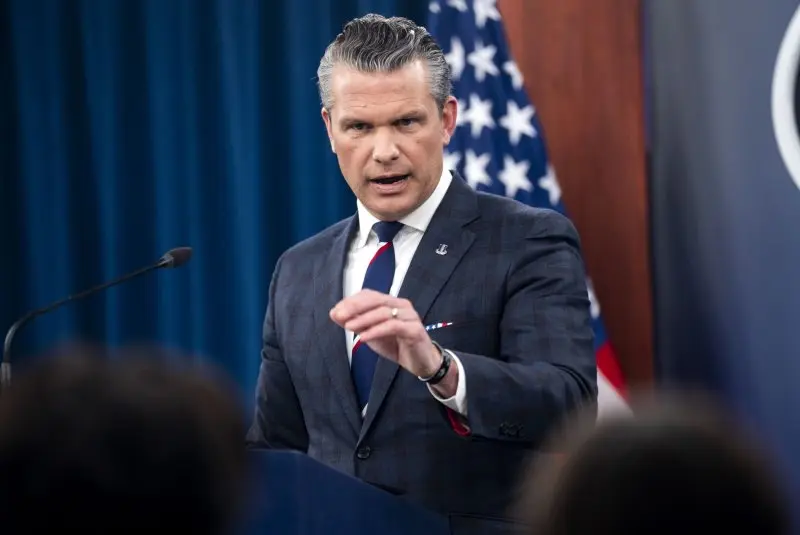
Secretary of Defense Pete Hegseth speaks during a press briefing at the Pentagon in Washington, D.C., on Nov. 10. Photo by Bonnie Cash/UPI UPI
Nov. 18 (UPI) -- The Pentagon has decreased the number of recognized religious affiliation codes from 211 to 31 in what it describes as an administrative measure, but the move has raised criticism for infringing on religious freedom.
The move is just one by the Department of Defense relating to religious beliefs. It also directed members of the Air Force to update their records to adhere to its new standardized religious affiliation codes, due earlier this month.
While the Pentagon describes these decisions as efforts to clean up record keeping, they have caused confusion among service members. Secretary of Defense Pete Hegseth's emphasis on Christianity, holding televised Christian prayer services monthly, have coupled the confusion with a sense that some belief systems are not welcome in the armed services.
On Tuesday, Hegseth hosted Pastor Doug Wilson at the Pentagon to lead the monthly prayer service. Wilson is a self-described Christian nationalist who has expressed views that have drawn criticism for being associated with the White supremacy movement.
Derek S. Jones, executive director of the Chaplain Alliance for Religious Liberty, told UPI that, as the Department of Defense says, the recent policy changes regarding religious preference codes and recognized beliefs are about record keeping, not showing preference to one religion.
The Chaplain Alliance for Religious Liberty says its mission is to "ensure that chaplains can defend and provide for the freedom of religion and conscience that the Constitution guarantees."
"Obviously, the government is not in the religion business. What they have to do is they have to rely upon or recognize the free exercise for all of their soldiers," Jones said. "That's why chaplains exist. How those chaplains and the military operate for religious preferences, if there's a religious preference, it's annotated in a member's permanent record."
Those preferences are noted on a soldier's dog tags, Jones said for an example. Religious preferences, and non-religious beliefs, are important to keep record of so a soldier's beliefs are respected while they serve, if they are injured and if they die.
The number of recognized faiths and belief systems in the armed services grew over decades, distinguishing different denominations, newly established faith groups and non-religious belief systems.
Jones said, even as the list of recognized faiths grew to 211, some groups still felt they were not appropriately represented.
"The administrative move to take some of this down, it was probably due," Jones said. "I would agree with most critics who say we probably need a few more codes. They are still reviewing them. The first cut took it down to about 20 and so they have added some since then as they have become educated."
Among the 31 religious affiliation codes from the pared down list, 21 are Christian denominations. Other codes that remain are agnostic, Baha'i faith, Buddhism, Church of Jesus Christ of Latter Day Saints, Hindu, Islam, Judaism, Sikhism, no religion, other religion.
"Our commitment to the spiritual readiness and religious freedom of every Airman and Guardian remains steadfast," Richard Anderson, assistant secretary of the Air Force for Manpower and Reserve Affairs, said in a statement. "Transitioning to these standardized codes ensures our Chaplain Corps has the accurate demographic data they need to provide tailored resources and support for our Service members, while continuing to respect their individual convictions."
The Air Force noted in its announcement calling for service members to update their religious codes that they will not be limited to choosing from the standardized list when selecting religious preferences for their dog tags.
Mikey Weinstein, founder and president of the Military Religious Freedom Foundation, told UPI there are a few concerns he and members of his organization share about the direction of the armed forces when it comes to religious beliefs.
MRFF represents more than 100,000 military members from a broad range of faiths. Though a majority of its members identify as Christians, it also has members who do not subscribe to a religion, secularists, humanists, atheists and agnostics.
At the core of those concerns is the dynamics between commanding officers and subordinates. As Weinstein describes, "They have complete and total control of everything you do."
That level of control can create a hostile environment for someone who practices beliefs that are not accepted by the top brass.
"When you start telling people you need to update your religious faith or none thereof, this is already a slippery slope," Weinstein told UPI.
Whether the Pentagon's reduction of recognized religion or directive for members to update their religious codes is an administrative measure, it runs into a potential violation of the Constitution.
The Establishment Clause of the First Amendment prohibits the government from establishing a national religion. Showing preference to one religion over another can be viewed as a violation, though the courts have delivered decisions for and against religious practices and symbols in government settings.
The government is also prohibited from conducting any religious test,, under Article VI, Clause 3 of the Constitution: the No Religious Test Clause. Under this clause, no religious test shall ever be required to qualify for any office of public trust.
By directing service members to adhere to its new standardized code system, Weinstein fears that those members are being asked to out themselves. Under Hegseth's leadership, those who do not fit his preferred characteristics risk being held back from promotions, treated disfavorably by higher-ranking officers or ousted altogether.
Hegseth's preferred characteristics, in Weinstein's view, are: straight, white, Christian nationalist and male.
"The average member of the military is not going to call our friends, they're allies, at the ACLU or Americans United or the Freedom of Religion Foundation," Weinstein said. "This type of procedure is not something merely logistical or administrative. It's an attempt to out any of those that are not part of the approved body. It is horrific. It is disgusting. It is unconstitutional. It is un-American."