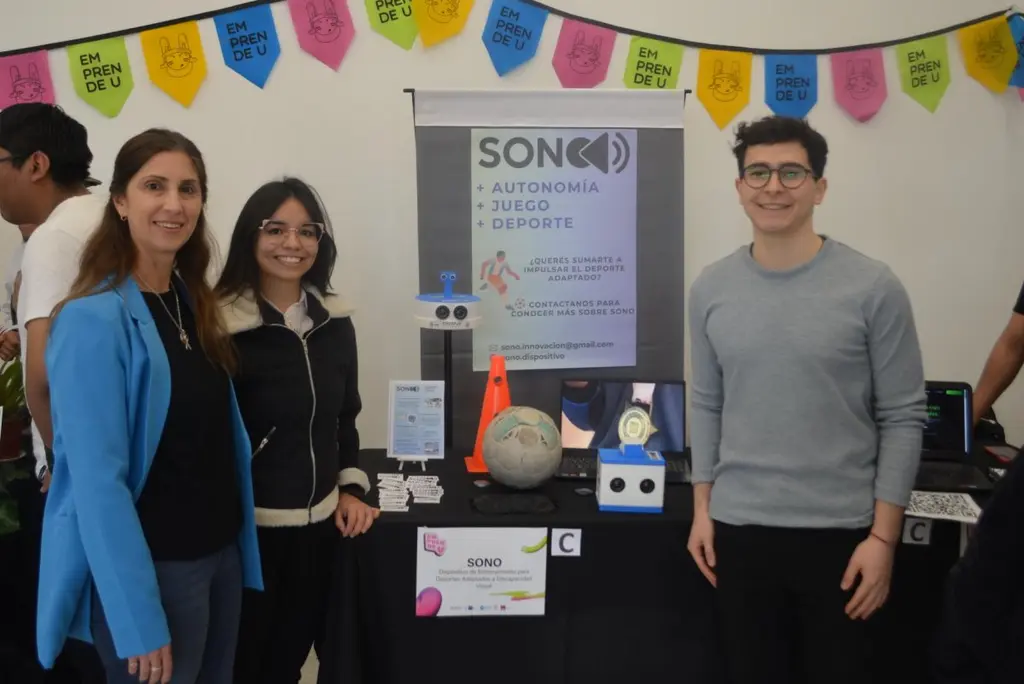

Argentine engineers develop sound-emitting cones for blind athletes
Argentine engineers developed sound-emitting devices to help blind athletes train independently. The national blind soccer team already uses them.
BUENOS AIRES, Argentina, Nov. 20 (UPI) -- Two Argentine engineers have developed a device that uses sound signals to help blind athletes navigate training exercises without relying on someone to guide them.
The technology, called Sono, has been incorporated into training sessions by Las Murciélagas, Argentina's women's national blind soccer team, which has won two world championships.
In blind soccer, players rely on sound to navigate during matches. The ball contains bells that help them locate it, while verbal instructions from teammates and coaches allow them to follow the game.
Physical training outside matches presents different challenges, however, because athletes often need someone to explain routes and guide them through exercises.
Sono addresses that challenge through devices that emit sound signals from different locations. Players can identify each device's position and use it as a reference to complete training circuits and exercises, much as sighted athletes use cones during practice.
"It's an electronic device that emits sound signals. Its purpose is to help people with visual impairments navigate using echolocation. To use it, athletes place the devices at different points in the training area, where each one emits a sound that serves as a reference," Agustín Pérez, one of its creators, told UPI.
Echolocation allows people to gather information about their surroundings by identifying where sounds originate and how they reflect off surfaces. With Sono, acoustic signals help athletes locate each device and identify the route they need to follow.
"In a conventional training session, a sighted person can identify cones and move from one to another. With Sono, blind people use sounds to locate each device and know where it is. That way, they can complete an exercise they have designed or one assigned by their coach without needing someone to guide them along the route," Pérez said.
The battery-powered device operates by remote control. The engineers designed its electronic components and developed the technology to withstand the conditions of a sports training environment.
The project began while Pérez, 27, and Agustina Zavala, 28, were studying biomedical engineering. Both are from Argentina's San Juan province and graduated from the National University of Córdoba.
The first version of Sono emerged from an assignment in a rehabilitation engineering course, a field focused on developing technological solutions for people with disabilities or specific needs.
The students became interested in the concept and decided to expand it into their final thesis project.
"We identified a lack of tools that would allow people with visual impairments to train and participate independently in physical, recreational and even educational activities. That's why we developed a device that allows them to exercise without depending on a guide, assistance that is currently often necessary for these types of activities," Pérez said.
To evaluate Sono, the engineers involved Las Murciélagas from the project's earliest stages. Players and coaches participated in testing, offered suggestions and helped adapt the design to actual training conditions.
The team also used a user-centered design methodology known as Design Thinking, which involves intended users throughout the development process, from identifying problems to testing solutions.
"It's essential to involve the people who will use the device from the beginning. Their opinions and recommendations allow us to correct mistakes and verify that the tool actually meets their needs. Otherwise, we might design something that seems useful to us but doesn't work for the people it's intended to help," Pérez said.
The creators hope to expand Sono's distribution to other Argentine provinces and eventually introduce it in Latin American countries such as Brazil, Chile and Peru.
Those countries also have institutions and sports centers serving people with visual impairments, which could help bring the technology to new settings.
Potential applications extend beyond competitive sports. The engineers also envision using Sono in schools, recreational facilities and public spaces, where acoustic references could help blind people navigate their surroundings more independently.