
Supreme Court turns away Virginia Democrats seeking to reinstate new voting map
WASHINGTON — The U.S. Supreme Court on Friday turned down an appeal from Virginia Democrats whose new voter-approved state election map was canceled by the state's Supreme Court. The justices made no comment, and the legal outcome came as no surprise. The U.S. Supreme Court has no authority to review or reverse rulings by state judges interpreting their state's constitution — unless the ...
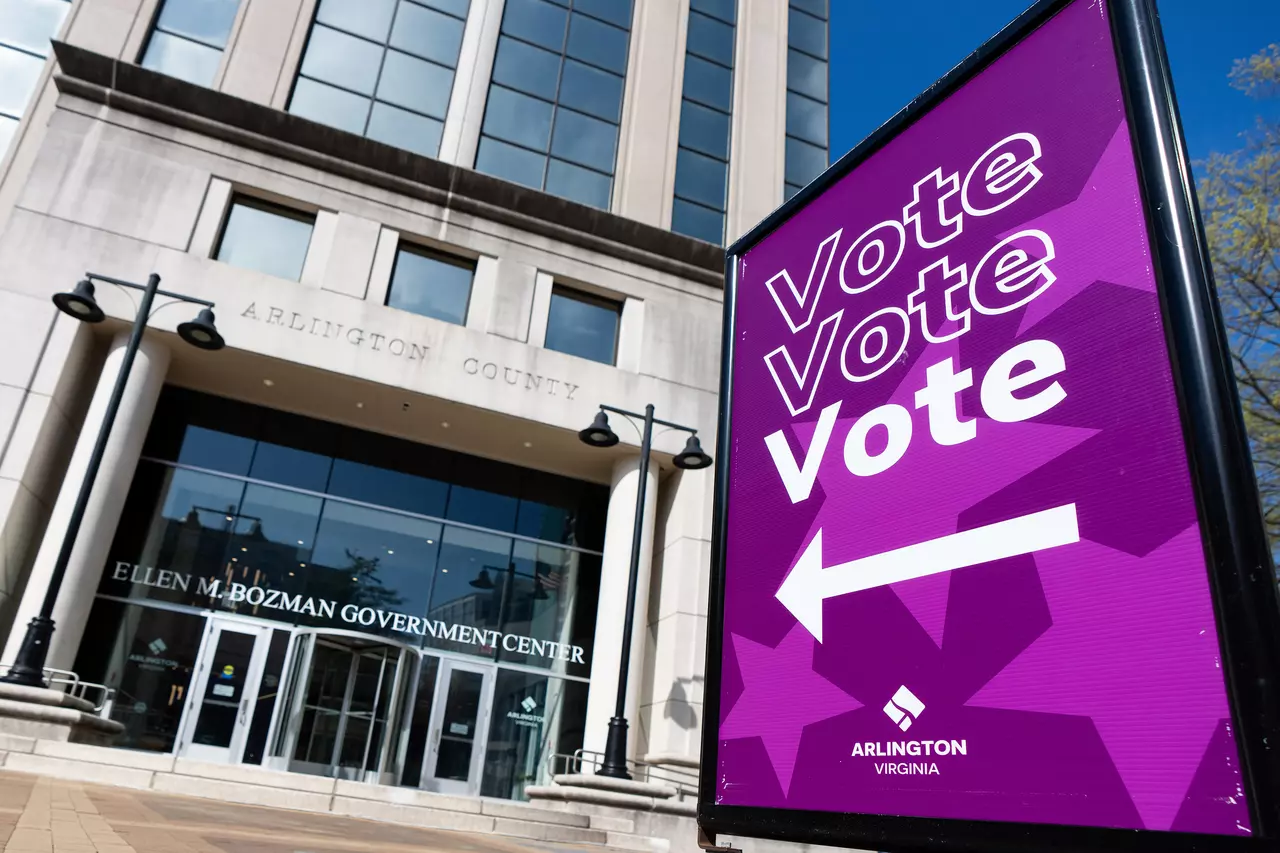
A sign directs early voters on the Virginia redistricting referendum to the Ellen M. Bozman Government Center in Arlington, Virginia, on March 31, 2026.
Bill Clark/CQ Roll Call/Zuma Press/TNS
WASHINGTON — The U.S. Supreme Court on Friday turned down an appeal from Virginia Democrats whose new voter-approved state election map was canceled by the state's Supreme Court.
The justices made no comment, and the legal outcome came as no surprise.
The U.S. Supreme Court has no authority to review or reverse rulings by state judges interpreting their state's constitution — unless the decision turned on federal law or the U.S. Constitution.
But the Virginia ruling came as a political shock, particularly after 3 million voters had cast ballots and narrowly approved a new election map that would favor Democrats in 10 of its 11 congressional districts.
That would have represented an increase of four seats for Democrats in the House of Representatives.
Even worse for Democrats, the court setback in Virginia came a week after the Supreme Court's ruling in a Louisiana case had bolstered Republicans.
In a 6-3 decision, the justices reinterpreted the Voting Rights Act and freed Republican-controlled states in the South to dismantle districts that were drawn to favor Black Democrats.
In the two weeks since then, the GOP has flipped seven districts in Tennessee, Alabama, Louisiana and Florida.
The Virginia Supreme Court decision pointed to a procedural flaw that turned on the definition of an "election."
To amend the state Constitution, Virginia lawmakers must adopt the proposal twice — once before a "general election" and a second time after the election. It is then submitted to the voters.
Last fall, Democrats proposed to amend the state Constitution to permit a mid-decade redistricting.
However, by a 4-3 vote, the state justices said the General Assembly flubbed the first approval because it took place on Oct. 31 of last year, just five days before the election.
By then, they said, about 40% of the voters had cast early ballots.
In defense of the Legislature, the state's attorneys said the proposed amendment was approved before election day, which complies with the state Constitution.
But the majority explained "the noun 'election' must be distinguished from the noun phrase 'election day'."
It reasoned that because early voters had already cast ballots before the constitutional amendment was first adopted, the proposal was not approved before the election.
The dissenters said the election took place on "election day" and the proposal had been adopted prior to that time.
The state's lawyers adopted that view in their appeal and argued that under federal law, election takes place on election.
But the Supreme Court turned away the appeal with no comment.
The result is that a state amendment that won approval twice before both houses of the Legislature and in a statewide vote was judged to have failed.
The state says it will use the current map, which had elected Democrats to the House in six districts and Republicans in five.
_____