
‘The year bald eagles decided to make history’: 3 eaglets spotted in Chicago for first time in a century
CHICAGO — Hyde Park birding couple Pat and Steve Pearson have ventured out to Chicago’s Southeast Side once a week for over a year keeping their eyes and camera focused on two bald eagles soaring above South Deering. The couple watched the birds carry large twigs high into the treetops near Park No. 597, just south of Indian Ridge Marsh, gradually building a massive nest. They weren’t sure the ...
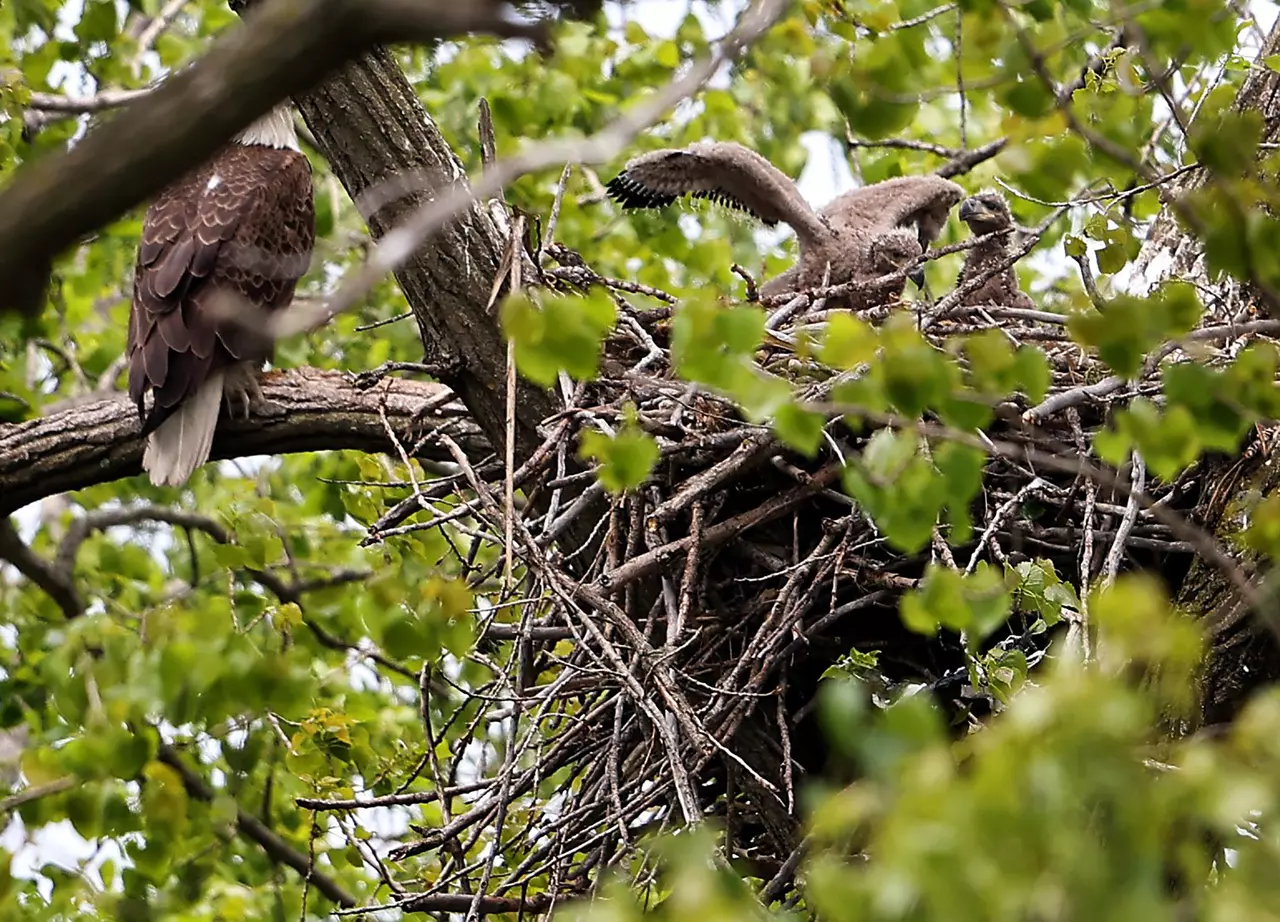
Two eaglets are seen in their nest, right, in Chicago's South Deering neighborhood while an eagle stands watch on Thursday, May 7, 2026.
Chris Sweda/Chicago Tribune/TNS
CHICAGO — Hyde Park birding couple Pat and Steve Pearson have ventured out to Chicago’s Southeast Side once a week for over a year keeping their eyes and camera focused on two bald eagles soaring above South Deering.
The couple watched the birds carry large twigs high into the treetops near Park No. 597, just south of Indian Ridge Marsh, gradually building a massive nest.
They weren’t sure the nest would produce a baby eagle — but they hoped.
The national bird hasn’t been born in Chicago in over a century.
That changed on April 28, when the Pearsons spotted a small grayish-brown eaglet peek its head above the nest.
Pat Pearson, 68, said she was overcome with emotion when she saw the baby.
“Just out of the blue, there was this rather scruffy-looking little bird sticking its head out there,” she said. “When I saw that baby’s head pop up for the first time and my husband standing right there, I literally teared up.”
Steve Pearson, 80, snapped a photo of the history-making raptor.
The couple initially kept the discovery quiet, worried potential crowds would disturb the nesting birds.
“It’s not about us, it’s about them,” she added.
The Chicago Park District called the successful nesting an important ecological achievement for the city in a Wednesday announcement. By Thursday, observers and park officials confirmed there were actually two eaglets in the nest.
“It’s an inevitable milestone that we’ve been waiting to happen,” said Edward Warden, president of the Chicago Ornithological Society. “It was only a matter of time because of the amount of work that’s been done on Chicago’s waterways, on Chicago’s ecology. We knew that they were going to return some day.”
Over the weekend, Warden said birders observed another eagle nest with at least one eaglet at Oak Woods Cemetery in the nearby Grand Crossing neighborhood.
“This is the year bald eagles decided to make history, twice,” he said.
Warden said Chicago — particularly the Calumet region — provides ideal habitat for bald eagles because of its extensive waterways.
“Even if you can’t necessarily see what’s underneath the waves in the Calumet River or the Chicago River or Lake Michigan,” he said, “the fact that these birds are present and making a home and are making the gamble that they can functionally raise a family, that there’s enough here for them to raise the next generation, is about as big a validation as you can get that these waterways are truly healthy again.”
Previous bald eagle nesting attempts in Chicago, all on the Southeast Side, failed to produce eaglets, Warden said. While bird experts cannot say exactly why, he noted the unsuccessful nests suggested the birds wanted to return, but environmental conditions weren’t yet suitable.
“Here we are today, finally seeing a nest where the conditions are right,” he said.
Park No. 597, also known as SEPA Station #1, proved to be an ideal nesting site for these eagles, said Park No. 597 Supervisor Stephen Bell.
The eagle nest sits high above a thriving wetland of Caspian terns, herons and swans — where restored marshes meet the industrial landscape of nearby landfills and freight trains.
Though the Southeast Side is often associated with Chicago’s industrial past, it’s also home to extensive marshes, forests and waterways.
“The legacy of industry has left these abandoned, forgotten, some of them abused spaces that are slowly being restored,” Bell said. “That open space creates an opportunity for species like the eagle.”
The marsh and forest preserve area were previously managed by the Metropolitan Water Reclamation District of Greater Chicago before the Park District assumed control in 2019 as part of broader efforts to expand healthy natural areas on the Southeast Side.
Since then, restoration crews have removed invasive species such as buckthorn and worked to rebuild wetland and forest ecosystems — efforts that conservationists say helped to attract nesting eagles.
The eaglets represent a major victory for those restoration projects, Chicago Park District General Superintendent and CEO Carlos Ramírez-Rosa said in a statement.
“We’d like it to be a regular occurrence, and for that to happen, we need the public’s cooperation to see even more wildlife thrive in our urban parks,” Ramírez-Rosa said in the statement.
Although bald eagles are increasingly common throughout Illinois and are occasionally spotted within Chicago city limits, successful nesting in the city has remained elusive until now. The birds are typically drawn to large rivers and lakes such as the Calumet River and Lake Calumet.
“People slot (the Southeast Side) as this vast, polluted, uninhabited region of the city,” Warren said. “Not only is all of that just not true, but the future of this region is already starting to be manifested, of truly one of the most ecologically diverse and important areas in our city.”
As restoration work continues, Warden said the improvements benefit both wildlife, like bald eagles, and residents.
“Everything that we’re doing for these birds is directly benefiting any of the people who live on the Southeast Side of the city as well,” he said.
He hopes the successful nesting marks the beginning of a broader return of bald eagles across Chicago.
“There’s no reason why there can’t be more, why some day it can’t be that bald eagles go from a ‘Wow, that’s a really cool novelty’ to a common occurrence all across the city,” he said.
The bald eagle, long considered a symbol of American strength and freedom, was officially designated the national bird in December 2024.
The nest is protected under the federal Bald and Golden Eagle Protection Act, which prohibits disturbing nesting eagles and carries penalties of up to $100,000 in fines and one year in prison.
To honor the moment, the Park District said it’s asking Chicagoans to submit names for the eaglets by May 15. At the end of the contest, local birding groups and the Park District will announce entries for residents to vote on by June 1.
Bell said his early suggestion is “Hazel,” in honor of Hazel Johnson, widely regarded as the mother of environmental justice activism on Chicago’s South Side.
“She fought to ensure these spaces were saved and restored,” he said.
Birders say the moment symbolizes more than the return of a species, it reflects the city’s ecological recovery and future potential.
“That’s the next generation,” Warden said. “It was born right here. That small little precocious thing has no idea what kind of a legacy it’s leaving behind. But we do.”
_____