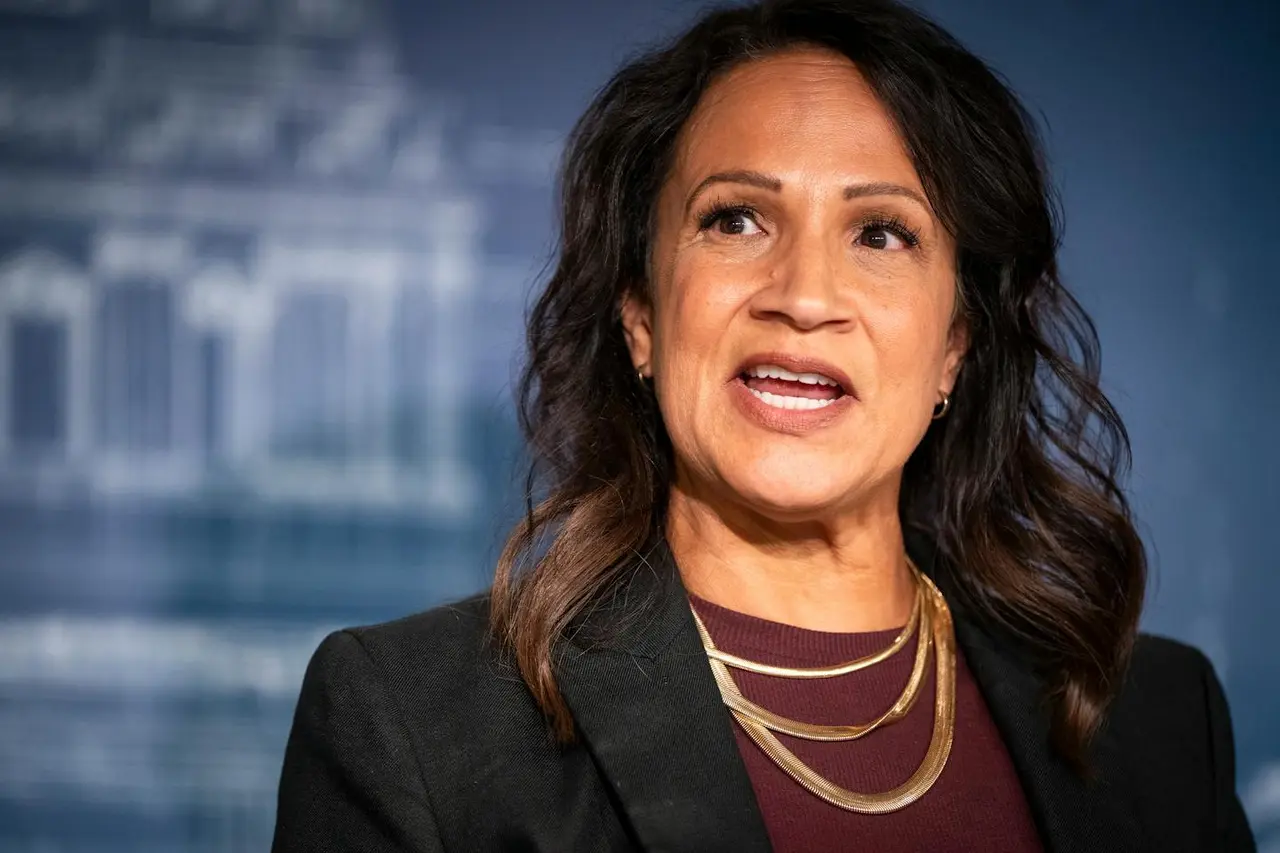

Demuth and Tafoya would make history in Minnesota, but race and gender aren’t their pitch
MINNEAPOLIS — On a rainy April afternoon, hundreds of Republican activists sat on folding chairs in Albert Lea’s middle-school gymnasium as House Speaker Lisa Demuth explained how racism in central Minnesota shaped her youth. Some in the small city of Paynesville did not welcome the daughter of a Black father and white mother, who now, decades later, is running for governor. “I was called the ...
Lisa Demuth, the Republican nominee for governor, holds a news conference at the Minnesota State Capitol in St. Paul on Sept. 14, 2026.
Leila Navidi/Minnesota Star Tribune/TNS
MINNEAPOLIS — On a rainy April afternoon, hundreds of Republican activists sat on folding chairs in Albert Lea’s middle-school gymnasium as House Speaker Lisa Demuth explained how racism in central Minnesota shaped her youth.
Some in the small city of Paynesville did not welcome the daughter of a Black father and white mother, who now, decades later, is running for governor.
“I was called the n-word almost every day of first grade,” Demuth said. “Had a phenomenal family, but it was a difficult place to be. We moved to the metro.”
In May, Demuth’s campaign had a much different message about race for thousands of conservatives at the Minnesota GOP convention in Duluth.
“The pundits will say, ‘Vote for Lisa because she’ll be the first Black female governor in the history of America,’” said Demuth’s running mate, Ryan Wilson. “I say, ‘No, we don’t believe in identity politics.’”
The two scenes illustrate the careful, particular and sometimes inconsistent ways Demuth and her counterpart in the U.S. Senate race, Michele Tafoya, have talked about race and gender in their campaigns.
Though each would make history if elected — Demuth would be the first woman to be governor of Minnesota, and the first Black woman to lead any state, while Tafoya would be the first Hispanic senator from Minnesota and the first Republican woman — both have also been selective about when and how they talk about issues of identity.
The candidates speak publicly about racism and sexism at times, and their trailblazing careers could broaden Republican appeal in left-leaning Minnesota. The GOP has often struggled to win over women and minority voters in Minnesota, one reason the party has not won a statewide election since 2006.
At the same time, Tafoya and Demuth have also mostly resisted the idea that voters should pick a candidate because of identity, especially as they represent a party that has campaigned against identity politics, DEI policies and “woke” ideology.
Both declined to comment to The Minnesota Star Tribune for this article.
Demuth made political history years before running for governor. The legislator from Cold Spring was the first woman and person of color to lead Minnesota House Republicans in 2022. Then, after the House was locked in a partisan tie in 2024, she became the first Black woman and first Republican woman to be House Speaker.
In 2022, Demuth said it was her qualifications, not her race, that earned her the job. In 2025, she also said the milestones were an honor. “I look forward to the day that it will no longer be a surprise or an unusual thing,” she said.
Since announcing her campaign, Demuth has not shied away from speaking about racism as an obstacle — at least early in life.
She often mentions that when she was born in February 1967, interracial marriage was legal in Minnesota but not everywhere in the U.S.
Demuth, 59, tells the story about leaving Paynesville for the Twin Cities. She also says central Minnesota is a better home now.
“We moved back to the Paynesville area and then the Cold Spring area where we’ve been in the same house almost 30 years,” Demuth said during a primary debate for governor in March.
Demuth has also grappled with her gender on the campaign trail, notably after one of her rivals in the Republican primary, Kendall Qualls, declared “the boys are back in town” after he won the state GOP endorsement. In response, Demuth said that type of mentality would be “horrible” against DFL nominee Amy Klobuchar.
Like most other Republicans, Demuth has argued the left’s focus on race and gender has gone too far in many aspects of society. She has clashed with Democrats over what is the best type of government policy to help historically underrepresented communities.
During a March Republican primary debate in Apple Valley, Demuth said Minnesota should get rid of “the woke ideology” in education and return “back to the basics of reading, math, science, just the basics of education.”
...