
‘Broadview Six’ judge requests US attorney’s office communications, including Boutros email
The federal judge considering potential sanctions in the controversial “Broadview Six” made her first formal discovery requests to the U.S. attorney’s office on Friday, demanding any written communications with anyone outside the office regarding “investigatory or charging decisions” as well as an email sent to U.S. Attorney Andrew Boutros attaching an expedited transcript of grand jury ...
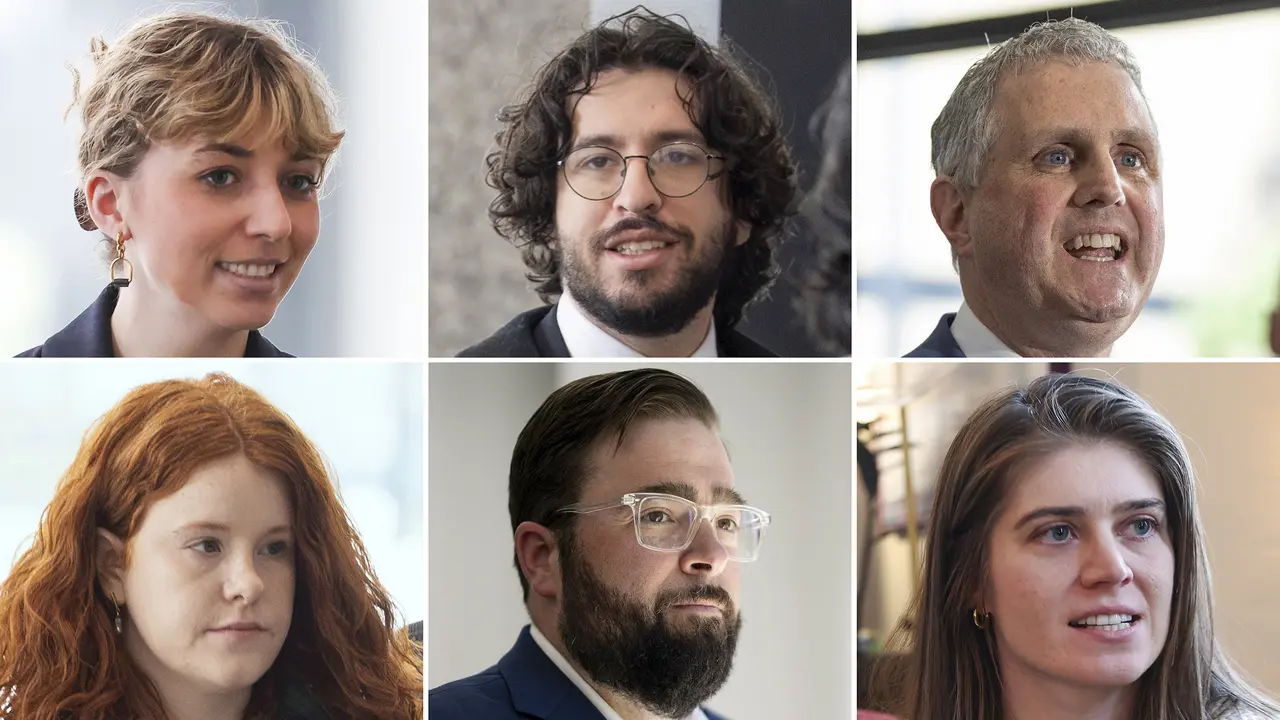
"Broadview Six" defendants Katherine Abughazaleh, clockwise from upper left, Andre Martin, Michael Rabbitt, Joselyn Walsh, Brian Straw and Catherine Sharp.
Chicago Tribune/Chicago Tribune/TNS
The federal judge considering potential sanctions in the controversial “Broadview Six” made her first formal discovery requests to the U.S. attorney’s office on Friday, demanding any written communications with anyone outside the office regarding “investigatory or charging decisions” as well as an email sent to U.S. Attorney Andrew Boutros attaching an expedited transcript of grand jury proceedings.
If the communications were oral rather than written, U.S. District Judge April Perry said in her order, the government must provide the people present for such communication, the date, time, and length of the conversation, a certification that there was no recording or transcription made of the discussion.
“If the communication was later summarized in writing or notes were taken, they should be produced,” Perry wrote. “Testimony from witnesses may be requested at a later time, after the Court has reviewed the relevant documents.”
Perry ordered the materials produced by Oct. 30.
The discovery request comes a week after Perry said she’d initiate a “fact finding” process to determine whether the U.S. attorney’s office intentionally misled her in the “Broadview Six” case, a rare step that could lead to sanctions or even appointment of a special prosecutor to bring criminal contempt charges.
While Perry has made no finding at this point that there was intentional misconduct in the Broadview case, the judge said at the Oct. 1 hearing it was clear that “several aspects of this prosecution were very flawed” and that certain representations made to her by Boutros’ office were not accurate. She also said whether a cover-up occurred to hide illegal conduct — or maybe simply something that was “embarrassing” — does not matter.
Perry made clear last week that any response from the U.S. attorney’s office will be “under oath, under penalty of perjury,” whether or not that response includes live testimony from witnesses.
She also said her inquiry would not be focused on any misconduct before the grand jury, which is no longer on the table because the charges have been dismissed.
“My sole focus at this point is on the lack of candor, concealment of material facts, or other misconduct that occurred before me,” Perry said.
The judge’s requests Friday appear to be in line with that thinking, focusing on whether prosecutors were being truthful with the court when they said there were no communications with anyone in the U.S. Justice Department that influenced the decision to charge the case.
Perry also wants to drill down on Boutros’ insistence in court that he knew nothing of the alleged misconduct before the grand jury in the Oct. 9, 2025, session — which ended in a rare “no bill” vote refusing to return an indictment — until shortly before the case fell apart in May.
The now-retired assistant U.S. attorney who prosecuted the case, Sheri Mecklenburg, has said Boutros personally requested the transcript. In a court filing in August, however, Boutros, who was emailed the transcript on Oct. 14, said he was “quite certain” he never read it.
In her order, Perry requested not only the email to Boutros but any “replies to or forwards of that email” as well.
“If an email is part of an email chain, all versions of that chain must be produced, along with their attachments,” the judge wrote. “Electronic records must be produced with all associated metadata (for both emails and attachments) including read receipts, delivery status, and message tracking logs.”
The inquiry by Perry has put Chicago’s premier federal law enforcement office in largely uncharted waters and adds fuel to a scandal that erupted four months ago, when Boutros dismissed all charges against the six Operation Midway Blitz protesters amid allegations of prosecutorial misconduct.
In announcing the move last week, Perry illustrated her thinking with a quote from Spider-Man — “with great power comes great responsibility” — and by invoking the old adage that the cover-up is often worse than the crime. She said given the massive power wielded by federal prosecutors, they have a duty to be truthful and that any attempt to willfully deceive the court could and should be punished.
“It is clear to me that the mistakes and inaccuracies were material,” Perry said. “They affected the trajectory of the case and how long those defendants were subject to criminal prosecution. It affected not only their pocketbooks, but their lives.”
Attorneys for the Broadview Six have said they believe the decision to indict the group of local Democratic activists for allegedly impeding an Immigration and Customs Enforcement agent’s vehicle during a Sept. 26, 2025, protest was politically motivated amid pressure from President Donald Trump’s administration to make an example of them.
Boutros, who was first appointed in March 2025 by then-U.S. Attorney General Pam Bondi, has publicly denied bringing any cases for political reasons. In a filing explaining their position in August, prosecutors said that while mistakes were made, corrective measures have since been taken and there is no evidence of vindictive prosecution that would warrant further hearings or sanctions.
_____