
Peggy Flanagan channels anti-Trump anger into US Senate campaign to ‘avenge Minnes
MINNEAPOLIS — On the steps of the State Capitol in March, Peggy Flanagan stood before a massive crowd gathered to protest President Donald Trump and the federal immigration crackdown that had gripped Minnesota for months. She reached for a favorite line from the late Sen. Paul Wellstone: “Sometimes you gotta pick a fight to win one.” “My purpose is clear,” Flanagan told the crowd at the “No ...
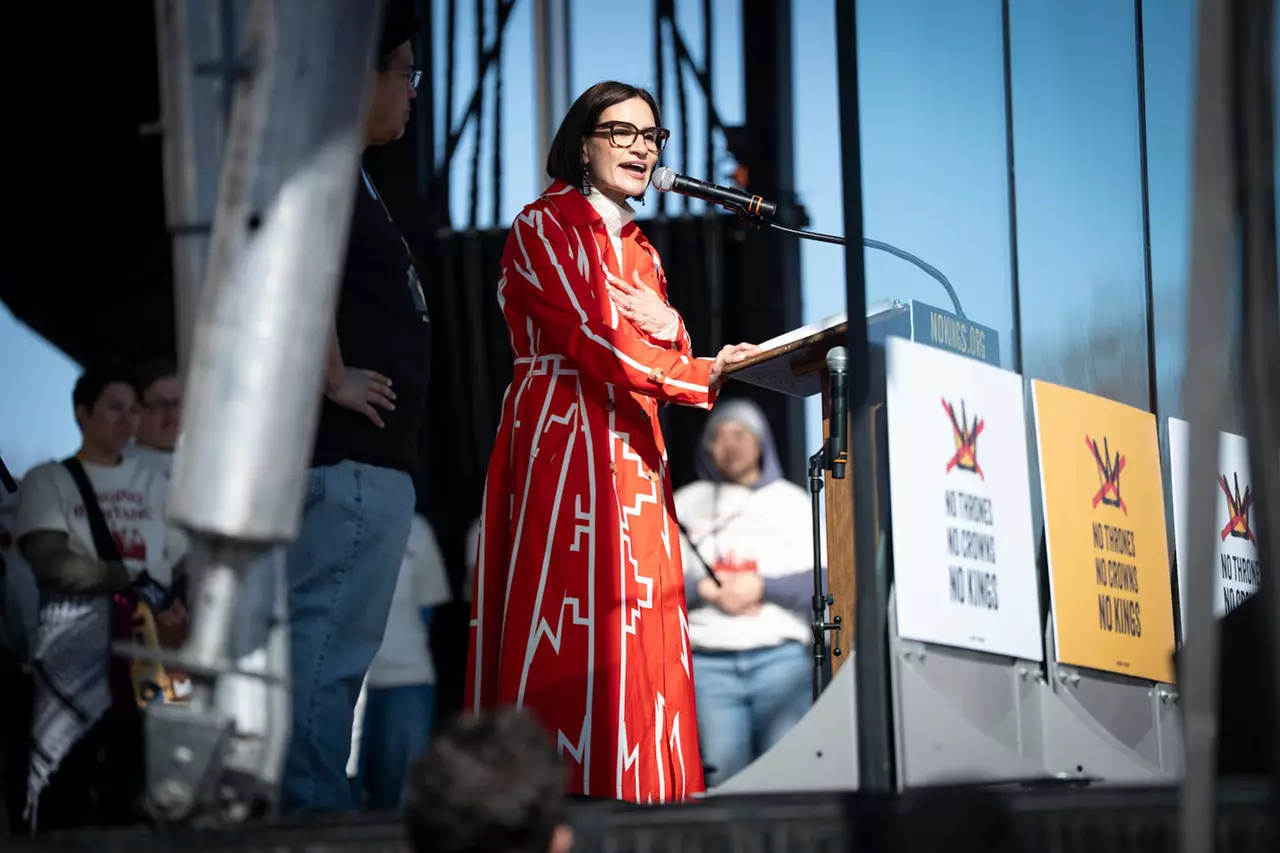
Peggy Flanagan speaks to the crowd at the No Kings rally at the Minnesota State Capitol in St. Paul on March 28.
Renée Jones Schneider/The Minnesota Star Tribune/TNS
MINNEAPOLIS — On the steps of the State Capitol in March, Peggy Flanagan stood before a massive crowd gathered to protest President Donald Trump and the federal immigration crackdown that had gripped Minnesota for months.
She reached for a favorite line from the late Sen. Paul Wellstone: “Sometimes you gotta pick a fight to win one.”
“My purpose is clear,” Flanagan told the crowd at the “No Kings” rally in St. Paul. “No matter what I do from here on out, I am fighting to avenge Minnesota.”
As an estimated 100,000 people packed the Capitol grounds, Flanagan cast the moment less as part of a political campaign than a movement, one she said is powered by grief and anger over Operation Metro Surge — and Minnesota’s resilience.
For Flanagan, Minnesota’s lieutenant governor, the scene also captured the core argument of her campaign for the U.S. Senate against Congresswoman Angie Craig, a more moderate Democrat known for flipping and holding a tough suburban swing district. Running as someone who knows how to channel grassroots energy into political action, Flanagan has raked in funding and support from some of the country’s most prominent progressive organizations and lawmakers, including Sens. Bernie Sanders and Elizabeth Warren.
That backing has come as the race has emerged as one of the nation’s highest-profile Democratic primaries, highlighting tensions within the party over whether Democrats should focus on energizing their progressive base or winning back the moderates and independents who often decide general elections.
As she heads into the DFL Party’s endorsing convention this weekend in Rochester, Flanagan has emerged as the favorite to win the party’s backing, a development that wasn’t a foregone conclusion when she entered the race.
Flanagan had never run statewide on her own or faced a significant challenge in her previous legislative runs. As lieutenant governor, she shared the ticket with Gov. Tim Walz and played no formal role in approving legislation. Yet she’ll carry some of the baggage of the Walz administration, particularly a sprawling fraud crisis in the state that prompted the two-term governor to drop his bid for re-election.
But the backlash to Operation Metro Surge energized progressive activists and gave Flanagan and her supporters an enduring line of attack against Craig, who — with her establishment backing and a proven track record of winning in a battleground district — initially looked like the candidate to beat to replace retiring Sen. Tina Smith.
In January 2025, Craig voted for the Laken Riley Act, the federal immigration bill allowing law enforcement to detain undocumented immigrants accused of nonviolent crimes.
In a different election cycle, the vote might have reinforced Craig’s moderate credentials. Instead, many Democratic voters viewed it as out of step with the urgency and outrage they felt watching federal immigration raids unfold across Minnesota.
“The scale and the ferocity and the awfulness of Operation Metro Surge triggered an equal and opposite reaction on immigration and standing up for neighbors,” said former state House Majority Leader Ryan Winkler, who has endorsed Craig. “And I think it fundamentally changed the nature of this election.”
Flanagan said her motivation to run traces back to her upbringing in St. Louis Park. Raised by a single mother, she relied on food stamps and often talks about carrying commodity cheese home “like a football” and having a different-colored lunch ticket at school.
“I know what it feels like to think the bottom could fall out at any moment,” Flanagan said during an interview at a St. Louis Park coffee shop in April.
She worked at Children’s Defense Fund-Minnesota, helping campaign for an increase to Minnesota’s minimum wage. Javier Morillo, then president of a local SEIU labor union, said Flanagan was adamant about indexing the state’s new minimum wage to inflation, even if it meant clashing with Senate Democrats.
“We ended up forcing them to do something that they would not otherwise have done,” Morillo said.
Flanagan ran unopposed in a special election to the Minnesota House in 2015 after Winkler, then a state representative, encouraged her to seek his seat when he moved abroad.
Just three years after her election to the House, Flanagan joined Walz’s gubernatorial ticket — in part to boost his support among the progressive wing of the party — becoming the first Native American lieutenant governor in the country when they took office in 2019.
In both the Legislature and as lieutenant governor, Flanagan has prioritized policies she believes will help children and families and worked to improve relationships between the state and Native American tribes.
Now Flanagan is trying to channel that same progressive energy into a statewide campaign that has been transformed by backlash to Trump’s immigration crackdown.
That shift was reflected most prominently by Smith, who after initially staying neutral in the race, endorsed Flanagan in February, largely due to Operation Metro Surge. “People are thirsting for leaders who are not afraid to take a big stand,” Smith said.
Yet Flanagan is also tethered to the political liabilities of the Walz administration, including persistent scrutiny over rampant fraud in Minnesota’s social service programs. Walz has the authority to appoint and oversee agency heads tasked with running government programs. It’s a vulnerability both Craig and Republicans have repeatedly invoked on the campaign trail.
Asked what level of responsibility she bears for the administration’s record on fraud, Flanagan said any amount of fraud is unacceptable. But she also portrayed the issue as a partisan one, saying Republicans will try to paint any Democrat with the fraud brush.
“I don’t think we should do Republicans’ jobs for them,” Flanagan said of the criticism from Craig.
Former DFL Party Chair Mike Erlandson, who has donated to Craig’s Senate campaign, said opposition to the surge brought out Minnesotans who hadn’t been active in party politics, creating a boon for Flanagan.
But he said she’s never faced a tough race as the candidate at the top of the ticket. And, he said, Flanagan will “have to own up to” the state’s fraud challenges as it’ll be Republicans’ primary line of attack.
“You want to take the good of what the administration did and accomplished, and I think there’s plenty of that,” Erlandson said, “but then how do you not also then accept responsibility [for fraud] if you were truly one of the inner-circle leaders of the Walz-Flanagan administration?”
He said Flanagan was deeply embedded in Walz’s inner circle during the administration’s early years, helping shape both policy and political strategy. But the relationship frayed after Walz’s unsuccessful vice presidential bid in 2024, exposing tensions that allies on both sides now describe very differently.
In high school cafeterias and senior centers across the state, Flanagan has been shaking hands and making her pitch directly to delegates to the endorsing convention. At a party convention in North St. Paul in March, she cast herself as the candidate for Democrats frustrated with party leader they feel are too cautious.
“Everywhere we go, people tell us that they are sick and tired of Democrats who are fighting from a defensive crouch,” Flanagan said. “Or nibbling around the edges or governing by sternly worded letters. It is time for us to ask for more.”
It’s a message that appears to resonate with some voters. Sabine Fritz of North St. Paul said she appreciated Flanagan’s refusal to take corporate money in her campaign.
“That’s, I think, the biggest issue right now in politics — all of these candidates that accept PAC money and then vote for the interests of those rather than the interests of us,” Fritz said.
Elise Smith-Dewey, a Lakeville Democrat, has supported Craig’s congressional campaigns for years, donating the maximum amount each cycle. She said she appreciated having Craig represent her district even though the congresswoman lands to the right of her politically. But in the Senate race, Smith-Dewey said she is drawn to Flanagan.
“She’s not beholden to the cryptocurrency ... to Chevron or whatever the heck,” Smith-Dewey said. “She’s beholden to the people. I just feel like Peggy is more genuine.”
Still, Craig’s coalition remains durable among many longtime DFLers. Jeremy Bierlein and Heidi Edmonson were elected as delegates to this month’s state convention supporting Craig. The married couple from Eagan have supported Craig since her election in 2016.
“There’s a lot of folks in the middle,” Bierlein said. “There’s even some disaffected Republicans ... Angie definitely has demonstrated election over election the ability to build a coalition.”
Craig’s vote on immigration, Edmonson said, looms large in party politics, but not in everyday life.
While one of Craig’s chief arguments against Flanagan is that she’d be a tougher opponent against the GOP’s nominee this fall, Flanagan notes the momentum she’s built in the endorsement contest shows her message is resonating with voters.
“My hope is also that people see that you can run a grassroots campaign powered by real folks and you can win and it can be winning electoral politics,” Flanagan said as she left the “No Kings” rally.
Those in the front row of the rally warmly greeted Flanagan — in her “ICE OUT” earrings. She leaned into her message of collective action, telling attendees to look to each other and realize that “we deserve better.”
“We are what we need to build the future,” Flanagan said, “and we are going to keep fighting until we get it.”