
Commentary: What Chicago’s Pride Parade revealed about the rule of law
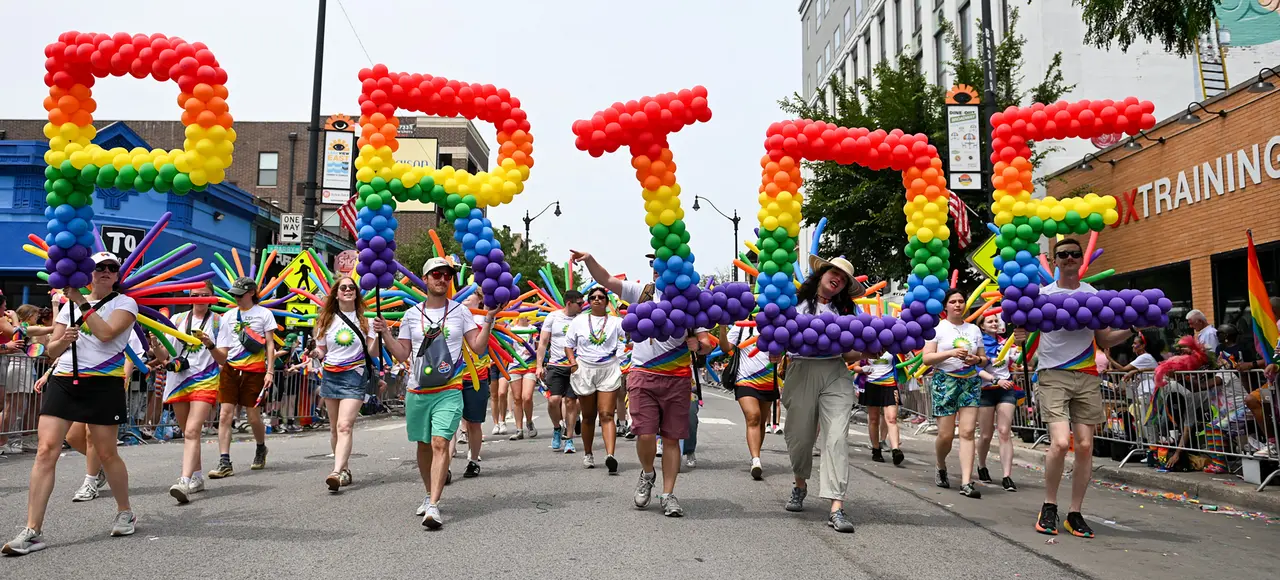
On June 28, the 55th annual Chicago Pride Parade stepped off from Grace Street and Broadway under this year’s theme, “Free to Be Proud.” Leading the procession as one of the parade’s community grand marshals was the Alliance of Illinois Judges, the state’s association of LGBTQ+ judges. I marched as a judicial extern with the Cook County Circuit Court, walking alongside judges from courtrooms ...
The 55th annual pride parade in Chicago, on Sunday, June 28, 2026.
Seth Donovan/ZUMA Press Wire/TNS
On June 28, the 55th annual Chicago Pride Parade stepped off from Grace Street and Broadway under this year’s theme, “Free to Be Proud.” Leading the procession as one of the parade’s community grand marshals was the Alliance of Illinois Judges, the state’s association of LGBTQ+ judges.
I marched as a judicial extern with the Cook County Circuit Court, walking alongside judges from courtrooms across Illinois. Openly LGBTQ+ judges walked shoulder to shoulder with colleagues who are allies. It was a small but powerful reminder that the rule of law is not only written into court opinions. Sometimes it is lived out in public, on a sidewalk, over a 2-mile walk through Chicago’s Northalsted neighborhood.
That distinction matters more than it might seem. The judiciary, in almost every society, is the branch of government built to judge, to sanction, to punish. Judges are trained to maintain distance and not to take sides. So when a body whose entire function is to sit in judgment instead chooses to stand, visibly, with a community that has spent decades being judged, something genuinely different is happening. Illinois Supreme Court Justice Sanjay Tailor marched with his wife. Cook County Judge Cecilia Horan walked alongside her law clerks. U.S. District Judge Mary Rowland — one of a small number of openly LGBTQ+ federal judges in the country — marched with her wife, Julie Justicz. They are the people who preside over custody disputes, criminal sentencings and civil rights claims in this city, and on that Sunday they wore rainbow ribbons and Pride colors without hesitation.
The Alliance of Illinois Judges was founded in 2009 by 15 Cook County judges, led by Judge Thomas Chiola, who in 1994 became the first openly gay person elected to public office anywhere in Illinois. What began as informal dinners among judges who felt isolated in their own profession has grown into an organization of nearly 200 LGBTQ+ and allied members, now led by Judge Jill Rose Quinn, Illinois’ first openly transgender judge and elected official.
It is worth considering what that kind of visibility can do at a city level. Researchers who study hate crimes and community well-being have long argued that both are shaped not only by the law on the books, but by who is seen enforcing, interpreting and embodying that law. When the people responsible for punishing wrongdoing are also visibly part of the community they might otherwise be asked to judge, something shifts in how a city understands itself. For generations, judges have been remembered mostly as strict enforcers — the ones who send people away. What happened on Sunday inverted that image, if only for 2 miles: The same institution that once, not so long ago, treated homosexuality as a pathology or a crime showed up in Pride colors to celebrate it.
History offers a reminder of how recent that inversion is. In early 19th century Yorkshire, England, Anne Lister— now remembered as one of the first women to leave a detailed written record of a lesbian life — chose to live openly with her partner, Ann Walker, and in 1834, the two women took Communion together at a local church, an act many historians now consider an informal marriage. They did this in a country where, in 1835, two men, James Pratt and John Smith, were hanged for sodomy. Public judgment, family shame and the threat of the gallows did not stop Lister and Walker from choosing each other. Their courage is part of why, generations later, cities such as Chicago, London and New York can call Pride a celebration.
I think inevitably of Iran, where I have watched this same struggle play out with none of that celebration. Iran’s Islamic Penal Code, adopted in the years after the 1979 Islamic Revolution, imposes the death penalty for consensual same-sex relations between men. I have followed cases of Iranian police raiding private gatherings, arresting frightened young people and delivering them to some of the country’s harshest judges to be sentenced. I think of families who fear even acknowledging that a son or daughter is gay, and of the rare parents who find the courage to accept a child publicly, only to face condemnation from their own relatives. Many still remember the moment in 2007 when Iran’s president, addressing Columbia University, dismissed a question about LGBTQ+ Iranians by claiming the country simply does not have queer people — a statement met with disbelieving laughter in the hall, and with quiet devastation by the Iranians who knew otherwise.
It was not always this way. In February 1978, a year before the revolution, two men held a wedding ceremony at Tehran’s Commodore Hotel, attended by friends connected to the royal court. It caused a scandal, but it happened openly. Today, that same event would very likely end in arrest and execution, not a wedding announcement.
At the parade, Horan, the Alliance of Illinois Judges’ immediate past president, told me that Pride used to be substantially smaller and that I could see by looking around how different it had become. As a researcher of constitutional law and democracy, I believe good law can reshape bad culture, not merely reflect it. It made me wonder whether Iran’s own constitution might, someday, make room for that same kind of recognition.
That is, in the end, what Sunday’s parade was really about. Chiola and fellow judges founded the alliance so that judges like them would no longer have to choose between their careers and their lives. Seventeen years later, that organization led a parade through the heart of Chicago.
My hope, admittedly a distant one, is that a similar day might be possible elsewhere — that judges in Tehran might one day walk beside their neighbors rather than sentence them.
____
Pegah Banihashemi, a native of Iran, is a legal scholar and journalist in Chicago whose work focuses on human rights, constitutional and international law, and Middle East politics.
___