
Paraguay: Taiwan's most important test in Latin America
When the third Taiwan-Paraguay Technology Forum opened at Paraguay's Central Bank on Sept. 11, its theme was artificial intelligence.
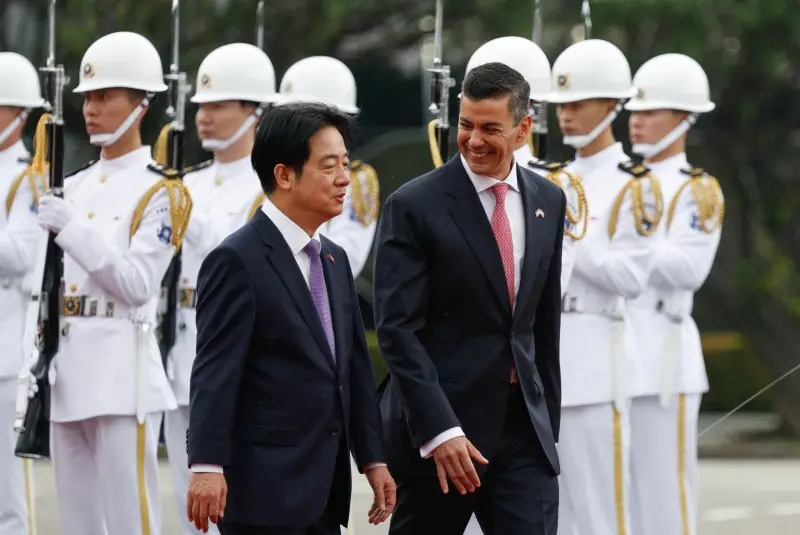
Taiwan President Lai Ching-te (L) and Paraguay President Santiago Pena (R) react as they review honor guards during a welcome ceremony in front of the presidential office Taipei, Taiwan, on May 8. File Photo by Ritchie B. Tongo/EPA UPI
Sept. 14 (UPI) -- When the third Taiwan-Paraguay Technology Forum opened at Paraguay's Central Bank on Sept. 11, its theme was artificial intelligence, the same field in which Asunción and Taipei signed one of their most ambitious agreements in May.
Earlier in the month, 87 engineering students from the Taiwan-Paraguay Polytechnic University arrived in Taipei for a year of study at Taiwan Tech.
Milestones like these bring back a question I have raised with Taiwanese leaders during visits to Taipei for years. Paraguay has been one of Taiwan's most loyal partners, so why can that friendship not become the world's clearest example of what a democratic partnership can deliver?
Paraguay and the Republic of China (Taiwan) established diplomatic relations in 1957. Sixty-nine years later, Paraguay is Taiwan's only ally in South America and one of just seven in Latin America and the Caribbean.
That steadfastness has earned deep gratitude in Taipei. The next phase calls for something more tangible: Taiwanese investment and economic engagement on a scale that matches the importance of the relationship.
The debate inside Paraguay has never disappeared. China is the world's second-largest economy and a vast buyer of agricultural commodities, and Paraguay is a major producer of soybeans and beef.
Some producers and politicians understandably ask whether recognizing Beijing would open a market too large to ignore. The argument deserves a serious answer, because China's size is real.
Part of that answer is that Paraguay already trades heavily with China. China was the largest source of Paraguay's imports in 2025, supplying more than a third of the total, according to Paraguay's Central Bank.
The real question is whether switching diplomatic recognition would add more than it would cost, and market size is only one measure of that calculation.
A mid-sized country also needs to know how much it matters to the other side and whether the relationship builds lasting capacity at home. For China, Paraguay would be one relationship among many.
For Taiwan, Paraguay is one of its most important friendships in the world and its only formal diplomatic foothold in South America. President Santiago Peña reaffirmed that commitment during a state visit to Taipei in May, even as Beijing again pressed Asunción to break with Taiwan.
The evidence of lasting capacity is encouraging. Paraguayan exports to Taiwan reached $342 million in 2025, nearly 50% more than the previous year, according to figures cited by Paraguay's economy ministry.
Beef accounted for about $271 million and pork another $49.6 million. Taiwan now buys most of Paraguay's pork exports, and in May it opened its market to Paraguayan poultry.
During Peña's visit, the two governments signed a mutual legal assistance treaty, a cybersecurity agreement and a memorandum on a sovereign artificial intelligence computing center designed to turn Paraguay's abundant hydroelectric power into computing capacity.
The project is being structured as a 50-50 partnership, beginning with a 10-megawatt pilot facility on government land near Asunción. Paraguay is expected to contribute infrastructure and energy while Taiwan provides advanced computing equipment and technical support. A second phase of roughly 100 megawatts is intended to attract private investment.
Private capital is beginning to follow. Taiwanese bus manufacturer Master Bus is developing a production facility connected to the Taiwan-Paraguay Smart Technology Park in Minga Guazú, with plans to assemble electric buses in the Ciudad del Este area.
Paraguay's Ministry of Industry and Commerce has projected the investment at about $30 million, with the potential for 2,000 to 2,500 direct jobs.
I have visited Taiwan several times and have met Taiwanese diplomats in Asunción, Guatemala, Belize and Saint Lucia. I have also helped organize regional forums examining China's growing role in the hemisphere.
Those experiences have convinced me of Taiwan's value as a democratic partner, and they have taught me that close friends owe each other candor.
In that spirit, a bus plant and a pilot data center are promising but early steps for a 69-year friendship. Scholarships, technical cooperation and official visits have served the relationship well, but the next phase will be measured by the private investment Taiwan helps bring to Paraguay and the industries that investment creates.
Taiwan's strengths in semiconductors and artificial intelligence fit naturally with Paraguay's low-cost hydroelectric power and its central location in South America.
Taipei should therefore make it a priority to bring Taiwanese companies into the AI center's second phase. Few developments would give Paraguayans more visible evidence that the partnership is producing new industries and higher-skilled jobs at home.
None of this requires Paraguay to turn against China. Nor does Taiwan gain anything by asking Paraguay to sacrifice legitimate economic interests in order to demonstrate friendship. Washington has a stake in the outcome too.
The United States has urged Latin American governments to reconsider their dealings with Beijing, and a Paraguay visibly prospering alongside Taiwan would reinforce that case with evidence.
After 69 years, the relationship between Asunción and Taipei has already proved its durability. Its next test is what the two countries build together. If they succeed, other governments in the region may begin asking a different question about Paraguay: less why it still recognizes Taiwan than how they might secure the same results.
Thomas R. Field is Regional Representative for Latin America of the Global Peace Foundation and president of the Latin America and Caribbean Presidential Mission. He has lived and worked in Latin America for more than four decades, including almost 20 years in Paraguay. The views expressed are solely those of the author.