
For Rangers' Peyton Gray, mom's resilience in cancer battle served as inspiration in MLB journey
DETROIT — Lisa and Billy Gray weren’t entirely certain if their son would even be activated — let alone pitch the next day — when he called home at 11:30 p.m. one Wednesday night with the news of his long-awaited promotion. They knew their son Peyton Gray, a journeyman right-hander, was on his way from Round Rock to Arlington after the Rangers called him up from the minor leagues. They knew it ...
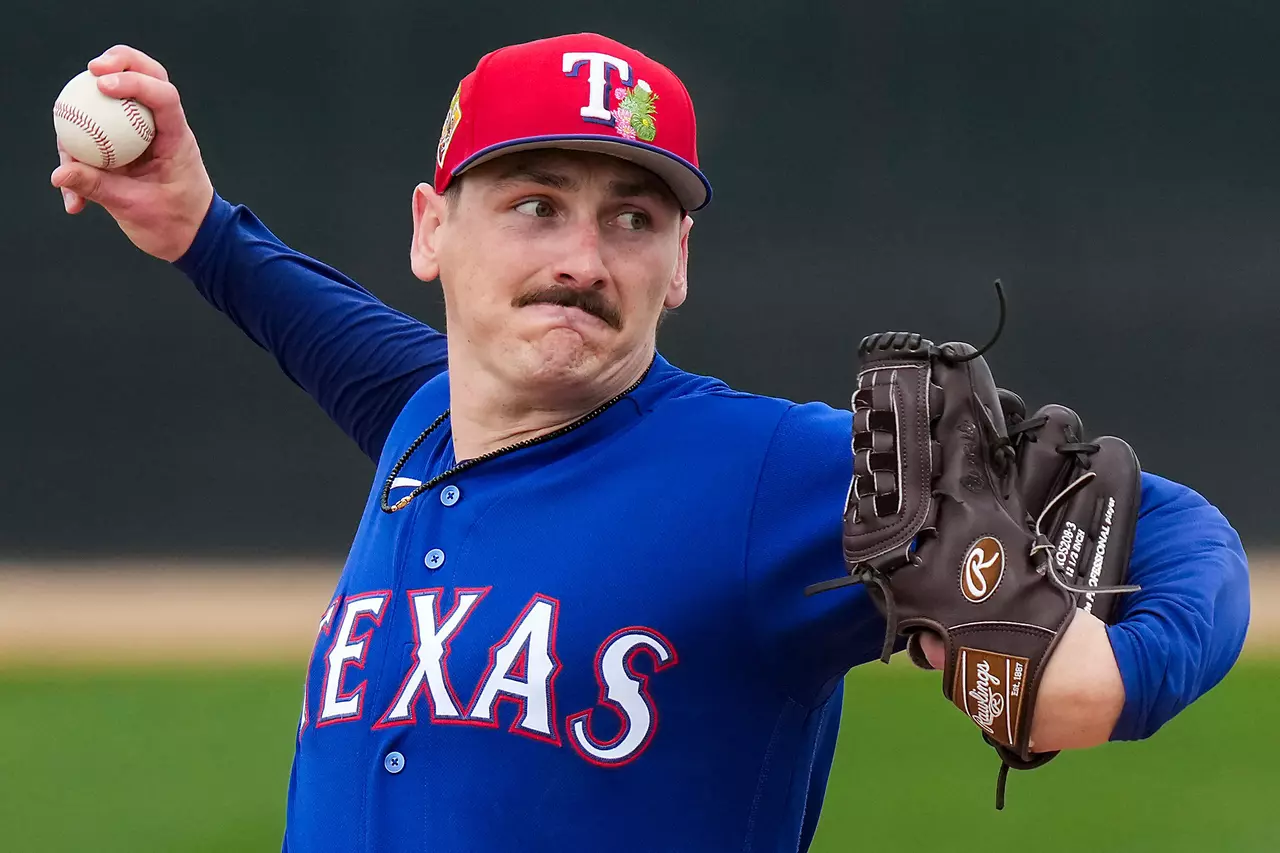
Texas Rangers pitcher Peyton Gray throws live batting practice during a spring training workout at the team's training facility on Monday, Feb. 16, 2026, in Surprise, Arizona.
Smiley N. Pool/The Dallas Morning News/TNS
DETROIT — Lisa and Billy Gray weren’t entirely certain if their son would even be activated — let alone pitch the next day — when he called home at 11:30 p.m. one Wednesday night with the news of his long-awaited promotion.
They knew their son Peyton Gray, a journeyman right-hander, was on his way from Round Rock to Arlington after the Rangers called him up from the minor leagues.
They knew it couldn’t be worse than one of the last times they made a cross-country trek when, five years ago, the two drove from their Columbus, Ind., home to a Scottsdale, Ariz., rental only to learn upon arrival that their youngest child had been released by the Kansas City Royals just as he was cleared to return from a year-long injury that nearly forced him into athletic retirement.
They knew that the 12-hour drive through the night with a pair of German Shorthaired Pointers in the family vehicle, one brought on because Lisa Gray’s breast cancer treatment prohibits her from flying, was nonnegotiable.
They knew Gray’s big debut — a perfect inning thrown in a 6-1 win against the Pittsburgh Pirates at Globe Life Field last month — would mark the serendipitous culmination of an unlikely decade-long journey forged by resiliency.
“I cried the whole time he pitched,” Lisa Gray said. “I don’t know that anything would have made that moment any less perfect.
“Even cancer.”
Lisa Gray, in remission after her second bout with breast cancer but still in the midst of preventative chemotherapy treatment, has now seen her son pitch twice in the major leagues since he was added to the club’s bullpen last month. Gray — who went undrafted out of college, has been released three times, overcame a year-long injury and crossed international lines to give himself a professional chance — has finally arrived on baseball’s biggest stage as a 30-year-old rookie.
It’s taken some serious fortitude.
From mother and son.
“She’s always on my mind,” Gray said last Friday in the visitors’ dugout of Detroit’s Comerica Park. “She’s a true hero, she’s a fighter, I’ve seen her beat it once, and I know she’s going to beat it again.”
A family of fighters
Gray was 5 when his mother signed him — and, inadvertently, his father — up for T-ball. Lisa Gray had been “bugging” her husband to enroll their youngest son in the sport, as she put it, and eventually took it upon herself to do so after “he kept putting it off.”
The team needed a head coach and an assistant coach
“Oh,” Lisa Gray said, “my husband will be a head coach.”
“That’s kind of my way of saying ‘You probably should have signed him up,’ ” she said with a laugh. “I think he was probably looking at me when he was coaching T-ball like, ‘Why did you do this to me? You couldn’t even say assistant? You signed me up to be a head coach?’ ”
Gray’s father coached him through the youth leagues, and when he began travel ball, his mother would often drive the two-hour round trip to and from Bloomington, Ind., after work three nights a week for practice. Lisa Gray, who works at the youth service center in the family’s hometown and has been “a parent to many kids” as her son described, was first diagnosed with breast cancer in 2013, shortly before his senior season at Columbus East High, and started chemotherapy soon afterward.
The teenaged Gray saw the impact those treatments had on his mother’s body firsthand and grappled with the reality that his parents weren’t “untouchable” as children can be led to believe. He also watched her maintain a patented “game face” despite the disease and, eventually, beat it for the first time.
“The whole ‘never give up attitude’ is what I get from her,” Gray said. “So many people count on her and she fought and fought to be here. I think that’s how I take it into baseball.”
Gray did that and then some. He went undrafted out of Florida Gulf Coast University — one of the three colleges he attended — and signed a minor league contract with the Colorado Rockies.
He was released less than two years later and began a circuitous journey that included three stints with the independent Milwaukee Milkmen of the American Association, three consecutive jaunts in the Mexican Pacific Winter League, two more opportunities in affiliated ball that ended in unemployment and more than a three-year gap between minor league games.
“I had to live at home for a long time, and they always pushed me to keep going, keep playing,” said Gray, who lived with his parents until he was 26 and, in the offseasons, worked for DoorDash with his father and held other odd jobs. “Without them, who knows, I could’ve given up?”
There were moments that forced him to consider that option. Gray signed with the Kansas City Royals prior to the 2021 season and had settled into a groove at High-A Quad City before he tore his ulnar collateral ligament midseason and required Tommy John surgery, a year-long recovery and another setback for someone already four years older than the average player in his minor league classification.
“At that moment,” Gray said, “I was like, ‘man, I think I’m done. I can’t miss a year.’ And at that point I felt like I was old, I was in High-A and I was going to miss a year. It was hard to see the future, but having my parents, my brother and my wife, having them motivate and support me, who knows if I would be here without all of that?”
But Gray, his mother said, “has always been a little hardheaded.” His older brother, Jordan, chose the phrase “supremely stubborn” and still remembers that when the two were children, and when professional wrestling was a fixture in the household, Peyton would refuse to tap out even when locked in arm bars while the two siblings grappled.
“She’s probably where my brother gets a lot of his stubbornness,” Jordan Gray said. “She’s such a fighter and a go-go-go type of person."
Consider that a family trait.
“He had a quote about how our mom is the real hero,” Jordan Gray said, “but what Peyton is doing is inspirational too.”
Game faces
It still irks Lisa Gray that she was only able to attend one of her son’s games last season, and in a phone interview with The Dallas Morning News, she reiterated several times that it’s uncharacteristic for her attendance to be that low.
“She always has her game face on,” Gray said. “She never wants anyone to know that she’s struggling or anything like that.”
Lisa Gray had an advanced-stage breast cancer recurrence in February 2025, a dozen years after her initial diagnosis, and underwent radiation, chemotherapy and eventually surgery to fight the disease. She scoffed at the suggestion of palliative care from an oncologist because “we weren’t just going to keep me comfortable.”
“We,” Lisa Gray said, “were going to battle.”
Her youngest son was in the midst of his own battle at the same time, because after a strong performance with Algodoneros de Guasave of the Mexican Pacific Winter League, he’d signed a minor league contract with the Rangers and returned to affiliated ball nearly four years after his last appearance.
“I’m putting great amounts of pressure on myself to break spring training with the team, make a roster, whether it’s Double-A or Triple-A,” Gray said, “and then that’s going on back home, and it’s tough to be away from home, because you just want to hug her.”
Gray was kept informed of his mother’s progress through family group chats, and often when he needed a significant update, he’d have to call and seek it out “because they want me to be focused on baseball.”
“He’s constantly checking in,” Lisa Gray said, “and I’m constantly reassuring him that I’m fine — even if I don’t feel fine — because I want my kids to think I’m fine.”
Gray impressed the organization enough in his first camp with the Rangers and began the season at Double-A Frisco. He reached Triple-A Round Rock before the summer and was closer to the major leagues than ever before. At one point, when Rangers shortstop Corey Seager neared the end of an injured list stint and needed to face a live pitcher before a rehabilitation assignment, the team flew Gray to Globe Life Field to face the five-time All-Star in a simulated session.
The Grays had rushed to purchase Rockies apparel after their son signed as an undrafted free agent eight years ago. They did the same when the Royals signed him three years after that, and when the Cincinnati Reds picked him up two years later, they restocked their closets once again.
There was, admittedly, hesitancy this time around.
“We didn’t immediately go out and start buying Rangers stuff,” Lisa Gray said. “We just didn’t, because it was like, ‘Have we jinxed him always before by buying the gear and everything?’ ”
The superstitions might have worked. Gray, whose performance in camp this spring astounded Rangers manager Skip Schumaker and the club’s front office, didn’t make the opening day roster but began the season on the short list to assist the major league team sooner rather than later.
He was promoted April 23 after a scoreless start to his minor league season, and with his parents and wife, Sammy, in the stands, was welcomed into that night’s game by applause from the Globe Life Field fans who were aware of the circumstances.
Lisa Gray felt “somewhat normal” that night because her chemotherapy treatments were temporarily on pause after a bout with pneumonia two months ago. She restarted chemotherapy last Monday, but still drove five hours north to Detroit to see her son pitch live for a second time this season.
“I didn’t want to miss that,” she said. “Peyton’s very in tune with me, too, so as much as I try to hide when I don’t feel well, my kids know. I didn’t want him worrying when he’s got so much good stuff going on. I put on my game face this weekend.”
Gray put on his, too, and pitched a pair of scoreless innings to extend the shutout streak that he’d started his career with. His brother, Jordan, also in attendance, said it was the most “confident” his younger sibling had looked yet with the big league team.
It’s not difficult to understand where he gets it from.
“I have so much faith in my mom winning that battle like she has in the past,” Jordan Gray said, “and I have no doubt that Peyton is going to keep doing his thing and succeed in any avenue he goes into.”