
Court ruling could scramble early voting plans across Minnesota
MINNEAPOLIS — A recent state Supreme Court ruling could make it harder for cities and counties to offer multiple in-person early voting sites this fall. The court ruled last week that Minneapolis must use party-balanced election judges at its early voting polling places, rejecting arguments from the city and Secretary of State’s office that nonpartisan local employees could administer the new ...
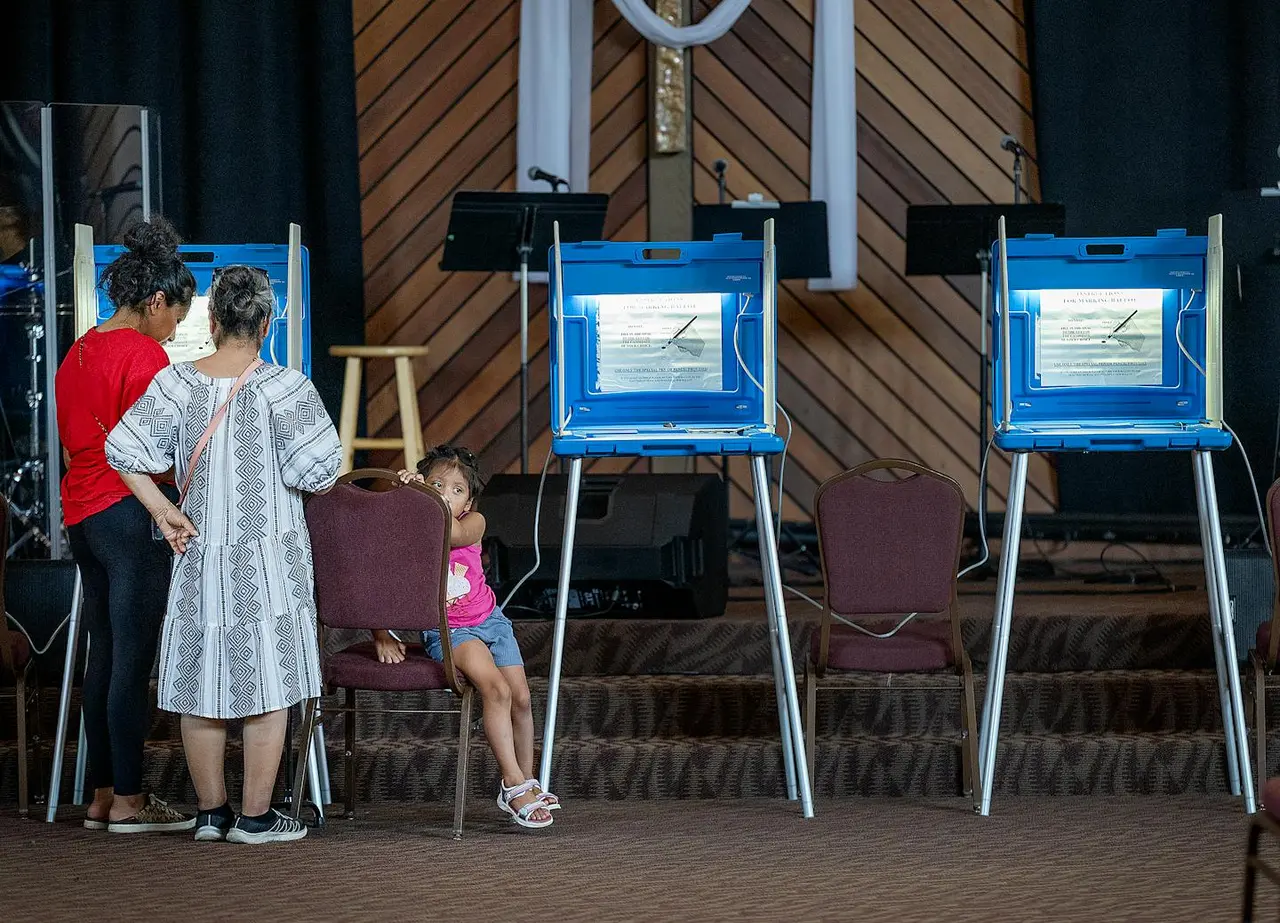
Voters, work on their ballot in a voting booth at St. Michael's Lutheran Church in Bloomington MN on Tuesday, Aug. 11, 2026.
Elizabeth Flores/The Minnesota Star Tribune/Elizabeth Flores
MINNEAPOLIS — A recent state Supreme Court ruling could make it harder for cities and counties to offer multiple in-person early voting sites this fall.
The court ruled last week that Minneapolis must use party-balanced election judges at its early voting polling places, rejecting arguments from the city and Secretary of State’s office that nonpartisan local employees could administer the new system.
The requirement could prove difficult for some local governments that had planned to offer early voting at multiple locations. Minneapolis warned in court that it would be “very difficult, and potentially not possible” to find the necessary election judges, though city officials now say they expect to keep their planned locations open.
The new early voting system is separate from the existing absentee voting method, which can also be done in person, and was established by a 2023 DFL-sponsored law. It allows voters to cast a ballot in a traditional Election Day-like manner up to 18 days before an election. The program kicked in across the state during this summer’s primary and local officials were preparing for it again this fall.
But the conservative Minnesota Voters Alliance, represented by the Upper Midwest Law Center, challenged the city of Minneapolis’ plans to run its early voting polling places without a balance of Republican and Democrat election judges at each of them.
The court agreed with the groups, finding that the “plain, unambiguous language” of state law requires election judges to perform certain duties during early voting.
The dispute centers on election judges, the tens of thousands of temporary, partisan workers and volunteers who staff polling places and help administer Minnesota elections.
State law assigns election judges certain Election Day duties, from checking in voters to handling ballots, and requires partisan balance among the judges serving in a precinct or ballot-counting location.
The Secretary of State’s office and city officials argued the 2023 law allowed local governments to use non-partisan staff like a city clerk or county auditor to serve as “early voting officials” at early voting locations. The existing in-person absentee program is administered by government staff at smaller jurisdictions, the Secretary of State’s office added.
Lawyers for the city of Minneapolis also argued the Democratic-leaning city has historically struggled to find enough Republicans to serve as election judges on Election Day and has resorted to recruiting them from outside of the city. In their legal brief, city officials also raised the specter of closing early voting sites.
After the ruling, however, the city said that would not happen.
“The city will staff early voting locations in accordance with the ruling, and it has contingency plans in place as with every election,” city spokeswoman Jess Olstad said in a statement.
Upper Midwest Law Center President Doug Seaton said the group’s primary intention was to enforce state law and ensure a fair process, but added that they also believe voting days and locations should be more “concentrated.”
“If it takes contraction of the number of locations or days for early voting to comply with the law, then so be it,” Seaton said in an interview.
DFL lawmakers who sponsored the legislation said during the 2023 session that it was intended to make voting easier and more accessible.
But the conservative groups argued that legislators wrote the law to require election judges be present during early voting. Minneapolis and state officials argued the opposite, saying lawmakers would not have required judges when they were trying to expand access to the ballot.
Rep. Emma Greenman, DFL-Minneapolis, who co-sponsored the law, said legislators did not intend to require election judges but admitted that perhaps the bill’s language wasn’t clear enough.
She criticized the conservative groups for bringing the lawsuit, which she predicted will curb access — especially in smaller counties with limited resources.
“It’s not in the interest of free and fair elections and it’s not in the interest of our democracy,” she said. “And I certainly wish organizations like that would stop.”
The Secretary of State’s office, which declined to comment, argued in court that smaller jurisdictions “would certainly struggle” to implement the election judge requirement.
Officials from a handful of counties reached by the Minnesota Star Tribune, including Kandiyohi, Beltrami, Blue Earth, Morrison, and Ramsey, said they either had not been aware of the ruling or expected to be able to comply with it.
But there are many more local jurisdictions that run elections in Minnesota, and so far it’s not clear how the ruling will impact all of them.
Seaton said his group will be prepared to pursue cases against jurisdictions that don’t follow the Minneapolis precedent.
“We’re very glad the court is prepared to enforce the law,” he said.