
Are custom treatments and 'nanovaccines' the future of fighting cancer?
DALLAS — Scientists are closer than ever to creating a vaccine that can fight off and destroy cancer. On June 1, a study published in the Journal of Clinical Oncology by researchers at NYU Langone Health analyzed the five-year results of a melanoma trial, finding that a personalized cancer vaccine led to a 49% reduction in cancer recurrence when used along with standard immunotherapy ...
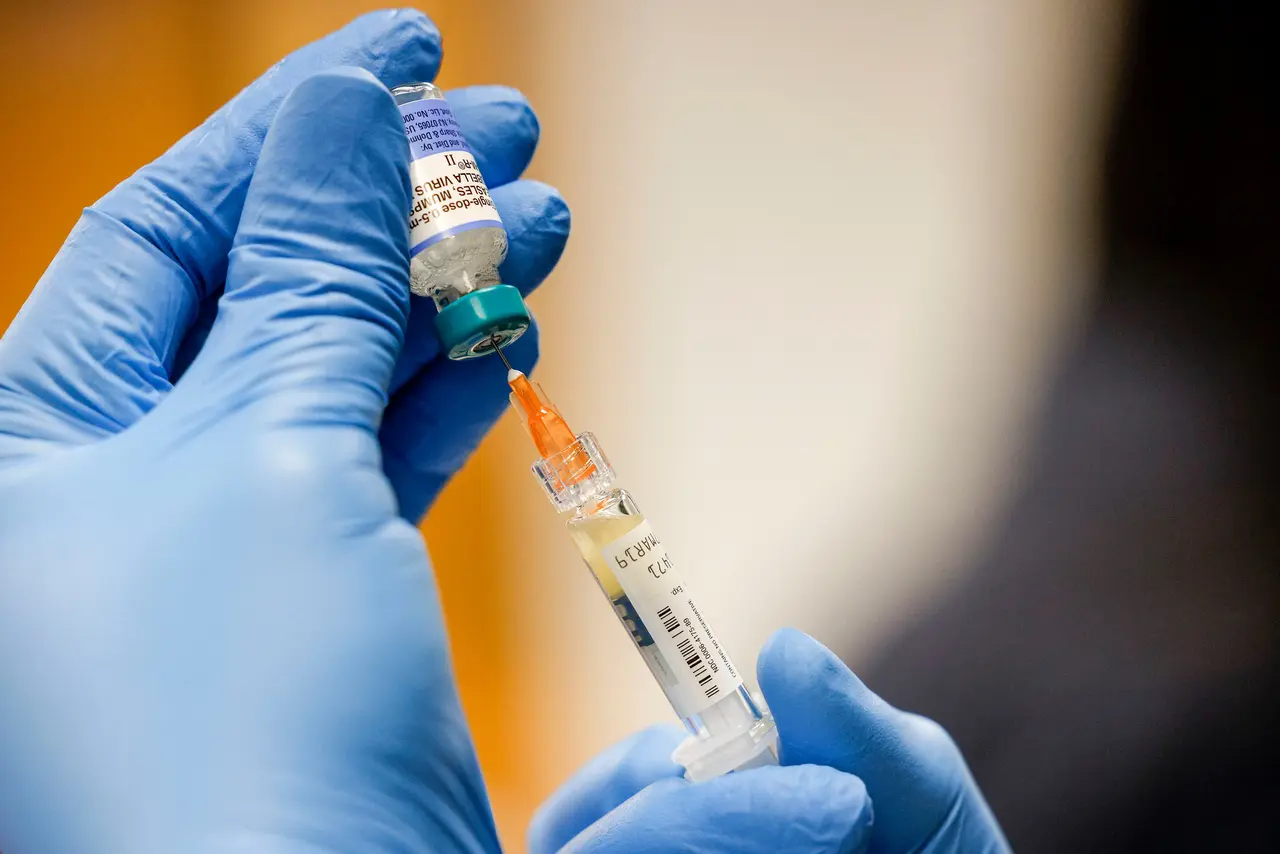
A nurse mixes a dose of the measles, mumps and rubella virus vaccine at a pop-up clinic at the Carrollton-Farmers Branch ISD Administration Building in Carrollton, Texas, on Friday, March 7, 2025.
Liz Rymarev/The Dallas Morning News/TNS
DALLAS — Scientists are closer than ever to creating a vaccine that can fight off and destroy cancer.
On June 1, a study published in the Journal of Clinical Oncology by researchers at NYU Langone Health analyzed the five-year results of a melanoma trial, finding that a personalized cancer vaccine led to a 49% reduction in cancer recurrence when used along with standard immunotherapy treatment.
Meanwhile, in Dallas, researchers at UT Southwestern Medical Center have been working for over a decade on developing a vaccine to reach cancers that have metastasized, or spread throughout the body.
What are cancer vaccines?
Most people think of vaccines as preventive, helping to protect against diseases such as the flu and COVID-19. These vaccines are called prophylactic, and some of them can protect against viral infections that cause cancer, such as HPV.
Therapeutic vaccines are a newer type of vaccine in the world of cancer research. They are designed to be given after a cancer diagnosis to destroy any cancer cells already present.
These vaccines are a type of immunotherapy aimed to activate the body's natural defenses, said Jinming Gao, a professor at UT Southwestern who co-leads research into cancer vaccines there. The goal, he explained, is to restore the immune system's ability to recognize and eradicate cancer cells, especially at late, metastatic stages where surgery and radiation can no longer reach every tumor.
Why therapeutic vaccines are difficult to develop
Therapeutic vaccines are challenging to develop, mainly because of two reasons, Gao said. First, by the time a patient has been diagnosed with cancer, they may have accumulated decades of genetic mutations. Treating a disease like cancer after it has progressed to such an extent is always much more difficult.
The second issue is that vaccines, like the body's immune system, are designed to tackle foreign disease-causing pathogens. For example, when it comes to treating something like Ebola, Gao said, the proteins are so clearly nonhuman that the immune system can quickly mount a response.
Cancer, meanwhile, isn't foreign, but our own mutated cells. This means the immune system can't automatically identify cancerous cells as something bad they need to destroy.
This is further complicated by something scientists refer to as heterogeneity: No two tumors are alike, and cancer cells within the same tumor can be drastically different. This makes it challenging to develop a treatment that can identify and eliminate all the different cancer cells at once. "It's almost like trying to find something one-size-fits-all," Gao said.
Current cancer vaccine research
The recent study from NYU Langone Health analyzed the results of a five-year melanoma trial that treated patients with vaccines developed using information from patients' tumors.
To make these vaccines, surgeons removed tumor tissue from each patient, sequenced its DNA, and then used an algorithm to identify the 34 most abnormal proteins specific to that patient's cancer. Those proteins were encoded as targets in a customized mRNA vaccine, essentially a mini instruction manual, and given alongside pembrolizumab, a commonly used immunotherapy drug, to prevent the recurrence of melanoma.
Dr. Janice Mehnert, the director of melanoma and cutaneous medical oncology at NYU Langone Health and senior investigator on the study, emphasized the personalized nature of these vaccines, saying, "It really results in one vaccine per patient."
Mehnert said this approach will be "scalable," explaining that it only takes around six weeks for a personalized vaccine to be developed.
Of the 157 patients who participated in the study, 107 received the combination therapy and 50 received only the immunotherapy drug. After five years, 68.8% of patients treated with the combination therapy remained cancer-free, compared to 49.1% of the patients given only the immunotherapy drug.
"We hope that we're finally getting smarter about this approach and making it into something that can help manipulate every person's unique immune system," Mehnert said. She said their research will soon enter Phase 3 clinical trials, the final step before public use.
Gao's lab at UT Southwestern is exploring cancer vaccines from a different angle. Rather than building a custom vaccine for each patient, his team has spent over a decade engineering what they call a nanovaccine: microscopic particles designed to activate the immune system.
The nanovaccine works by exploiting an alarm system in our cells known as STING, which stands for stimulator of interferon genes. STING acts as a sensor that detects abnormal DNA and triggers an immune response whenever something goes wrong, like cancer cell formation or a viral infection.
Gao's team has been working to develop a systemic way of targeting HPV-related cancer tumors. They have been testing a nanovaccine that can identify tumors based on characteristics like acidity and low oxygen levels, and then release a payload that alerts the body's immune system that cancer is present.
Preclinical trials showed the nanovaccine was effective in eradicating primary HPV-related tumors and metastatic cancer that spread to other organs, with 71% of mice with metastatic lung cancer still alive 60 days after treatment. When the scientists combined the nanovaccine with existing therapy, all of the mice survived.
The researchers are exploring a potential startup to license the technology and conduct preclinical and clinical studies, Gao said. They also aim to expand the vaccine technology to non-HPV-related cancers by exploiting other tumor-specific antigens.
"I'm pretty optimistic that we will create an effective cancer vaccine," Gao said. "But we're not there yet."
____
Niamh Ordner is a science reporting fellow at The Dallas Morning News. Her fellowship is supported by the University of Texas at Dallas. The News makes all editorial decisions.