
‘Diaspora World Cup’ provides opportunities for players with multiple passports
SAN DIEGO — There are seven sets of brothers on rosters at this World Cup. Only three play for the same country. Nico and Inaki Williams were born in Spain to Ghanaian parents and play for the same Spanish club, Athletic Bilbao. But Nico represents Spain; Inaki, after initially saying it wasn’t fair to take a roster spot from someone who “felt Ghana 100%,” plays for the Black Stars now. Desire ...
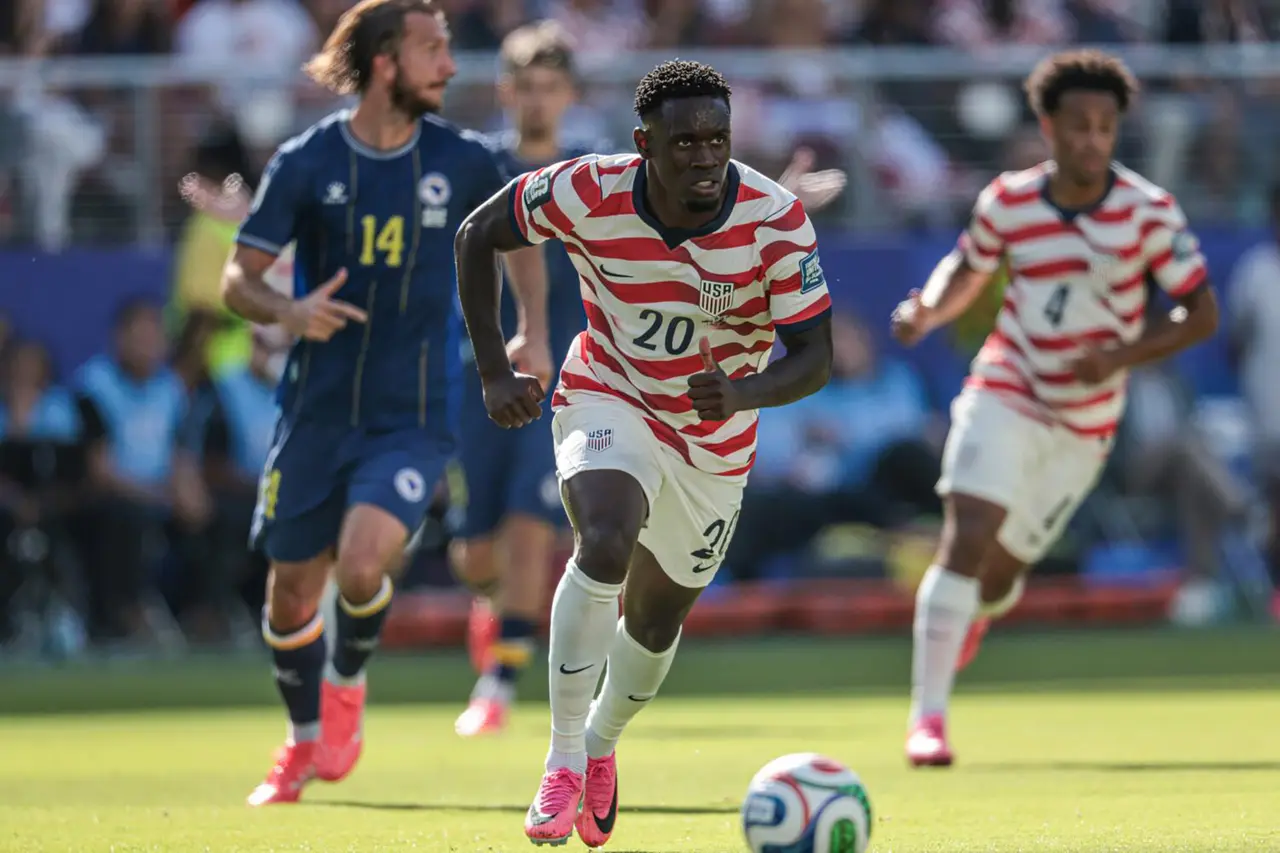
The United States' Folarin Balogun controls the ball against Bosnia Herzegovina in a World Cup Round of 32 match in Santa Clara, California, on July 1, 2026.
Robert Gauthier/Los Angeles Times/TNS
SAN DIEGO — There are seven sets of brothers on rosters at this World Cup.
Only three play for the same country.
Nico and Inaki Williams were born in Spain to Ghanaian parents and play for the same Spanish club, Athletic Bilbao. But Nico represents Spain; Inaki, after initially saying it wasn’t fair to take a roster spot from someone who “felt Ghana 100%,” plays for the Black Stars now.
Desire Doue said he and older brother Guela “are like twins,” but the former plays for France, the nation of their mother, and the latter for Ivory Coast, the nation of their father.
John Souttar plays for Scotland. His brother Harry played for Scotland at the youth level but switched to Australia, where their mother was born.
Brian Brobbey (Netherlands) and Derrick Luckassen (Ghana), who have the same Ghanaian mother but different fathers, became the first brothers to score for different nations at the same World Cup.
The brave, new World Cup.
The migration World Cup.
The diaspora World Cup.
The tournament expanded to 48 teams this year, and 40 have at least one player on the 26-man roster born outside the country. Curacao had only one player born on the Caribbean island. Qatar had players born in 10 other countries. Twenty players on Democratic Republic of the Congo were born elsewhere, 17 on Bosnia and Herzegovina, 17 on Haiti, 16 on Algeria, 14 on Cape Verde.
Morocco has 19. At one point in the opener against Brazil, that included all 11 on the field.
The U.S. team is not immune from the vagaries of migration and citizenship quirks. In Wednesday’s 2-0 win against Bosnia and Herzegovina, Folarin Balogun and Malik Tillman scored goals for a country they barely knew until recently.
Balogun was born in New York only because his Nigerian mother, visiting from England, was seven months pregnant and denied boarding for the flight back to London. They returned a month later, and Folarin grew up in England, representing it on youth national teams and dreaming of playing for the Three Lions at a World Cup one day.
Tillman was born in Germany to a German mother and an American serviceman father who left the family shortly after. Malik grew up in Germany, representing it on youth national teams and dreaming of playing for Die Mannschaft at a World Cup one day.
When the call never came, they applied for U.S. passports and switched soccer nationalities.
Twenty-five years ago, it wouldn’t have been possible. FIFA regulations stipulated that once you represented a country in an official capacity at any level, you couldn’t change.
The rules were altered in 2004 at the urging of Algeria, which was struggling to field a competitive national team with wholly domestic players and saw dozens of better prospects from the diaspora living in France.
FIFA instituted a one-time switch before the age of 21. That’s been modified twice since, most recently in 2020 to allow a switch at any age as long as you haven’t played more than three official matches (friendlies don’t count) or appeared in a major international competition at the senior level for another country.
From the 2002 through 2018 World Cups, the number of nationality switches hovered in the 70s and 80s for the 32-team tournament. In 2022, it shot up to 137, or 16.5% of rosters, and for the first time a player (Switzerland’s Breel Embolo) scored a World Cup goal against his birth nation (Cameroon).
In 2026, with 48 teams and 1,248 roster spots, it’s up to 292.
That’s nearly one in four players. Globally, about 4% of people don’t live in their birth nation.
“The national team is no longer only a reflection of population inside the border,” Myriam Cherti, a senior researcher at Oxford University’s Centre on Migration, Policy and Society, told the BBC. “It’s increasingly a reflection of migration, history and global mobility.”
It’s also a reflection of opportunity, rooted in a desire to play on the planet’s biggest stage, in many cases, more than some unwavering allegiance to another flag.
The profile of most foreign-born players is similar: Grew up in another country, represented it at the youth level, didn’t get called by the senior team, applied for a nationality switch.
And were welcomed by their new teams with open arms, eager for a chance at qualifying for a World Cup and the lucrative FIFA payouts that come with it.
Morocco’s rise from missing four straight World Cups to reaching the 2022 semifinals and looking dangerous again here can be traced to a shift in the federation’s philosophy toward player identification. Instead of looking exclusively within, it sent scouts to France and other European nations with robust youth development systems to find the sons of Moroccan immigrants.
Why spend millions on youth development, with no guarantee of ROI, when someone else will do it for free?
France supplied 99 players in this World Cup, 13 of whom play for Algeria, 12 for Haiti, 11 for Congo and 10 for Senegal. Sixty-seven are from the Netherlands, 50 are from England and 47 are from Germany.
Bosnia and Herzegovina midfielder Esmir Bajraktarevic is from Appleton, Wisc., the son of immigrants who fled the bloody civil war in the 1990s. More people of Bosnian heritage (4 million) live outside its borders than inside (3.1 million).
“He’s a classic example of what’s happening lately since I’ve been here,” said coach Sergej Barbarez, whose team qualified for only its second World Cup. “We expanded our horizons all the way to the U.S. We’ve been looking for guys who want to play for Bosnia and Herzegovina. We have guys who were actually born all over the world.
“This is maybe a big advantage for us that we managed to bring in all the different cultures, habits and mentality toward football and put them into one unit.”
Cape Verde, which has a population of 530,000 and doesn’t have a domestic pro league, recruited Irish-born defender Pico Lopes on LinkedIn. Lopes initially ignored the message because it was in Portuguese, which he didn’t speak.
Nine months later, coach Rui Aguas tried again, this time in English. Lopes, who was never called back after one appearance for Ireland’s under-19 national team but has a Cape Verdean father, accepted.
Canada got a 6-foot-3 defender who had spent his entire life in the United Kingdom but mentioned to a former English club teammate in a sauna that he had a Canadian grandmother. The player contacted Canada coach Jesse Marsch, who leaned on the prime minister to expedite Alfie Jones’ passport application.
Canadian goalkeeper Owen Goodman didn’t have birthright or parental heritage but had lived in a small town in Ontario from age 5 to 13. He hired an immigration attorney and ultimately was granted citizenship based on residency.
Iran got a midfielder from Germany when his aunt, a television and film star in Tehran, randomly posted a family photo on social media.
Dennis Eckert was born and raised in Germany and doesn’t speak Farsi, but his late grandfather was Iranian. To verify his lineage, he flew to Tehran for a DNA test that was compared to one from his aunt. The family connection was confirmed in April, he received his passport in May and Iran named him its roster in June — as Dennis Dargahi, his aunt’s surname.
He wasn’t the only late addition to a World Cup roster. A week after French-born Yoan-Ange Bonney’s nationality switch was approved, Ivory Coast named him to its roster even though he had yet to don a Les Elephants jersey. Australia got an Italian midfielder who, during the 2022 World Cup, mocked the Socceroos’ loss to Japan on social media.
Late-blooming U.S. goalkeeper Matt Turner has a great-grandmother from Lithuania, got a passport and emailed the federation when playing for Team USA “didn’t feel like it was going to become a reality for me.”
“I think that email got left in the inbox, I guess, fortunately for me,” said Turner, who went from being undrafted by Major League Soccer in 2016 to starting in the 2022 World Cup. “It worked for me, playing here in the U.S.”
Now he’s on a national team where six starters are foreign-born and four had little connection to the United States — Balogun, Tillman, Sergino Dest and Antonee Robinson — until joining it. Half of the roster has dual citizenship.
“We’re a melting pot,” Turner said. “This is our country, right? This is America.”
Balogun and Tillman’s talent was undeniable, but both are shy by nature and struggled to acclimate to a country and culture they barely knew. Tillman, who speaks haltingly in his second language of English, seemed to turn a corner last summer in the Concacaf Gold Cup, missing a first-half penalty kick in the semifinals against Costa Rica before making one in a shootout that sent the U.S. to the final.
Tillman’s spectacular free kick in Wednesday’s 82nd minute sealed the win against Bosnia and delivered the United States’ first World Cup knockout victory since 2002.
“He just wanted to feel like he had a place,” captain Tim Ream said. “He’s a quiet kid, but he’s just come on in leaps and bounds. Now you look at him, and he looks like he’s playing with such an ease and a calmness. It’s incredible to see.
“I know we’ve had conversations with the other guys. He’s had that in him all this time. It was just a matter of him finding the confidence and him believing in himself, and he’s doing that now.”
Sometimes it’s not as easy as changing passports, jerseys and anthems.
“You’ve got to follow your heart,” Turner said. “When you’re playing for your national team, you have to really feel it in your blood if you want to perform to the highest level. You have to go and play when everyone else is on (offseason) holidays.
“You have to really want to be there.”
____