
10 showstoppers to see beyond Endeavour at the new Samuel Oschin Air and Space Center
LOS ANGELES — A recent Times review of the new Samuel Oschin Air and Space Center declares that the Endeavour space shuttle — displayed for the first time ever in launch position — "is, simply put, one of the greatest artifacts ever installed in a museum." While it may be true that visitors will flock to L.A.'s newest cultural haven just to see the shuttle, the 200,000-square-foot addition to ...
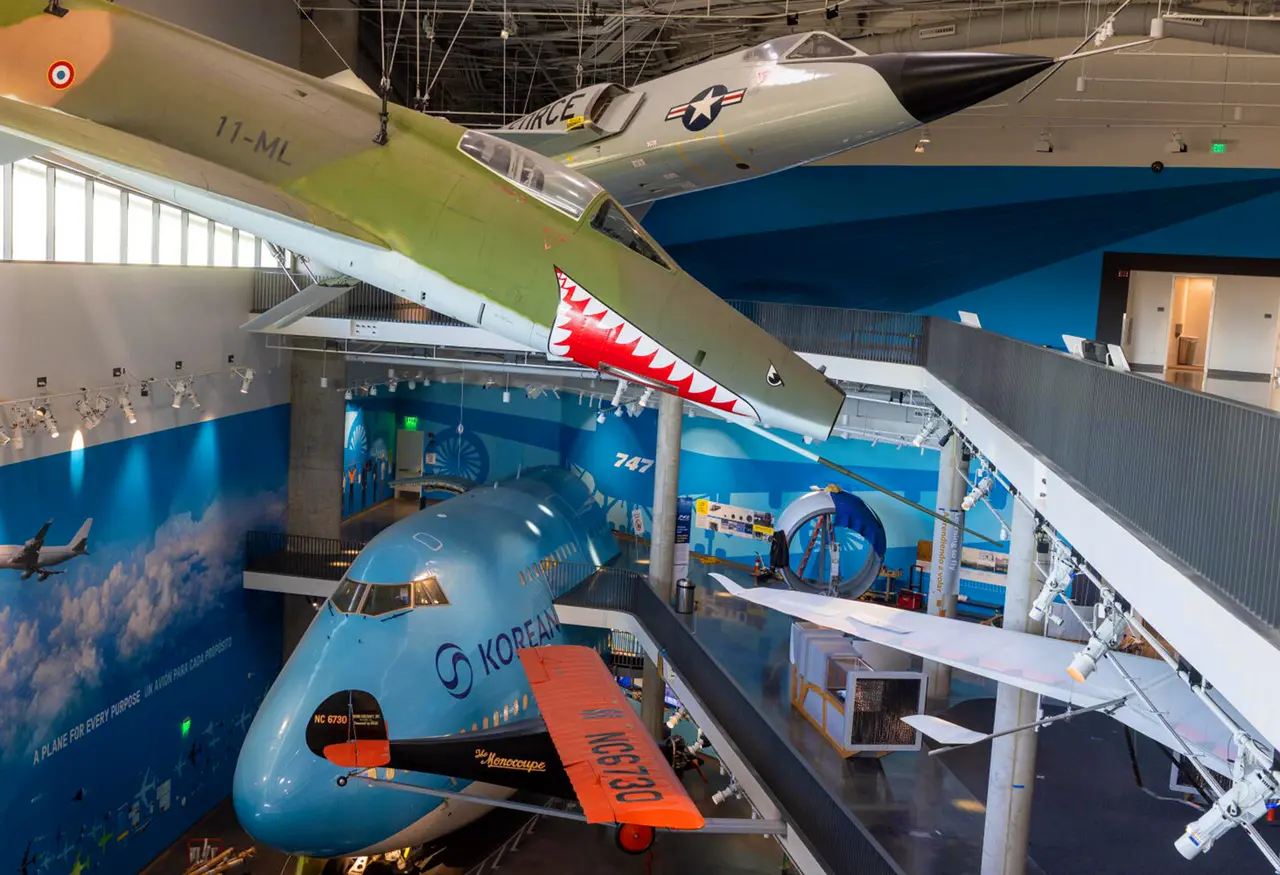
Several planes are on display inside the Korean Air Aviation Gallery at the Samuel Oschin Air& Space Center at the California Science Center in Exposition Park Wednesday, Oct. 7, 2026. The gallery explores the science and engineering of flight, including the principles of lift, thrust, drag and weight, with aircraft displayed on the floor and suspended overhead...
Allen J. Schaben/Los Angeles Times/TNS
LOS ANGELES — A recent Times review of the new Samuel Oschin Air and Space Center declares that the Endeavour space shuttle — displayed for the first time ever in launch position — "is, simply put, one of the greatest artifacts ever installed in a museum."
While it may be true that visitors will flock to L.A.'s newest cultural haven just to see the shuttle, the 200,000-square-foot addition to the California Science Center contains plenty of other mind-melting artifacts to gawk at — especially if you're an aerospace buff. If you've read Tom Wolfe's riveting 1979 book "The Right Stuff" (or seen the movie) about the early years of NASA's space program, you'll likely feel downright starstruck when confronted with iconic pieces of history ripped straight from its pages.
But there's much more than history at this tech-forward new museum. This list of must-see artifacts reminds us of all we know about air and space, and all we don't — as well as the many novel and ingenious ways we continue to work toward fresh discoveries.
These capsules transcend time
A short walk from Endeavour you'll find a display of three historic space vessels. In 1961, the Mercury-Redstone 2 transported a brave "astrochimp" named Ham to space in order to discern if the trip would be safe for humans. The heat-scarred cone resembles a large child's toy, and it's hard to imagine what Ham must have been thinking and feeling strapped to the small couch visible inside the capsule. Nearby you'll see the Apollo-Soyuz Command Module, which American astronauts Tom Stafford, Deke Slayton and Vance D. Brand flew to meet with a Russian Soyuz spacecraft orbiting Earth in 1975. Visitors can see the docking tunnel where American and Russian astronauts greeted each other in space for the first time. Finally, be sure to check out the Gemini 11 capsule, which set an altitude record of 850 miles when it took astronauts Dick Gordon and Pete Conrad into space in 1966.
Rover around the museum
Humans have not yet reached Mars, but we've sent rovers. You can see models of these amazing, otherworldly vehicles at the Oschin and thrill at the thought of all they have accomplished in the name of science. The Mars Exploration Rover looks a little bit like the quirky, lovable robot in the 1986 film "Short Circuit," but its serious-minded mission lasted approximately 15 years, during which time it found geological evidence that water once flowed on the Martian planet. Meanwhile, the large Perseverance Rover landed on Mars in 2021 and set an off-world driving record by traveling 28 miles while collecting rock and atmosphere samples. Finally, in 1997, the more primitive, mini-tanklike Sojourner Rover was the first wheeled robotic vehicle to roam Mars.
Fly by a trick plane
There are nearly two dozen aircraft hanging from reinforced concrete beams inside the three-story aviation hall, but our favorite is the bright red Pitts Special S-1C, which — with its radiant white stripes — resembles an exotic bird. This open-cockpit aerobatic biplane was built around 1970 but was originally designed by Curtis Pitts in 1944 as an amateur-built aircraft, also known as a kit plane. It soon distinguished itself as a top-of-line competitor in aircraft aerobatics because of its impressive ability to execute daring rolls, spins, loops and dives. These stunning biplanes ruled aerobatic competitions for decades.
Step into a rocket booster
Gigantic, hypnotic portions of solid rocket boosters have been installed in the space gallery — displayed on their sides so guests can physically walk through them. They resemble a glowing white tunnel, 30 feet long and 12 feet in diameter. Not only does the experience allow you to fully register the enormous size of these artifacts, but you'll also learn about the rocket booster's importance in the shuttle stack: When completely assembled, twin 15-story boosters produced the more than 6 million pounds of thrust needed to lift a shuttle into orbit. Once they burned out, these boosters landed in the ocean, where they were recovered, refurbished and reused — including, now, in the museum.
Giggle (if you must) at a space potty
According to Science Center employees, one of the most common questions that comes up on museum tours is about where, and how, astronauts went to the bathroom. The Oschin Center seeks to tackle that question head-on by displaying a genuine space potty, extracted from the Endeavour herself and displayed in a glass case. The odd-looking waste management system looks a bit like a futuristic torture device, with a crenelated funnel and hose to suck up urine and a small, vacuum-sealed hole for defecating. Remember, without the suction and sealing, poop and pee would simply float around the bathroom. Wild!
High fashion in space
A selection of space suits resides in a glass case near a fun interactive exhibit that allows you to try on your own digital space suit. Inside you'll see the high fashion worn in space. The Mark II suit, with its Army green hue, zippers, pull strings and brown straps, looks like it belongs on the cover of a 1960s sci-fan fan magazine. It was developed by the U.S. Navy for high-altitude flight and served as a predecessor to the first American space suit. Nearby, the shiny silver Project Mercury test training suits were specially created to fit each individual astronaut. Oxygen entered these suits through ports on the waist and exited through the helmet.
Ground control to Major Tom
A row of industrial blue historic launch consoles that were once used by NASA's launch control at Kennedy Space Center on Merritt Island in Florida were given to the Oschin to display near Endeavour. It's wonderful to behold their many primitive-looking screens, buttons, dials and keyboards, and know that these same tools were responsible for the safety of the astronauts as they blasted into the unknown. From these consoles, teams monitored weather and wind conditions, and issued the all-important "go" if things were right, or "no go" if changes needed to be made.
Satellite launcher
Ever wonder how satellites get to space? Standing 59 feet tall and shooting up through multiple galleries to the ceiling of the center's third floor, the sleek black Electron Rocket is one of the answers. It's the world's most frequently launched small orbital rocket and contains the first 3D-printed rocket engine. After launch, Electron is capable of sending multiple satellites to Earth's orbit — each along a unique orbital path. To date, Electron has delivered nearly 200 satellites that are used for a variety of purposes including in academics, as well as by commercial companies and national defense.
A future robot
It's not all about what already happened in space, but also what will happen. As you roam the galleries, you'll encounter many exhibits that aim to show the future of humankind's extraterrestrial exploration. Our favorite is the long, winding Exobiology Extant Life Surveyor robot — also called EELS. NASA's La Cañada Flintridge-based Jet Propulsion Laboratory built this snakelike machine with the goal of one day using it to explore difficult-to-reach places on other planets, moons or asteroids. It could slither down craters, squeeze into crevices, and even push its way underground in search of answers.
A sky taxi
Squeezed in among a variety of historic aircraft, you'll find the very futuristic Joby SHy4 air taxi. This hydrogen-electric, helicopter-like vehicle was developed by Joby Aviation, which boldly advertises on its website that its all-electric air taxi is "soon to be bookable at the tap of a button." (Although, the company is in legal trouble over a trade secrets lawsuit, and hurdles remain in the commercial air taxi market.) The model at Oschin is a hydrogen demonstrator aircraft, and can seat one pilot along with four passengers. With its sleek form, black bug-eyed windows, and six mini overhead rotors, it looks like what would happen if a helicopter and a Waymo had a baby.
This story originally appeared in Los Angeles Times.