
Seattle is stage for one of Team USA’s biggest moments
SEATTLE — Monday nights hold a special place in the American sports culture. The exclusivity. The history. Every sports fan knows the music. Whether it’s the lead-in to a Monday night NFL game, or the Monday night when the NCAA men’s basketball champion is decided, when the musical chords hit, everyone knows what’s about to happen. Playing, performing, attending or watching on a Monday night ...
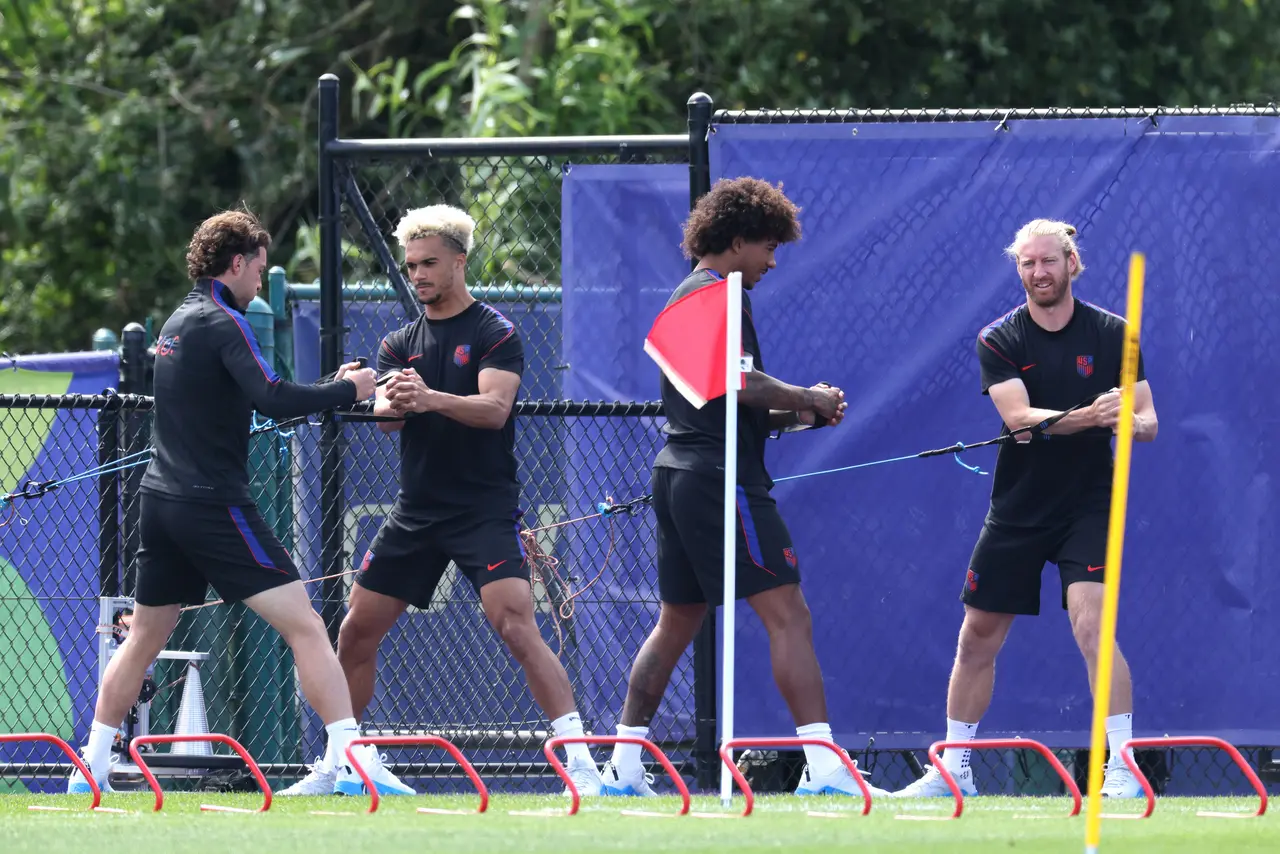
Antonee Robinson, Chris Richards and Tim Ream of the United States attend a training session ahead of the FIFA World Cup 2026 Round of 16 match at University of Washington on Sunday, July 5, 2026, in Seattle.
Jamie Squire/Getty Images North America/TNS
SEATTLE — Monday nights hold a special place in the American sports culture.
The exclusivity. The history. Every sports fan knows the music. Whether it’s the lead-in to a Monday night NFL game, or the Monday night when the NCAA men’s basketball champion is decided, when the musical chords hit, everyone knows what’s about to happen.
Playing, performing, attending or watching on a Monday night remains a special opportunity on the sporting landscape.
That background brings us to this Monday night and the opportunity before the United States men’s national soccer team facing Belgium in the round of 16 in the FIFA Men’s World Cup.
Seattle has the chance to be the dateline to the most significant men’s match in U.S. soccer history in a venue — Seattle Stadium or Lumen Field — that has seen its share of prime-time moments etched into the local and national sports landscape.
Does that statement seem outlandish? Maybe. But consider the aspects involved.
It’s a home game for the United States to be played in a city — our city — that already captured the attention of the country with the way it showed up and rallied around the team just over two weeks ago in the group stage of the tournament against Australia.
The Americans will be playing a European power ranked in the Top 10 in the world. There is history with Belgium as well, going back to the matchup in the same round of the tournament 12 years ago in Brazil, a game the Belgians won 2-1 in extra time.
There is controversy, which is likely to add eyeballs to what was already expected to be a record number of viewers tuning in. The suspension of Folarin Balogun’s one-game ban for a red card in the last match against Bosnia-Herzegovina and his ability to play against Belgium added an extra layer of disgruntlement from the opponents, joy for the Americans and undoubtedly general interest in what will transpire.
And, finally, there is the exclusivity of what Monday nights mean. The game will kick off at 8 p.m. back east, 5 p.m. on the West Coast, coming off the July 4 holiday weekend. The perfect opportunity for a team that has managed to grab the attention of even casual observers over the past few weeks.
All the ingredients are there — hype, drama, significance — to make this one of the most memorable nights in the annals of U.S. men’s soccer.
“I don’t want to speak for all of history in the U.S. I mean, I’ve played in less than 10 World Cup games,” U.S. star Christian Pulisic said. “So it’s a big game, there’s no doubt. We want to win. We want to go to the next round to say it’s the biggest again. That’s not for me to decide.”
The winner will earn a trip back down the West Coast for a quarterfinal matchup against either Spain or Portugal on Friday. Belgium has been here before — it beat the U.S. to reach the quarterfinals in 2014 and reached the semis in 2018 before losing to eventual champion France.
For the U.S., this would be a rarefied place. The only time the U.S. reached the quarterfinals was 2002 when the tournament was played in Japan and South Korea. The Americans played in the semifinals of the first World Cup in 1930, but that was a tournament that featured just four groups, 13 teams and the group winners advanced directly to the semifinals.
Reaching the quarterfinals was always seen as the optimal goal for the U.S. in this tournament. And now the opportunity is there, with Seattle as the backdrop.
“I think advancing, I don’t care if it’s signature or not, I don’t really care. I think advancing and taking this thing as far as we can is the most important thing,” U.S. midfielder Tyler Adams said. “I think we have a good opportunity here to do so. You have to back yourselves against whoever you’re playing and obviously Belgium is a great side.”
After a lackluster group stage, Belgium showed its resolve in the round of 32 by rallying with two goals in three minutes late in regulation to draw even with Senegal, then converted a penalty in the 125th minute — the latest goal in World Cup history — to advance with a 3-2 win.
Belgium’s golden generation may be fading and aging, but it’s still a quality side who saw a little spice added to the matchup on Sunday when Balogun’s ban was suspended making the leading goal scorer for the U.S. eligible to play.
“I am a head coach, I will focus on my team and tomorrow’s game regardless of the 11 starting players from the US,” Belgium coach Rudi Garcia said. “I will focus on my team.”
Before the World Cup began, this was always the dream scenario for Seattle. The chance for a second game involving the U.S. required the home team winning its group and then getting through a round-of-32 matchup.
To their credit, the Americans did their part. They won the group after beating Australia in Seattle on June 19. They withstood Bosnia despite playing with just 10-men for the final 30-plus minutes in the round of 32.
But so did Belgium. The stakes of this matchup feel different and perhaps lose a bit of significance if Senegal ended up as the opposition. Getting past Belgium would mean topping a true European power, even if this isn’t the golden generations of the Red Devils that will be on the field.
While getting a little payback for 12 years ago might be a tangential benefit, more to the point for this U.S. team is proving it’s better than the side that was walloped 5-2 in a friendly by Belgium just a few months ago.
“We learned from it, and they do have some world-class players that are going to give us some problems, potentially,” U.S. defender Chris Richards said. “So ultimately, we’re looking to the game as a tough one, but also go into this game with confidence because what we’ve done so far.”
There have been other seminal moments in past for the U.S. men. Some might argue that beating Colombia in 1994 to advance to the knockout round when the World Cup was first played here might be the most important match. Others could contend the “dos a cero” against Mexico in the round of 16 at the 2002 tournament in South Korea and subsequent quarterfinal loss to Germany were the most significant matches.
But in 1994, we were still a neophyte soccer country. In 2002, both of the knockout matches were in the middle of the night for parts of the country.
Even if the U.S. wins and advances, the rest of the tournament might not resonate the same. The quarterfinal in Inglewood, Calif., on Friday would start at noon PT. Same for the semifinal in Arlington, Texas on July 14. They’d still be massive if the U.S. could get that far, but maybe not have the same feeling as what Monday night could mean.
“You need to embrace the moment, that’s for sure,” Adams said. “To have opportunity to play in a round-of-16 game … it’s exciting.”
____