
Chicago Mayor Brandon Johnson pushes City Council to adopt tenants’ rights package
CHICAGO — Mayor Brandon Johnson added pressure to aldermen Monday as they began to vet his plan to overhaul Chicago renters’ rights with changes like capped move-in fees and a rental registry. Johnson pitched the plan as a way to strike back at corporate landlords who he blamed for soaring housing costs. His proposal won support from allies who argued it will empower renters and bolster ...
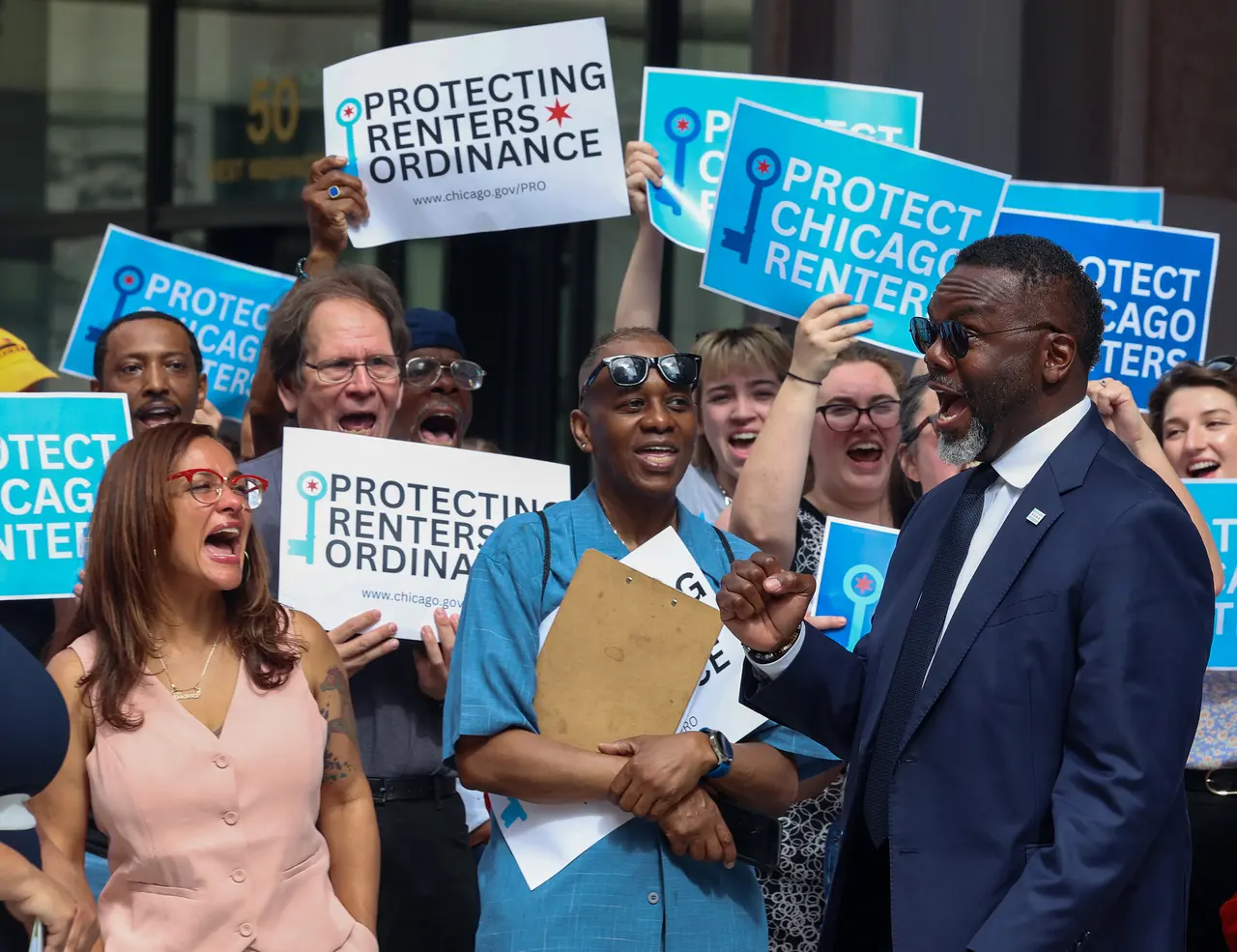
Chicago Mayor Brandon Johnson engages with the crowd during a press conference announcing the introduction of the Protecting Renters Ordinance at Daley Plaza on Monday, June 29, 2026, in Chicago.
Stacey Wescott/Chicago Tribune/TNS
CHICAGO — Mayor Brandon Johnson added pressure to aldermen Monday as they began to vet his plan to overhaul Chicago renters’ rights with changes like capped move-in fees and a rental registry.
Johnson pitched the plan as a way to strike back at corporate landlords who he blamed for soaring housing costs. His proposal won support from allies who argued it will empower renters and bolster stability, but opponents said it cracks down too hard on landlords and will ultimately force rents to rise.
“We’ve watched as rents continue to skyrocket, while faceless, unaccountable corporations continue to buy up homes and consolidate their influence,” Johnson said at an early-morning news conference. “We’re done watching. Chicago, housing is a human right, it cannot just be a rallying cry.”
The proposal — sure to be a high-stakes vote for aldermen who represent renter-majority wards in an election year — includes an array of major changes for landlords and renters.
The version Housing Committee aldermen debated in a no-vote hearing Monday would ban “junk fees” issued by landlords, create a new “Tenants Bill of Rights” and fund legal representation for tenants facing eviction.
It would also create a citywide rental registry that would require the disclosure of major building owners, many of whom remain hidden now through legal shell groups, and a new Bureau of Rental Housing Services tasked with enforcing tenants’ rights.
And it would create “just cause” protections requiring landlords to provide a valid reason if they seek to evict or even not renew a lease — and require them to pay as much as $5,000 or five months’ rent to help tenants move if they don’t.
But Johnson’s administration has made a key concession since the Tribune reported on a draft version of the proposal last month.
The mayor’s team removed a measure that would have forced landlords to pay 10 months’ rent or $10,000 — whichever is greater — when tenants move because of an “unconscionable rent increase” proposed by the landlord.
Johnson’s housing commissioner, Lissette Castañeda, said the change to the policy that landlord-aligned groups blasted as an attempt at rent control came amid conversations with rental industry groups.
“We listen to the feedback,” Castañeda told the Tribune. “I think that hopefully this more than anything points towards our willingness to ensure that feedback is taken seriously.”
The mayor’s decision to host an early-morning news conference before the committee meeting hinted at the political pressure building around the ordinance. According to Johnson’s administration, 54% of Chicagoans rent and nearly half of them are “rent-burdened,” meaning their rent takes up over 30% of their income.
For his part, Johnson pitched the proposal as an us-versus-them battle between renters and corporate landlords, acknowledging the stiff opposition landlord groups are organizing against it.
“Corporate interests are already mobilizing to defeat us and preserve the status quo, but we will not back down,” he said.
Groups including the Chicago Association of Realtors, Chicagoland Apartment Association and Neighborhood Building Owners Alliance continued to denounce the ordinance Monday in statements and during public comment at the meeting.
The proposal could worsen housing affordability, said Michael Mini, vice president of the apartment association.
“At a time when the city urgently needs more housing supply and investment, this proposal adds new penalties, mandates, administrative burdens, and legal exposure that will increase costs and discourage the development and operation of rental housing in Chicago,” Mini said.
After Johnson directly introduced the ordinance into the Housing Committee, a rare move designed to prevent opponents from delaying debate, aldermen now stand between the two opposing sides.
The mayor’s administration relied on an array of renter advocacy groups to make its pitch that aldermen must shift the power balance between renters and landlords.
“Growing numbers of out-of-state landlords target vulnerable communities, eviction rates have surpassed pre-pandemic highs and nonrefundable fees that would have been unthinkable just a few years ago are now common practice,” Johnson policy chief Jung Yoon told aldermen as the meeting began.
But several Johnson opponents argued the ordinance would place too large a burden on neighborhood landlords and should be reworked alongside them.
Northwest Side Ald. Gil Villegas, 36th, called the current ordinance a “political stunt,” even as he said that there is a housing crisis.
There has not been enough discussion with landlord-aligned groups, and the city has done too little to make other changes to address housing needs, like lowering the amount of time construction permitting takes, he said.
“This whole adversarial approach just really frustrates me. It’s always you guys putting us in a position where it’s, ‘You’re with these guys or that guy.’ No,” Villegas said. “Can we get to a point where we’re having a discussion and having everybody have a voice at the table?”
Ald. Anthony Quezada, 35th, said he was blocked from renewing a lease just a few years ago after holding his landlord accountable for not addressing issues. Such displacements are a key issue in his Northwest Side ward, he said.
The progressive first-term alderman appointed by Johnson said he rejects the idea that aldermen must choose between building housing and protecting renters.
“If we want people to stay in our neighborhoods, raise their families here and put down roots, then we have to make sure that they have both housing options and basic protections,” he said.
Ald. Pat Dowell, 3rd, argued the ordinance “requires more socialization” and urged Johnson’s team to slow its push for a vote.
When she questioned the tactic Johnson used to block other aldermen from delaying it, Yoon told her the atypical move had been made because the mayor’s office deemed the ordinance urgently needed amid a housing crisis.
“I think we’ve heard plenty of stories from tenants who can’t afford to wait,” Yoon said.
“That’s a bunch of junk,” Dowell said.
The committee’s chair, Ald. Byron Sigcho-Lopez, 25th, said after the meeting that he does not expect a vote to move forward this month. The Johnson ally added that a final vote could come in the fall.
_____