
Q&A: In 'Margo's Got Money Troubles,' they're a dysfunctional, ferociously loving family
LOS ANGELES — Somewhere in Los Angeles came a moment, in the early 2000s, where Michelle Pfeiffer and a toddler named Elle Fanning first crossed paths as screen partners in a story that explored matters of adulthood, parenthood and the value of love and family amid the chaos of life. Fanning was playing a younger version of her sister Dakota, then 7 years old, who was making her major feature ...
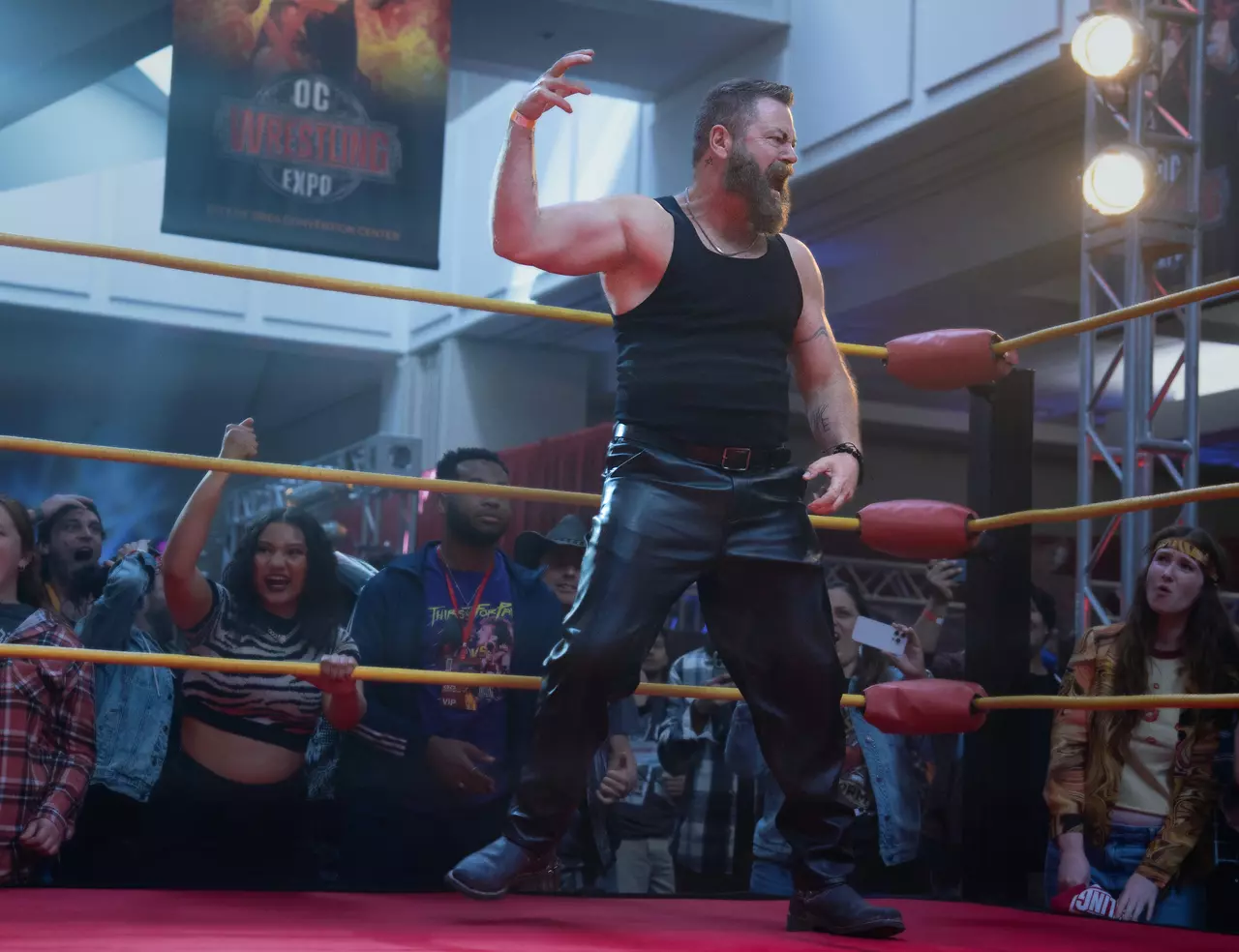
Nick Offerman’ s Jinx is a former wrestler and recovering addict who walks back into his daughter’ s life at a pivotal moment when she’ s in need of help.
Allyson Riggs/APPLE TV/TNS
LOS ANGELES — Somewhere in Los Angeles came a moment, in the early 2000s, where Michelle Pfeiffer and a toddler named Elle Fanning first crossed paths as screen partners in a story that explored matters of adulthood, parenthood and the value of love and family amid the chaos of life.
Fanning was playing a younger version of her sister Dakota, then 7 years old, who was making her major feature film debut as the daughter of a man with an intellectual disability, played by Sean Penn, fighting to secure custody of her in "I Am Sam." Pfeiffer portrayed the father's sharp-tongued lawyer.
A quarter-century later, they are starring in the new TV series "Margo's Got Money Troubles," an adaptation of Rufi Thorpe's 2024 novel that has them revisiting many of the themes, and others, that first brought them together.
Developed for TV by prolific producer David E. Kelley, the series, which premiered Wednesday on Apple TV with three episodes, stars Fanning as the titular character, Margo Millet, a recent college dropout and aspiring writer from a working-class background who, after becoming pregnant with her professor's baby and left to parent solo, is forced to figure out how to make ends meet and finds a financial lifeline as a creator for OnlyFans, the subscription-based platform made famous by adult content.
And in her first major television collaboration with husband Kelley, Pfeiffer portrays Margo's mother, Shyanne, an ex-Hooters waitress who raised Margo as a single mother and is trying to build a more stable life as she prepares to marry an Orange County youth minister (Greg Kinnear) — and while she isn't exactly thrilled by her daughter's life choices, like a mama bear, she'll slash you with her long fake nails in defense of her. Nick Offerman rounds out the complex family unit as Margo's estranged father, Jinx, a former pro wrestler fresh out of rehab who returns to her life in an attempt to right his wrongs.
"We all fell in love with Rufi's novel," Kelley says in a video call. "It had laughter, it had delight, it had pain, heartbreak — and at the center, it was this family. This family had a very dysfunctional way of loving, but they loved just the same, in a very ferocious way."
The Times spoke with the core parent-child trio in separate video calls — Pfeiffer and Fanning together from New York City, and Offerman beaming in from London — to talk about the series. These are some edited excerpts from that conversation.
Q: Both the book and the series take a very nuanced, unsensationalized approach to OnlyFans, sex work and expectations placed on mothers. There's a tendency to put mothers on a pedestal and we judge them harshly over every decision they make. What drew you to what the show was addressing?
Fanning: You talk about judgment, and I think that's something that all of these characters [deal with]; they're all messy and flawed ... they're all judged at first glance. The show really breaks down those boundaries, explores the deeper meaning and, hopefully will help people to not be so judgmental. The OnlyFans [element] is really interesting because I was aware of OnlyFans before we started, but it's just become more culturally talked about in a lot of different ways. Of course, there's a dark side to everything. But I think for Margo, it serves as this outlet for her. She's an aspiring writer and she thinks that she had to give up on that dream after she had her child and dropped out of college, and then OnlyFans becomes this opening in this space where she gets to create characters and write scenes and feel empowered in a way that she was not feeling empowered in her life. It's a place that she can get money and go earn income for her child, which is kind of this cycle because Shyanne did the same thing, she worked at Hooters, but she's quick to judge my character and that's where our relationship gets complicated and messy.
Q: To build on that, the show explores this idea of survival and how people are just trying to make the best of their situations. Nick, your character Jinx wasn't really in Margo's life but he's been in rehab and trying to turn his life around. What did he represent that was important to you?
Offerman: When I was a teenager, I worked on a blacktop crew in my hometown — blacktopping roads in the summer in cutoff jeans and drinking beer all days with a bunch of laborers, earning a man's wage to save money for theater school. But I immediately thought of them; what if one of those guys — which, I kind of feel like I was one of those guys — and I won the lottery? I'm a blacktop guy who ended up getting so much good fortune in life. I feel the same way about Jinx. He's just a guy who had the athletic attributes and the showmanship to rise to the top and become a star in the world of pro wrestling and, as so often happens with these blacktop guys, the reason a lot of them are there is because they have addiction problems and because life hasn't dealt them a full hand of winning cards. And whatever their failures are, that ends up being their ruling attribute to their poker game, as it were. That's where I went with Jinx.
Q: What research did you do for the role, Elle? It strikes me that Margo is selling a fantasy in the same way you do as an actor — it's wish fulfillment.
Fanning: We had an account made. When I've said, "Oh, I got an account," people think I made an OnlyFans account for myself. I did not do that myself. We had this account that we could log into. Also, you have to make purchases to see things, that was part of production for things like that. And Rico Nasty and Lindsey [Normington], who played KC and Rose in it, were also a real help to me.
Q: Michelle, this series has you collaborating with your husband, David.
Pfeiffer: I did "To Gillian on her 37th Birthday" [ a mid '90s film written by Kelley]. But that was years ago and it didn't really count. It was one day. I never really saw him on the set. It's not like we were avoiding working together, but we certainly weren't in a big hurry to work together. I just really cherish my marriage and didn't want to risk anything. Anyway, there was this book laying on the counter in the kitchen for a while. I'd walk by and would see it and say, "Oh, what's that?" And he'd say, "Oh, yeah, actually I think you'll like that. It's a fun read and there's a part that we all think you're the only person who can play it."
So I read it and fell in love with her. However, I was kind of like, "Really? How interesting that that is everyone's perspective of me." I feel like I've been waiting to play Shyanne my whole life. I know these women. Yes, she's from Fullerton. I'm from Orange County as well. I love her take-no-prisoners, unapologetic in every way [persona]. It was really wonderful to see the anticipation on everyone's face in the crew about what outfit I was going to show up in and what wild thing I was going to say.
Fanning: How much cleavage would be shown — the amount of the budget that went to chicken cutlets on this show and prosthetic boobs!
Q: Michelle, your character on "The Madison" is this affluent woman who is grieving the loss of her husband and life as she knew it. And here, your character is trying to build a more stable life but finds herself in the midst of a different type of grief over the life that could have been for her daughter. Who is Shyanne as you understand her?
Pfeiffer: It's so funny, I was just talking to a woman today about that — once you become a mother, it's like a constant state of grief. You grieve the baby, you grieve the toddler, then they go to college and you grieve them. This family is all grieving. They are all grieving the person they once thought they would be and grappling with the gulf between that and who they have become in order to provide for their children. You always want better for your child than what you had. And I think grieving the dreams, not only for myself [as Shyanne] — I think I've given up on those a long time ago — but I think now I'm grieving the dream I had for my daughter. It's really hard for her.
Q: Nick, you're known to learn new skills for the roles you take on. I imagine there was wrestling boot camp involved here?
Offerman: I used to be a fight choreographer at Chicago Theatre, so I have a lot of history of stage combat and I really love it. I always wanted to be a swashbuckling, sword-fighting Robin Hood. I generally always do my own stunts. There's a wonderful Hollywood wrestling guru these days named Chavo Guerrero. He did "Iron Claw." I did three weeks of training. I was 54 when we shot it. I did all my own wrestling. My favorite move was they would let me climb on the top rope and fly off the top rope and do this frog kick and land on my guy.
...