
Chicago Mayor Brandon Johnson downplays risk of being knocked off election ballot
CHICAGO — When Mayor Brandon Johnson’s nominating petitions were challenged a few weeks ago, his campaign brushed it off as a “distraction.” Now, with his signature review about a third of the way through, the incumbent mayor’s predicament has indeed become a spectacle. Objector Rickey Hendon, a former alderman and state senator and surrogate for four-time mayoral candidate Willie Wilson, is ...
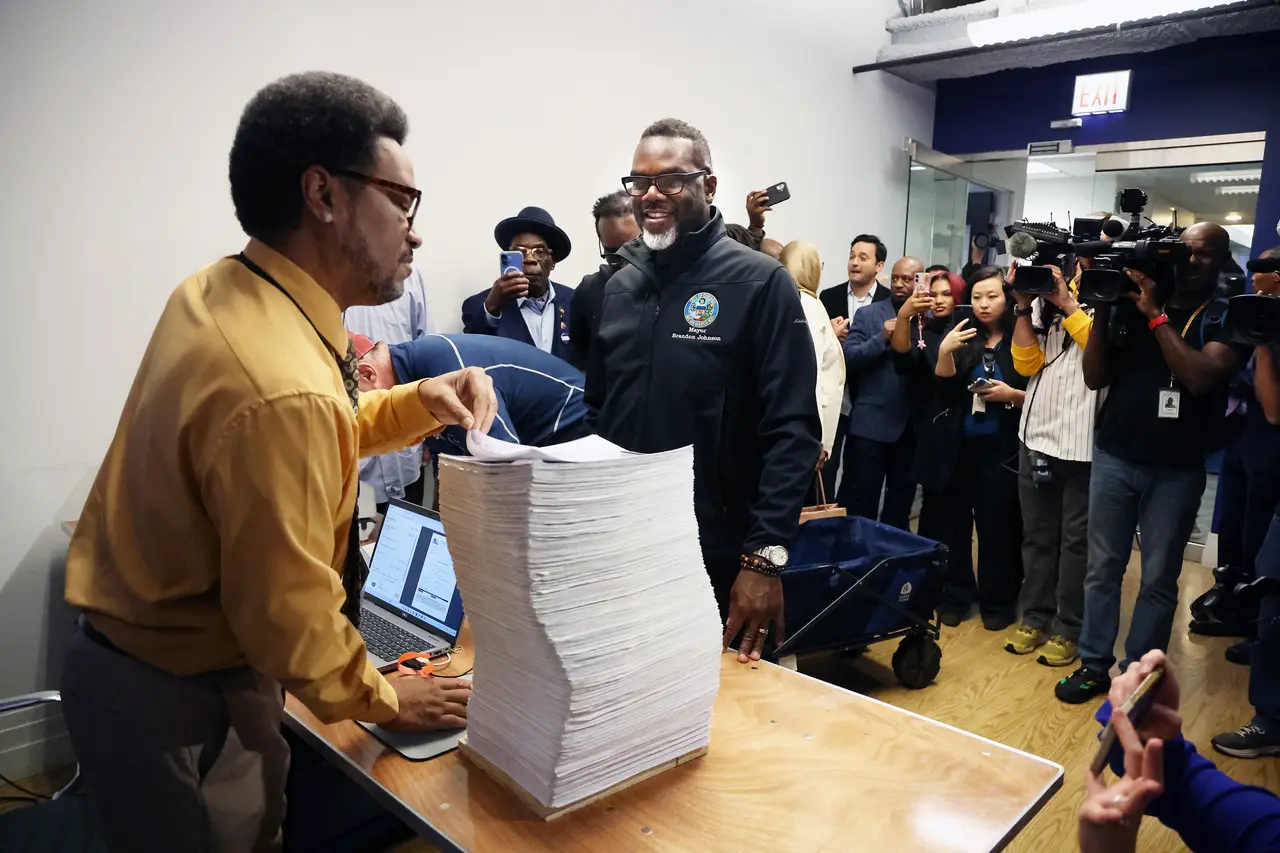
Chicago Board of Elections senior clerk Ralph Baker, left, helps Mayor Brandon Johnson file his election nominating petitions on Oct. 23, 2026, in Chicago.
Terrence Antonio James/Chicago Tribune/TNS
CHICAGO — When Mayor Brandon Johnson’s nominating petitions were challenged a few weeks ago, his campaign brushed it off as a “distraction.”
Now, with his signature review about a third of the way through, the incumbent mayor’s predicament has indeed become a spectacle. Objector Rickey Hendon, a former alderman and state senator and surrogate for four-time mayoral candidate Willie Wilson, is wasting no time playing up the ever-growing possibility that Johnson’s place on the February 2027 ballot is at risk.
Meanwhile, the libertarian-leaning think tank Illinois Policy Institute has also launched a “Will Brandon Johnson make the ballot?” website that tracks the daily outcomes of the signature objections, based on updates from local politico Frank Calabrese. It currently projects Johnson will just barely eke past the 12,500-signature minimum. Johnson’s petition challenge review is slated to finish in early December, with a final decision expected soon after.
The mayor, for his part, said he would not entertain the possibility of being knocked off the ballot at an unrelated news conference on Tuesday. He also shrugged off scrutiny over his nominating petitions being sloppy, though he said he welcomes changes to modernize the process.
“There are people who did a great service to make sure that we engaged with the residents of the city of Chicago around why I believe I should receive another four years,” Johnson said on his petition circulators. “If you go through anyone’s petitions, there’s a reason why politicians turn in double the amount and three times the amount of what’s required.”
Traditional political wisdom dictates that candidates should aim for at least three times the threshold to survive potential challenges. Johnson submitted over 31,000, of which Wilson’s campaign challenged more than 25,000. On top of that, Hendon is also alleging issues with the petition circulators, photocopied sheets and several pages from Chicago Treasurer Melissa Conyears-Ervin’s petitions ending up in Johnson’s batch.
As of Monday night, the Chicago Board of Elections sustained about 73% of the 17,448 objections to Johnson’s signatures that have already been processed — a higher rate than lesser-known candidates facing challenges, and one that has been growing as the review process continues.
It’s not unexpected for candidates to have some bad signatures among tens of thousands given the numerous ways objectors can protest them: signers not being registered to vote at the address they listed, potentially forged signatures, people signing more than one nominating petition or signees not being a Chicago resident.
Johnson listed some of those possibilities and downplayed their significance.
“Someone puts down their address, and they’re off by one number, or it’s hard to read the number because they’re collecting the signature and it’s cold and it’s raining,” Johnson said. “There’s just so many different circumstances that exist. That’s just a part of the process. Here’s what’s happening: There are individuals that know that they can get more political attention when they come after me. This does not make me unique. It just makes me the mayor.”
Johnson will also have a chance to cure some of those objections if his campaign can track down the signees or circulators and fix the issues.
But Hendon maintained in a phone interview Tuesday that “the evidence is damning,” and he expects Johnson’s signatures to get more problematic as the Board of Elections gets closer to the bottom of the pile.
“This is outrageous,” Hendon said. “I’m very confident because I believe that the Chicago Board of Elections is fair and honest and wants a fair and honest process. … We will prevail because the law is the law.”
Johnson, for his part, stuck to his usual progressive bona fides when pressed about the signature snafus.
“This election is going to come down to — and that’s what I’m going to focus on — who has the strongest record in standing up to Donald Trump,” Johnson said. “Who has delivered for working people? I have, and that’s what I’m going to run on, and I’m looking forward to getting reelected.”
_____