
New CIA task force on Cuba signals escalating US pressure for regime change
A newly created secret CIA task force targeting Cuba could be paving the way for military action or influence operations seeking regime change on the island and is a significant escalation in the Trump administration’s campaign to force political and economic change on the island, a former senior CIA official told the Miami Herald. Marc Polymeropoulos, a former CIA deputy chief for operations ...
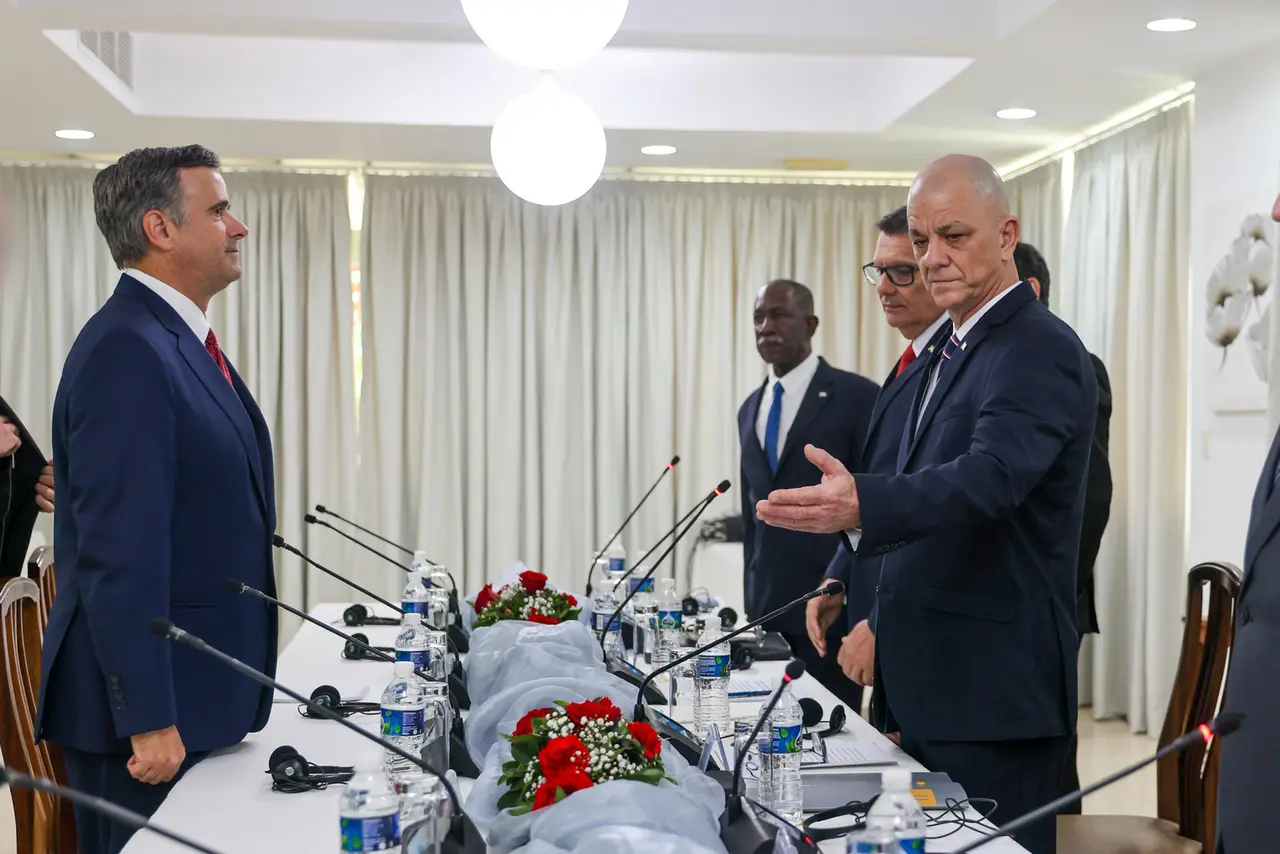
Ramón Romero Curbelo, the intelligence chief at the Cuban Interior Ministry, during a meeting with Cuban officials in Havana on May 14, 2026.
CIA/TNS/TNS
A newly created secret CIA task force targeting Cuba could be paving the way for military action or influence operations seeking regime change on the island and is a significant escalation in the Trump administration’s campaign to force political and economic change on the island, a former senior CIA official told the Miami Herald.
Marc Polymeropoulos, a former CIA deputy chief for operations in Europe and Eurasia, said the task force is likely “prepping the environment to do either military action or covert action, and covert action doesn’t mean a coup. It can mean influence operations.”
“You don’t put focus, you don’t put people and resources on an issue for nothing just to collect (intelligence) to write analytic papers. There’s a reason behind it,” he said. “I think it’s significant that they’re doing this.”
The existence of the task force was first reported by The New York Times. People briefed on the subject told the Times that the new unit is intended to let the agency move financial, human and technical resources against Cuba more quickly than before. Its goal, according to the Times’ sourcing, is to sow divisions inside Cuba’s political elite and pressure the government to replace hardline, anti-American officials with more pragmatic figures willing to negotiate with President Donald Trump.
The Trump administration has been in contact with Raúl Castro’s grandson, Raúl Guillermo Rodríguez Castro, and has sought to push out the country’s handpicked president, Miguel Díaz-Canel, who is seen as a hardliner. The Cuban government has announced economic reforms it has been stalling for years but has shown no inclination to make political changes.
According to the Times, the task force’s creation follows a broader policy shift: the Trump administration revised its National Intelligence Priorities Framework to reclassify Cuba as “Priority 1” — the top tier of the U.S. intelligence community’s ranking system, putting it in the same bracket as China, Russia and Iran.
The task force is reportedly staffing up with officers who specialize in recruiting informants, intelligence analysis, cyber operations and covert influence campaigns. Polymeropoulos said such units gather intelligence collected by different agencies in the U.S. intelligence community, including signals and human intelligence as well as satellite imagery and open-source information, to provide policymakers with options.
For several months now, U.S. military drones and surveillance aircraft have been spotted flying around Cuba in what are likely intelligence-gathering missions.
Growing pressure on Cuba
The reported task force emerges against a backdrop of mounting U.S. pressure on Havana that has intensified for much of the year with sanctions and a de facto oil blockade that has denied fuel to the Cuban government. Military planners at the Pentagon have also been developing options for strikes against Cuba.
Before Venezuela's strongman Nicolás Maduro was captured by U.S. forces, Trump had authorized covert actions in the South American country.
The CIA has already taken a key role in efforts to pressure Cuban leaders. CIA Director John Ratcliffe traveled to Havana in May to deliver a message from Trump laying out the changes the United States wants to see on the island.
Cuba is considered a hard target by the CIA — a place difficult to operate in and where officers have faced significant harassment. In late 2016, CIA officers stationed in Havana were among the first hit by the Havana Syndrome incidents that prompted the agency to close its station. The Biden administration reportedly reopened it in 2024.
Cuban intelligence and counterintelligence services, which were recently described by Secretary of State Marco Rubio as equal to those of a “superpower,” have a history of penetrating the U.S. government and running CIA-recruited assets as double agents.
The Times story followed earlier reporting by Politico, which found that the United States has quietly increased its intelligence presence in Cuba in recent months, deploying additional personnel and resources to the island. One person familiar with the administration’s plans told Politico that Cuba is “a huge priority” for Secretary of State Marco Rubio.
One person familiar with the intelligence buildup told Politico it “constitutes a tactical step” that could eventually pave the way for a military option. However, other officials stressed Washington intends to exhaust other tools first.
Orlando J. Perez, a political science professor at the University of North Texas at Dallas, shared his skepticism about the task force in a publication on X in which he argued it was “cheap signaling at a time Iran still consumes most of the attention” and “a reassurance to Miami diaspora that ‘everything’ is being done to topple regime” with no serious policy behind.
But Polymeropoulos said it is important to discriminate between “signals” of real action and media and political “noise.”
“Signal is when something actually happens, and I would put this task force in that category,” he said.
_____