
Dallas Stadium earns positive reviews from players after Netherlands-Japan World Cup bout
ARLINGTON, Texas — Three hours of what amounted to a joyous pre-match party crescendoed as Dutch and Japanese fans counted down the seconds to kickoff: 3 … 2 … 1. With a simultaneous roar and the referee’s whistle, the first World Cup game in North Texas in 31 years, 11 months and five days commenced Sunday afternoon in Dallas Stadium in Arlington. What 69,285 fans got was an action-packed and ...
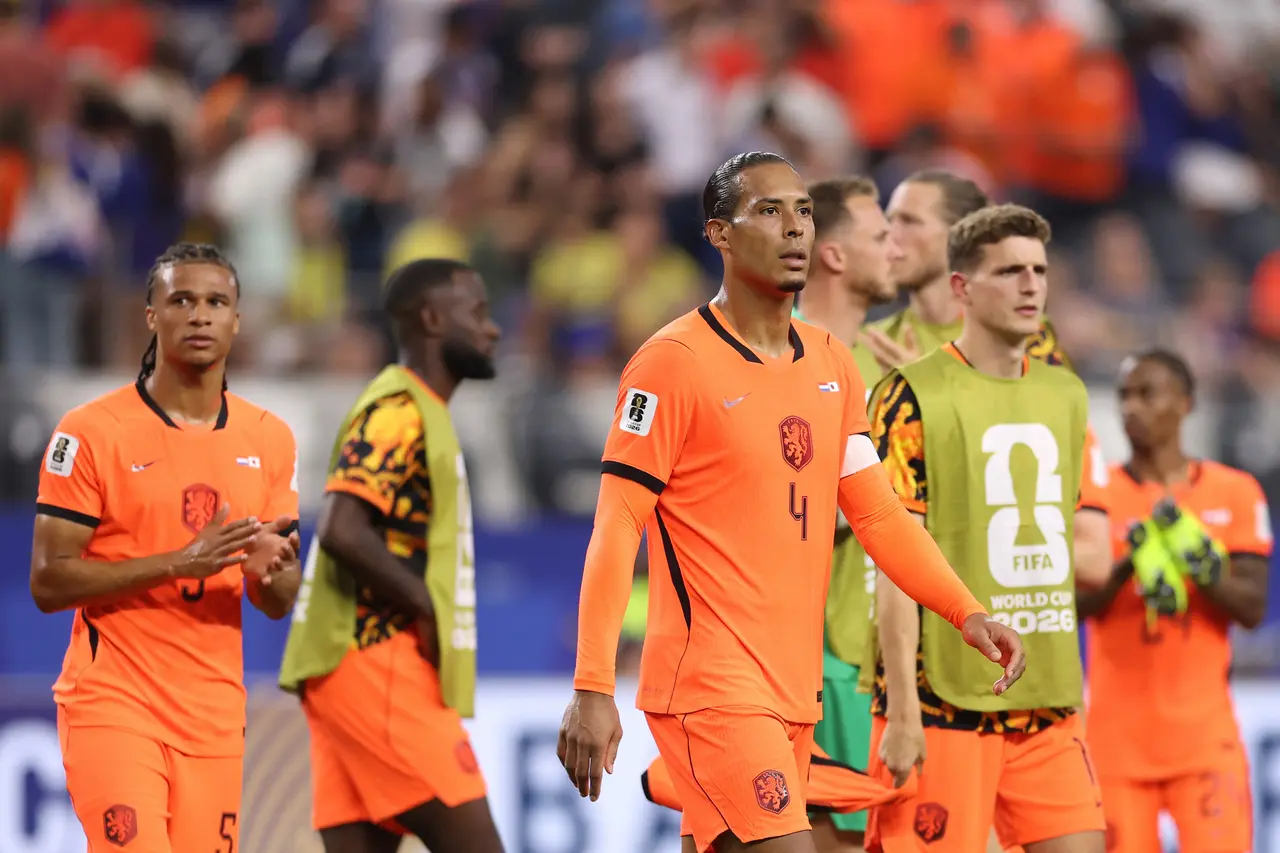
Virgil van Dijk of Netherlands reacts with teammates after the 2-2 draw during the FIFA World Cup 2026 Group F match between Netherlands and Japan at Dallas Stadium on Sunday, June 14, 2026, in Arlington, Texas.
Michael Steele/Getty Images North America/TNS
ARLINGTON, Texas — Three hours of what amounted to a joyous pre-match party crescendoed as Dutch and Japanese fans counted down the seconds to kickoff: 3 … 2 … 1.
With a simultaneous roar and the referee’s whistle, the first World Cup game in North Texas in 31 years, 11 months and five days commenced Sunday afternoon in Dallas Stadium in Arlington.
What 69,285 fans got was an action-packed and ultimately dramatic 2-2 tie— and somewhat of an upset — as No. 18 in the FIFA world rankings Japan got a goal in the 89th minute to earn the draw against No. 8 Netherlands to open Group F play.
“I think it was a great experience in the big stadium, good atmosphere,” said the Dutch captain, Virgil van Dijk, who scored the game’s first goal in the 51st minute. “Japan made a good atmosphere, as well, together with our fans.
“And, yeah, the pitch was fine.”
Stadium general manager Tod Martin and FIFA officials will take the last part of Van Dijk’s comment as a positive.
Due to FIFA sponsor restrictions, the Cowboys’ home since 2009 has been renamed Dallas Stadium during the one-month span in which the venue will host a World Cup-high nine matches, culminating with the July 14 semifinal game.
In past World Cups and other high-profile FIFA matches played in domed or roofed stadiums, the quality of the natural-grass pitch has been a focus. It’s a requirement that all 104 matches of this largest ever World Cup — 48 teams — be played on natural grass.
“It was good,” the Netherlands’ Crysencio Summerville said of the pitch. “Good stadium, good atmosphere. I love to play for many fans to let them enjoy, get out of their seats for me.”
Any Dutch fans who weren’t already standing jumped to their feet when Summerville gave The Netherlands a 2-1 lead with the 64th minute, his left-footed goal curled between two Japanese defenders, off the far post.
Although outnumbered by the bright orange-clad Dutch fans, Japan’s boisterous, blue-shirted Samurai Blue fans made their presence known throughout the afternoon — especially when Daichi Kamada’s equalizer in the 89th minute found the net.
The ball initially was headed by Koki Ogawa, then glanced off the head of Kamada, misdirecting it.
“In our meetings, we went into great detail about how we wanted to play, how we would adapt when substitutes came on, and even different match scenarios — what we would do if we were down 0-1, up 1-0, or if we ended up winning,” Kamada said. “We discussed all those fine details as a team, so I think everyone shared the same understanding and mind-set.”
It was on June 16, 2022, that North Texas learned it would be among the 16-city host sites across the United States, Canada and Mexico.
This 23rd quadrennial World Cup began last Thursday, but Dallas Stadium was among the last venues to experience its first match, heightening the suspense entering Sunday.
Dan Hunt is co-chair of North Texas’ World Cup organizing committee, a role his legendary father Lamar held during the 1994 World Cup, in which six matches were played in the Cotton Bowl.
“The beauty of the Dallas bid is it’s with our good friends, the [Jerry] Jones family,” Hunt said. “It has not been seamless, but it’s been a really incredible ride.”
The last World Cup game in North Texas before Sunday was a legendary one, eventual champion Brazil’s 3-2 victory over the Netherlands on July 9, 1994.
Many of Sunday’s players, as well as fans who packed the stadium Sunday, hadn’t been born when that game was played.
About 10 a.m. Sunday, the Netherlands’ famed bright orange-clad fans began massing on the large hill outside of Choctaw Stadium, former home of the Rangers.
Their number grew to an estimated 20,000 by the time they began their traditional Oranje Fanwalk, which on Sunday consisted of a half-mile walk to Dallas Stadium.
They chanted and sang and danced while on the Choctaw Stadium hill, and throughout their walk, and once inside Dallas Stadium. Perhaps they were somewhat cheered out by kickoff time, or perhaps the Japanese fans simply were louder while packed in the West end zone.
Especially during their drum-beating singing of “Vamos Nippon,” which Sunday’s onlookers heard so many times they’ll probably hear it in their sleep for several nights.
Dallas Stadium’s next game is Wednesday’s matchup of world No. 4 England against No. 11 Croatia. Then on June 22 comes No. 1 Argentina’s first of two straight matches here, against No. 24 Austria.
For the next month, FIFA’s head of pitch management for the Dallas Stadium matches, Ian Craig, will not take satisfaction in hearing positive reviews.
“I would probably ask you to ask me that question at the end of the tournament,” he said. “We’ll wait. We’ve got a lot of hard work still over the next month to make sure that this stays in condition throughout the tournament.”
____