
Column: For ‘Ferris Bueller’s Day Off’s’ 40th anniversary, we found the real Ferris Bueller
CHICAGO — Ferris Bueller is a lifelong Republican. He holds a conservative view of the U.S. Constitution. I know because we spoke the other day. Ferris Bueller was fun to talk to and extremely charming and, despite what the movie suggests, he was thoughtful. Ferris Bueller owns a sheep farm in the Hudson Valley of New York, and he produces his own maple syrup. He has also remained close to the ...
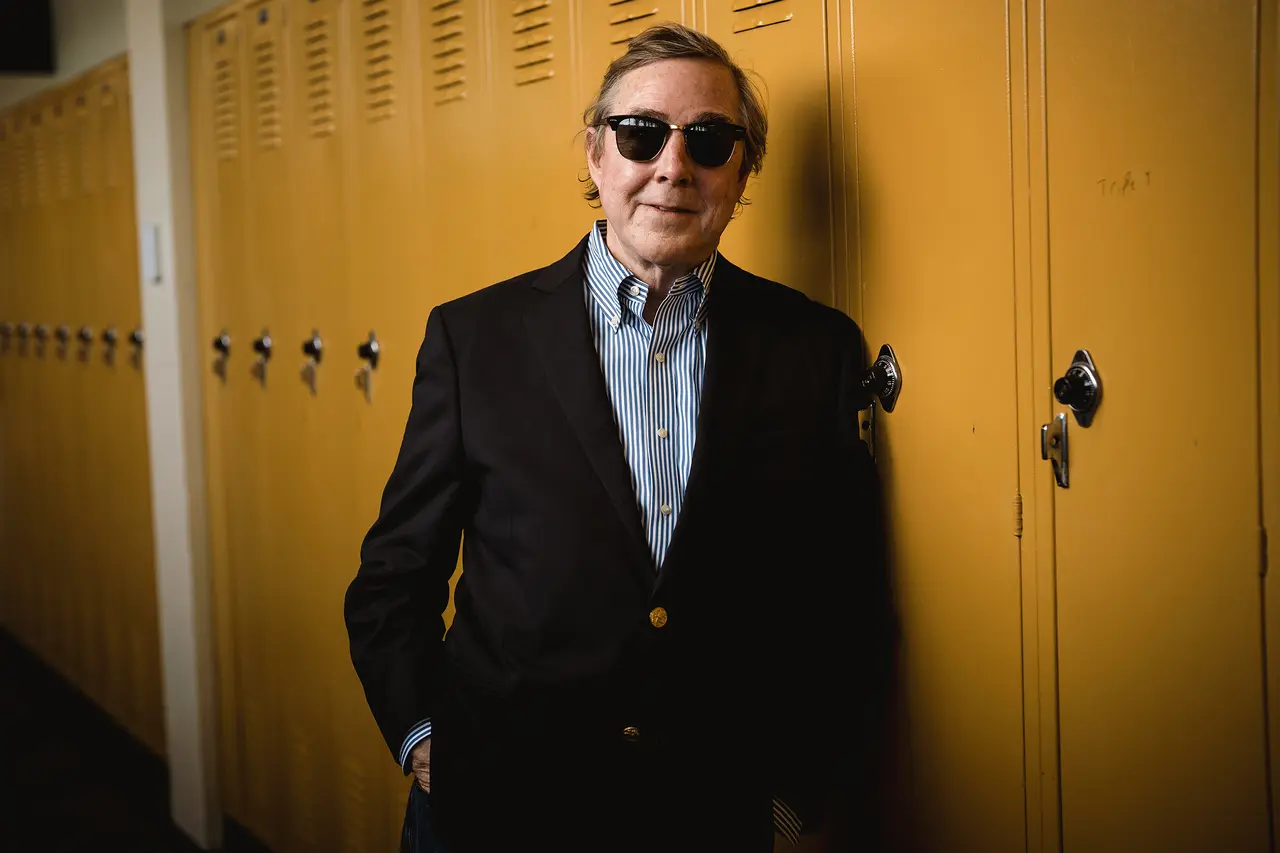
Ed McNally, a former student at Glenbrook North High School and the person that John Hughes most based the Ferris Bueller character on, is photographed at the school in Northbrook, Illinois, on May 28, 2026.
E. Jason Wambsgans/Chicago Tribune/TNS
CHICAGO — Ferris Bueller is a lifelong Republican.
He holds a conservative view of the U.S. Constitution. I know because we spoke the other day. Ferris Bueller was fun to talk to and extremely charming and, despite what the movie suggests, he was thoughtful. Ferris Bueller owns a sheep farm in the Hudson Valley of New York, and he produces his own maple syrup. He has also remained close to the major seats of power in this country for several decades. He served on the transition team during Donald Trump’s first term and worked with Brett Kavanaugh for George W. Bush, he wrote speeches for George H.W. Bush and represented — Ferris Bueller being a trial lawyer now — George Ryan, the former governor of Illinois.
Ferris Bueller didn’t want to talk politics, though.
He said John Hughes (a rare Hollywood Republican conservative) didn’t make political films.
None of which is why I have such mixed feelings about Ferris Bueller, as in the fictional character played by Matthew Broderick, the rascally folk hero of “Ferris Bueller’s Day Off,” which premiered 40 years ago this June and since become a Chicago touchstone.
Still, I was uneasy explaining my ambivalence to Ed McNally.
See, McNally IS Ferris Bueller.
Or rather, he very probably is. Director John Hughes never said flatly that McNally was the basis for the Ferris Bueller character, but McNally believes he was at least a major component in a thinly veiled composite, and frankly, the evidence is compelling. McNally and Hughes grew up on the same street and attended Glenbrook North High School together. McNally’s best friend back then was a kid named A.C. Buehler, though it was McNally who had such a talent for skipping class that Glenbrook’s principal launched a crusade to catch him. In the film, Ferris skips nine days of school. McNally skipped 27 days. On one of those days off, he “borrowed” his father’s prized possession — a purple Cadillac — and put 113 miles on it, then, as the fictional Ferris does with a red Ferrari, McNally lifted the car onto jacks and ran it backwards, hoping to reverse the odometer.
So, how is Ferris Bueller… er, uh, Ed McNally, 40 years later?
“My life, on certain levels, turned out about the way you might think Ferris’ life would turn out,” he said.
McNally went from almost a month of skipping classes and the wrath of the Glenbrook administration to Yale University, the University of Notre Dame and the London School of Economics. Then he was suspended a year from Yale because of his talent for pranking — including stealing several prized possessions of Harvard and planting a totally fake story about a Yale kite-flying team in the New York Times. A decade later, as a traveling scholar in China, while riding in a motorcycle sidecar, he was arrested with John Burns, the Times’ Beijing bureau chief, accused of espionage and expelled from the country.
“On some level, it all kind of tracks,” McNally said. “It’s about what you’d expect of Ferris. Like the movie, I guess it’s been a mixed bag of the consequences of exuberance.”
He later became an assistant attorney in the Southern District of New York; and George W. Bush’s first general counsel for Homeland Security; he’s now a law partner at the Manhattan-based firm Kasowitz, which has represented Trump and conservative commentator Bill O’Reilly.
Frankly, I can’t help but think of Tracy Flick, the overachieving anti-heroine of “Election” (1999), played by Reese Witherspoon as an intense, rule-bound Ferris. She spends much of the film certain of her place in the high-school meritocracy, and a thorn in the side of her teacher, played (serendipitously enough) by Matthew Broderick. But in the final minutes, we see her in Washington, years later. Broderick’s character is attending an educator’s conference and happens to spot Tracy getting into a politician’s limo. As he narrates, he remembers her relentlessness, he feels sorry she let ambition rule her life, but soon that annoyance veers into jealousy, his voice rises: Where is she going, why is she in a limo — “and who the (expletive) does she think she is?” He throws his drink at the car window, panics and runs off. Faced with the Ferrises of the world, all we can do is rage.
Indeed, Jeanie, Ferris’ sister (played by Jennifer Grey), expresses this very same irritation with her brother, blurting: “Why should he get to do whatever he wants, whenever he wants? And why should everything work out for him? What makes him so (expletive) special?”
Eventually, everyone gives in to his charms.
Even Cameron (Alan Ruck), Ferris’ best friend, who’s domineered by Ferris from the start, who should seethe with righteous anger by the end of the film, says: “It is possible to stop Mr. Ferris Bueller.” Then he takes the fall for Ferris Bueller.
All of which is why I want to build a case against Ferris, why I think Chicago should move on, rethink Ferris and stop shouting “BATTER, BATTER, BATTER SWING BATTER” at Wrigley Field in honor of Ferris and his pals and their day off. But I’ll be generous here and say, in a world now run by Ferrises, at least the kid believed in something. Everyone knows: “Life moves pretty fast. If you don’t stop and look around once in a while, you could miss it.” It’s been a senior quote in generations of yearbooks.
Everyone’s knows the basic plot, in so much as there is one: Ferris fakes a cold, convinces his mom and stays home from school; talks his best friend Cameron into stealing his father’s Ferrari; jailbreaks girlfriend Sloane (Mia Sara) from class; then everyone spends a day as Chicago tourists (Sears Tower, Wrigley Field, Art Institute of Chicago, the Loop), discussing their distracted parents and futures and sidestepping trouble, including the humorless principal Ed Rooney (Jeffrey Jones).
McNally, though, sees more, a broader Tao of Ferris.
He can imagine both the prosecution, and the defense, of Ferris.
He says he’s used Ferris’ outlook on life “every single day.” One line in particular hits hard: “You realize if we played by the rules right now, we’d be in gym?” “That is a lesson that should be part of everyone’s day,” McNally said. “Sure, you have to work for a living, and sure, you have to pay taxes, but if you’re lucky enough to have a backyard to BBQ or a hill to ski down somewhere, do it — our lives are filled with gym classes to avoid.” He also sees a recognition that “your situation doesn’t have to be what it appears.” He said, “It’s what I do for a living. I defend a lot of CEOs and politicians facing serious consequences, and my job is not only to protect and defend them but to help them see beyond their current situations. I will have CEOs crying in my office, and they think the world has come to an end.” He wants them to picture a different outcome.
On the other hand, Ferris Bueller, he agrees, is irresponsible.
“You goad a friend into stealing a prized car, you drive it recklessly, then you cause it to be ultimately damaged beyond recognition — which would have been catastrophic for Cameron and his family. And what happens to Ferris? Nothing. Which always felt a little too easy.”
Therefore, my case against “Ferris Bueller’s Day Off” is such:
No. 1: We need to stop thinking of the character Ferris Bueller as a hero, a spontaneous defender of freedom and Chicago, but as the entitled sociopath he proves himself to be. Despite a therapeutic motto about life moving fast and needing to stop and look around or miss it, he avoids introspection himself.
...