
Meet the 20 new MacArthur Fellows, the ‘genius grant’ winners of 2026
CHICAGO — On Tuesday morning, as has been happening annually since 1981, a small number of people have had their lives changed. This year, there are 20 of them, a group that has been formally announced as recipients of the 2026 MacArthur Fellowships, those so-called “genius grants.” Spread across the globe, these people will be receiving monetary awards of $800,000, paid out in annual ...
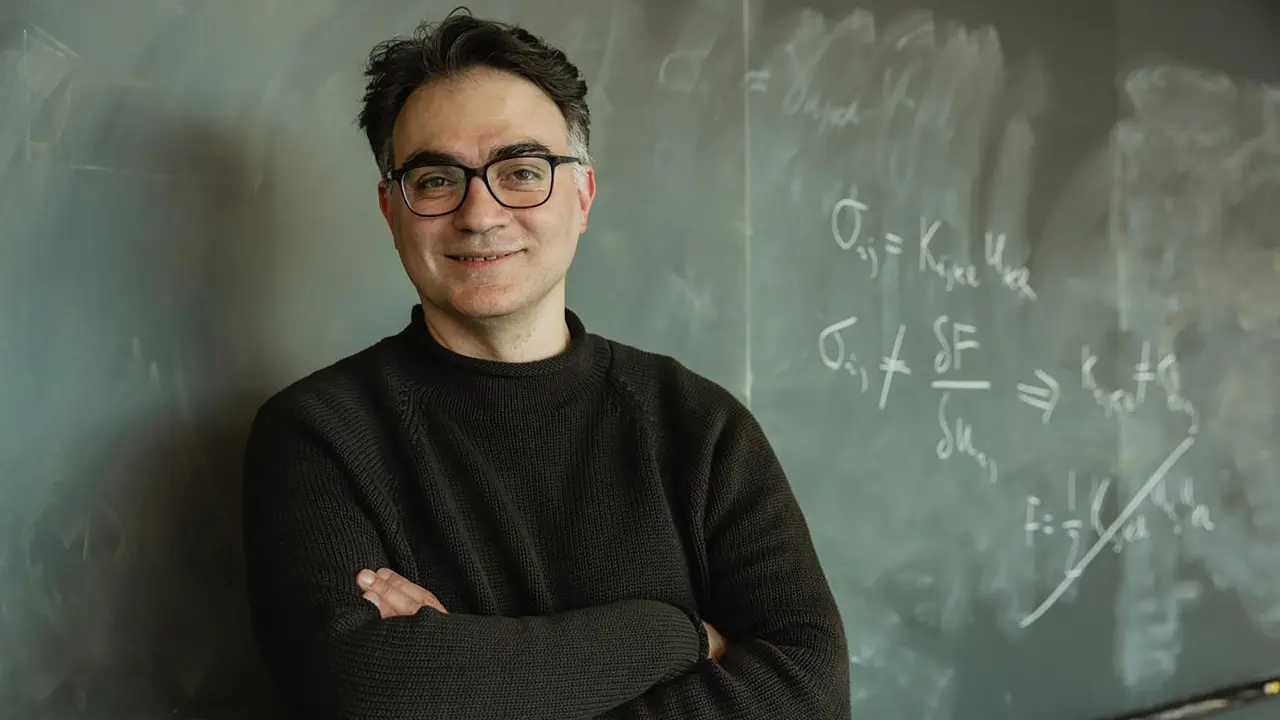
Vincenzo Vitelli is a professor in the Department of Physics at the University of Chicago and a recipient of a 2026 MacArthur Fellowship.
UC PRESS RELEASE/TNS
CHICAGO — On Tuesday morning, as has been happening annually since 1981, a small number of people have had their lives changed. This year, there are 20 of them, a group that has been formally announced as recipients of the 2026 MacArthur Fellowships, those so-called “genius grants.”
Spread across the globe, these people will be receiving monetary awards of $800,000, paid out in annual installments of $160,000 over five years. Candidates are nominated by outside sources. “Nominees are suggested by a constantly changing pool of invited external nominators,” according to the Chicago-based MacArthur Foundation, “chosen from as broad a range of fields and areas of interest as possible.”
The foundation further informs us that a “fellowship is not a reward for past accomplishment, but rather an investment in a person’s originality, insight and potential.” Naturally, the foundation hopes that its money will be used by recipients for the financial freedom that might allow them to pursue their most innovative ideas and, in so doing, enrich the planet.
Vincenzo Vitelli is a 48-year-old theoretical physicist at the University of Chicago. According to the MacArthur Foundation, “his work has led to major advances in diverse fields such as metamaterials, information physics, liquid crystals, spin glasses, and the modeling of complex systems — both biological and non-biological, and far from equilibrium.”
That’s a bit above my head, and I told Vitelli so when we connected via Zoom on Sunday from Paris, where he is spending a few months at the CNRS (Centre National de la Recherche Scientifique), France’s state-funded public research organization and the largest fundamental research agency in Europe.
He is with his wife, Leontine van Cleef, and their first child, the 5-month old Felix who was born in Chicago. In conversation, he was warm and friendly, talking about his affection for Chicago, Paris and Italy.
He is naturally delighted by honor, though when first informed by telephone “I thought it was a prank, a joke. Of course it is very exciting for me and for my family, though it will be some years before Felix is able to understand.”
Vitelli was raised in the ancient southern Italian city of Matera, the son of Franco Vitelli, a literary critic, and mother Caterina, was a school teacher who wrote for the local newspapers.
His father often took business trips to Milan, and always returned from those trips with books for Vincenzo. “Most of them were books for children,” he told me. “They gave me my first exposure to the outside world and one of them really introduced me to what would become my academic passion. It was called ‘The Great Book of Science.”
In high school, he loved math and, during a summer in England, learned English. He obtained a bachelor’s degree in theoretical physics from Imperial College London in 2000 and a doctorate in physics from Harvard University in 2006.
He was a professor in the Institute Lorentz for theoretical physics in Leiden University in the Netherlands, which is where he met his wife. He came here in 2017 to become a professor at the University of Chicago. Van Cleef earned a master’s degree in architecture, specializing in interior architecture, at the School of the Art Institute of Chicago.
The family will return to Chicago in December and settle back into their South Loop home. He has yet to make plans for the MacArthur money but he does say that “there are some ideas I would like to pursue and I am sure we will use some of it on Felix.”
The 2026 MacArthur Fellows
The other members of the 2026 class of MacArthur Fellows, in alphabetical order, as announced by the MacArthur Foundation:
Holly Jean Buck, University of Buffalo in New York (45): Sociologist investigating the social, ethical and political dimensions of climate and energy policies and emerging technologies.
Felipe De Brigard, Duke University in North Carolina (47): Philosopher and cognitive scientist interested in the nature and function of memory and its relationship to imagination.
Ellora Derenoncourt, Princeton University in New Jersey (39): Labor economist and economic historian investigating racial disparities in wealth and income mobility in the United States.
Elizabeth Ellis, Princeton University in New Jersey (38): Historian researching politics, diplomacy and conceptions of sovereignty among small Indigenous nations in early North America.
Kaiyu Guan, University of Illinois in Urbana-Champaign (41): Environmental scientist working to improve agricultural ecosystems’ productivity, resilience and sustainability.
Trajal Harrell, Zürich Dance Ensemble in Switzerland (age not provided): Choreographer and dancer who works in different dance traditions and creates works rooted in art and dance history.
Marika Holland, National Center for Atmospheric Research in Boulder, Colorado (58): Climate scientist investigating the interplay of polar sea ice and the global climate.
Christine Sun Kim, Berlin (46): Artist exploring the political, cultural, and multi-sensory dimensions of sound, spoken language, and communication.
Song Lin, Stanford University in California (40): Organic chemist designing electrochemical methods for the construction of complex organic molecules.
Layli Long Soldier, Santa Fe, New Mexico (54): Poet working with Native American histories and the celebration of kinship, strength and creativity.
Rodney McMillian, University of California in Los Angeles (57): Artist exploring how history and socioeconomic conditions determine experience and belonging in the United States.
Maaza Mengiste, Wesleyan University in Middletown, Connecticut (55): Fiction writer whose work focuses on the human costs of political violence.
Ariel Ron, Southern Methodist University in Dallas (48): Historian uncovering the role of Northern agriculture in economic growth and the expansion of federal power in 19th century America.
Kate Spradley, Texas State University in San Marcos, Texas (53): Forensic anthropologist enabling identification and repatriation of the remains of migrants who have died along the Texas-Mexico border.
Chip Thomas, Flagstaff, Arizona (69): Artist who transforms overlooked spaces into public works grounded in community histories.
Vincent Valdez, Houston and San Antonio (49): Visual artist depicting historical and present-day scenes to reflect the contemporary United States.
Bryan Washington, Tokyo (33): Fiction writer who writes about relationships in stories shaped by place, memory and rituals of daily care.
Immanuel Wilkens, Brooklyn, New York (29): Saxophonist and composer blending traditional jazz motifs with modern music in works that reflect on historical events.
Liangfang Zhang, University of California in San Diego (46): Chemical engineer and bioengineer creating nanotechnologies for targeted drug delivery, vaccines and other biomedical applications.