
Maryland is spending big on horse racing. But the competition is changing.
BALTIMORE — As Belmont Park reopens after a $555 million transformation, Maryland is in the midst of its own ambitious — and costly — effort to secure a future for horse racing in Baltimore. The state is spending about $400 million to build a new Pimlico Race Course and another $120 million to transform Laurel Park into a year-round training center. It also paid $85 million this summer to ...
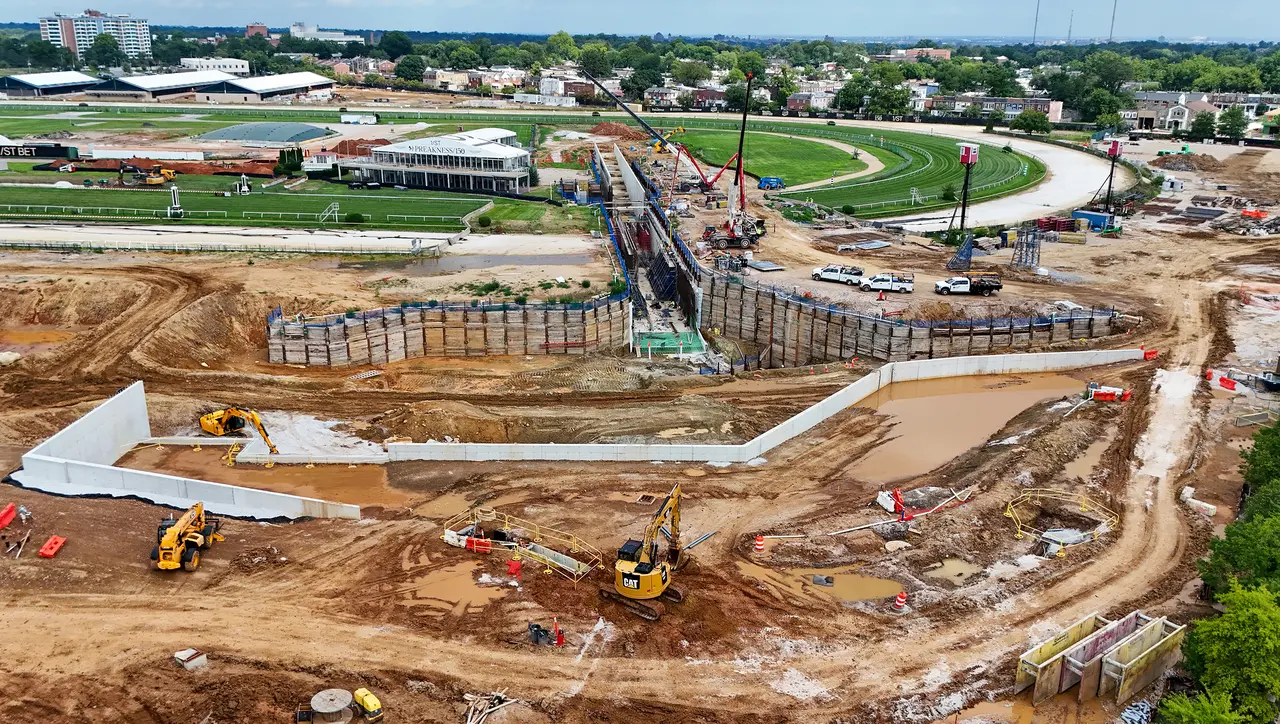
Construction crews continue work at Pimlico Race Course, home of the Preakness Stakes, as preparations and upgrades move forward at the historic Baltimore track.
Kevin Richardson/Baltimore Sun/TNS
BALTIMORE — As Belmont Park reopens after a $555 million transformation, Maryland is in the midst of its own ambitious — and costly — effort to secure a future for horse racing in Baltimore.
The state is spending about $400 million to build a new Pimlico Race Course and another $120 million to transform Laurel Park into a year-round training center. It also paid $85 million this summer to retain the intellectual property rights to the Preakness Stakes and Black-Eyed Susan Stakes after Churchill Downs sought to acquire them.
The timing is significant. As Maryland rebuilds Pimlico and reworks the Preakness, some of the biggest names in American racing are making their own moves to strengthen their positions.
Belmont Park is reopening after more than three years of construction with a new five-story, 1.25-million-square-foot facility. It comes as the New York Racing Association and Churchill Downs join forces on a new national Thoroughbred Championship Series that will begin in 2027. Pimlico is excluded from the competition.
That puts Maryland in an unusual position: The state is making one of the largest investments in its racing history while its signature race is outside an effort designed to connect the nation’s most prominent 3-year-old races into a season-long competition.
Thomas Rhoads, a Towson University economics and sports business professor, cautions against viewing the spending simply as an arms race among racetracks. In Maryland, he told The Baltimore Sun, the investment is aimed at maintaining the state’s position in the industry while protecting a broader horse-racing ecosystem that includes farms and training facilities in addition to racetracks and betting.
“All the spending at Belmont and Pimlico and Laurel Park is, in some sense, simply to maintain the status as a premier brand in horse racing,” Rhoads said.
Maryland’s investment, he said, “can partly be interpreted as an attempt to keep the entire industry in Maryland.”
The competition that faces horse racing has also changed significantly over the past decade, especially with the expansion of online sports betting, which has created another competitor for gambling dollars, Rhoads said.
“Online sports betting across the U.S. means there’s more competition for betting dollars and the horse racing industry must stay competitive in that market,” Rhoads said.
Frank Vespe, founder and publisher of TheRacingBiz.com, told The Sun that modern spectators expect more from venues, particularly those hosting major events such as the Preakness and Belmont Stakes. The racetracks hosting those events were aging and needed upgrades as the economics of horse racing changed, he said in an email.
“So I see this less as a de facto arms race and more as a rational response to a set of problems facing the racetrack operators,” Vespe said.
The six-race Thoroughbred Championship Series will include the Kentucky Derby, Belmont Stakes, Matt Winn Stakes, Jim Dandy Stakes, Travers Stakes and a championship race at Churchill Downs.
While being left out, Maryland officials are trying to chart a different path for the Preakness. The 152nd running is scheduled for Sunday, May 23, 2027, at the rebuilt Pimlico, eight days later than the race’s traditional spot on the third Saturday in May. The Black-Eyed Susan will move from Friday to Saturday, creating a two-day festival that will culminate with the Preakness.
Maryland officials said the schedule change is designed to give horses coming out of the Kentucky Derby an additional week to recover while creating a larger Memorial Day weekend destination in Baltimore.
It’s part of an effort to make the Preakness more attractive at a time when the sport is competing for the attention of fans, owners and the nation’s top horses.
“We acknowledge the great history of this race, especially the Preakness being two weeks after the Derby,” Bill Knauf, president and general manager of the Maryland Jockey Club, said. “But we recognize that change should always be examined. Other professional sports constantly reevaluate the rules, and now is the time for change.”
But the challenge for Maryland extends beyond the race’s date.
The state has committed hundreds of millions of dollars to create facilities capable of supporting racing for decades, while other racing jurisdictions are also investing heavily in their tracks and major events.
Belmont’s reopening is the latest example. The track will initially operate at a capacity of 6,000 during opening weekend and 4,000 afterward as construction continues. Eventually, more portions of the building will reopen and capacity will increase.
Maryland’s bet is different.
The state is betting that a rebuilt Pimlico, a modernized racing operation at Laurel, which is hosting its 2026 fall meet through Dec. 27, can keep Baltimore at the center of the sport even as the national racing calendar evolves.
The state says the racing industry supports more than 28,000 Maryland jobs and generates roughly $3 billion in economic activity annually.
Vespe said the investment is necessary for Maryland’s horse racing industry. Its success, he said, will depend on whether the spending strengthens the industry and, at Pimlico, encourages investment in surrounding neighborhoods.
“The initiative will be a success if the Maryland Jockey Club is able to build interest in the product among bettors and fans, maintain a robust year-round racing schedule for horsemen, and play a role in the economic growth of the Park Heights neighborhood,” he said.
Still, the Preakness needs the nation’s best 3-year-old horses. It needs television audiences and sponsors. And it needs to remain an event that fans around the country care about, as the Triple Crown leaves Preakness behind and evolves into the Thoroughbred Championship Series.
That is the competition Maryland has entered.