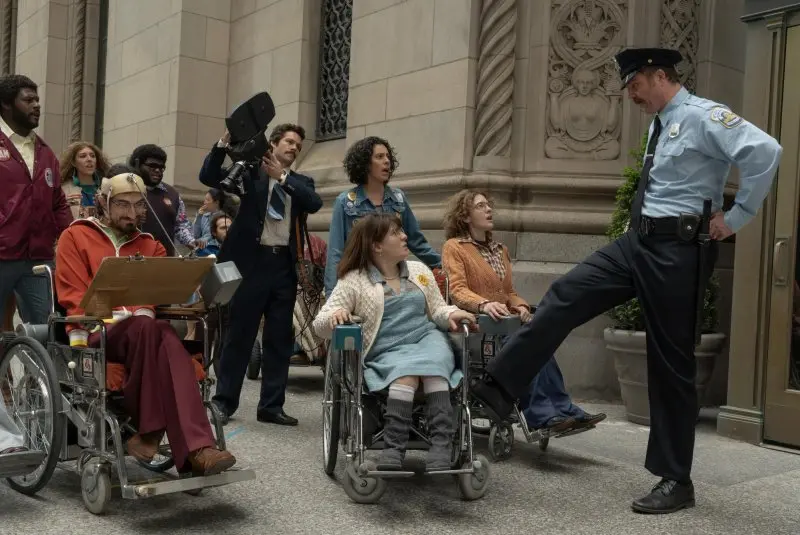

"Being Heumann," in theaters Friday, celebrates the activism of Judy Heumann (Ruth Madelay) who led disability activists in the '70s and beyond.

From left, Andrew Pilkington, Siena Rafter, Charlie Rush-Reese, Dylan O’Brien, Roberta Colindrez, Ruth Madeley and Madeline Delp face police in "Being Heumann," in theaters Friday. Photo courtesy of Apple TV+ UPI From left, Michael Patrick Thornton, Andrew Pilkington, Rein Barcel, Ruth Madeley, Rio Finnegan, Antwan Tolliver, Roberta Colindrez, Ray Fisher and D’Arcee Charington Neal star in "Being Heumann," in theaters Friday. Photo courtesy of Apple TV+ UPI Joseph Califano (Mark Ruffalo) addresses protestors in "Being Heumann," in theaters Friday. Photo courtesy of Apple TV+ UPI Siân Heder (R) directs Ruth Madeley in "Being Heumann," in theaters Friday. Photo courtesy of Apple TV+ UPI Ruth Madeley plays Judy Heumann in "Being Heumann," in theaters Friday. Photo courtesy of Apple TV+ UPI
LOS ANGELES, Nov. 2 (UPI) -- Being Heumann, in theaters Friday and Apple TV+ Nov. 13, is an important monument to political advocates so their hard fought struggles are not forgotten. It also shows how such struggles can form a fun community.
In 1977, the Rehabilitation Act had been passed for five years but remained unsigned. Section 504 was the clause that mandated accessible accommodations for the disabled like wheelchair ramps, curb ramps and interpreters for the deaf.
Judy Heumann (Ruth Madeley) led a protest outside the San Francisco office of Health, Education and Welfare that became a sit-in. Her goal is to get the attention of HEW Secretary Joseph Califano (Mark Ruffalo) to sign the regulation.
Califano and his staff don't even know what the regulation is at first, even though it is under their jurisdiction, let alone what it entails for the lives of disabled people. What is most unconscionable is the pride they seem to take in refusing to learn.
...
Politicians continue legislating in ignorance unless their constituents become impossible to ignore. Being Heumann shows how we can force our leaders to learn their own jobs.
Movements like Civil Rights. Women's Suffrage and LGBTQ rights utilized similar tactics to change the status quo. It requires tenacity and creativity.
It is inspiring to watch the protestors lay boards over steps so wheelchair users can get inside, then turn office furniture into makeshift camps and remodel bathroom stalls to make them accessible. The government tries to starve them out or intimidate them with police inspections.
The protestors keep finding workarounds and there is a delicious irony that the police fail to arrest anybody because they neither have vehicles large enough for wheelchairs nor cells capable of holding someone in a wheelchair.
But just showing how exhausting the work is might only dissuade people from engaging. Being Heumann depicts the day-to-day rewards of that struggle too.
Just being with comrades forms a community. Furthermore, being the '70s, they also find ways to party and couple up. Hard work also bonds those who engage together.
Showing how sexually active and desirable the characters are is monumental just because of how unfortunately rare it is to see in movies. They also hold sexual education classes to teach wheelchair users what they can accomplish in a chair.
Director Siân Heder, with writer Rebekah Taussig, adapting Heumann's autobiography, capture the diversity of disabled people with over 50 speaking roles. Hale Zukas (Andrew Pilkington) is quadriplegic and speechless, so uses a pointer attached to his forehead to spell words and sentences on a board to communicate.
...
Ed Roberts (Michael Patrick Thornton) is also quadriplegic but sleeps in an iron lung so cannot stay overnight. He finds other ways to help from the outside of the building.
Kitty Cone (Madeline Delp) is Heumann's closest assistant but much more shy than Heumann, so does more of the invisible labor coordinating food and bathing. Brad Lomax (Antwan Tolliver) is recently in a wheelchair due to Multiple Sclerosis.
The movement also learns to include other disabilities. The blind have concerns about lowering curbs for wheelchair access, and deaf people have different needs than others. Gay protestors raise concerns about working with other advocacy groups who have shown homophobic views.
There are deaf interpreters among the protestors like Lynette (Siena Rafter), who has to learn how to sign big words like "legislation." Dennis (Charlie Rush-Reese) is blind and at 18 has never been allowed in schools that refuse to accommodate him.
Apologies to the 40+ other wonderful performances who did not get personal shout outs in this review. You all contribute invaluably to this film.
With all of her fiery speeches, including recreations of many on the record, Heuman is also shown to be abrasive and challenging, even to her allies. She sprung the sit-in on the protesters, though she had planned to escalate the event.
She does have to motivate the protestors when they get discouraged. She reminds them that accommodations like ramps and readers for the blind are possible, and they should not feel guilty for requesting basic assistance to participate in society.
...
Of course, tensions rise as the sit-in approaches two weeks (out of a total of 20 days). Heumann's single-minded focus sometimes neglects her friends and partners' needs, so she learns how to make room for them too.
Being Heumann never loses its sense of humor throughout all the hardships the characters face. Much of the humor is found in the politicians' frustrations that their boilerplate nonanswer won't satisfy people with actual needs.
Califano keeps bringing up the $2.4 billion Section 504 will cost, which is not insignificant. But it was already voted in. That means they have to allocate for it.
Disability was not the first or even the most recent movement for rights that should automatically be afforded human beings. Until the day the world respects everyone equally without a fight, movies like Being Heumann can empower us to demand progress.
Being Heumann will stream on Apple TV+ Nov. 13
Fred Topel, who attended film school at Ithaca College, is a UPI entertainment writer based in Los Angeles. He has been a professional film critic since 1999, a Rotten Tomatoes critic since 2001, and a member of the Television Critics Association since 2012 and the Critics Choice Association since 2023. Read more of his work in Entertainment.