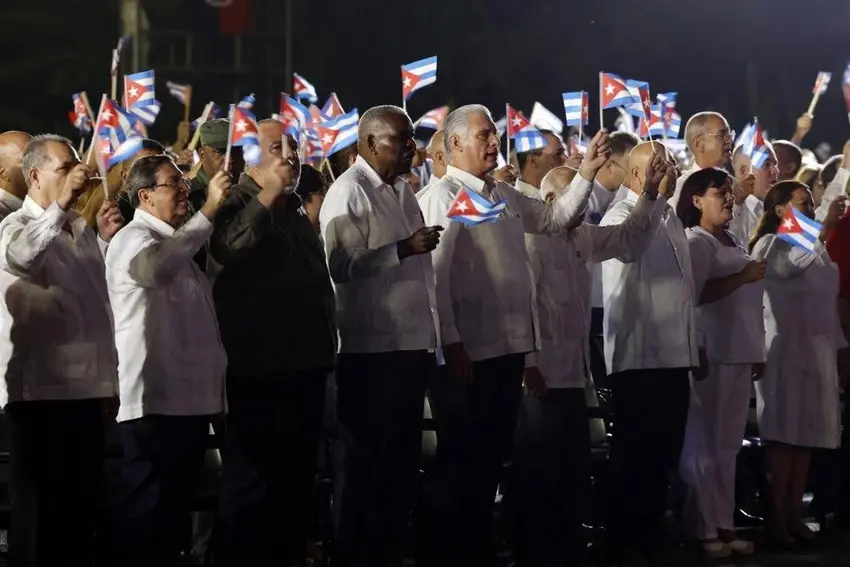

Cuba's Díaz-Canel defends economic reforms, blames U.S. for crisis
Cuban President Miguel Díaz-Canel defended a sweeping package of economic reforms, while blaming U.S. sanctions for the deepening economic crisis.
July 31 (UPI) -- Cuban President Miguel Díaz-Canel defended a sweeping package of economic reforms, while blaming U.S. sanctions for the island's deepening economic crisis.
He said Washington's policies have worsened power outages, fuel shortages and the country's economic decline.
Addressing the closing session of Cuba's National Assembly on Thursday, Díaz-Canel described Cuba as "a fortress under siege" and accused the current U.S. administration of reviving elements of German fascism through what he called policies of economic coercion and collective punishment.
He contended that Washington's "energy blockade" severely restricted fuel shipments to the island, noting that Cuba received only one fuel tanker in the past seven months.
According to Díaz-Canel, the fuel shortage has left about 1,400 megawatts of distributed power generation unavailable each day, contributing to prolonged nationwide blackouts and disrupting agriculture, tourism, healthcare and water supplies.
The Cuban leader also accused the United States of pressuring third countries and foreign companies to avoid doing business with Cuba to trigger social unrest and overthrow the country's socialist government.
Alongside those accusations, Díaz-Canel unveiled what he described as one of the government's most significant economic overhauls in recent years.
He said authorities have approved 176 economic and social transformation measures, with 120 ready to be implemented. The reforms are designed to expand productive capacity, encourage investment, strengthen state-owned, private and cooperative businesses, increase exports, attract foreign currency, and grant municipalities and state enterprises greater economic autonomy.
Díaz-Canel acknowledged public concerns over growing private wealth, income inequality and the expansion of private businesses, but insisted the reforms do not represent a shift away from socialism.
"The transformations we are implementing are not for more capitalism, but to defend and advance the construction of socialism," he said.
He also stressed that the reforms "are not being adopted to please the United States" or as the result of bilateral talks with Washington, calling them a sovereign decision by the Cuban government.
The president pledged there would be no privatization of healthcare, education, science, culture or other strategic public services.
Foreign Minister Bruno Rodríguez echoed many of those arguments in a separate address before lawmakers, accusing the United States of undermining international law through unilateral sanctions, economic coercion and military threats.
Rodríguez said Washington is attempting to isolate Cuba from the global economy by cutting off its access to fuel, technology and financing, while promoting what he described as a doctrine of "peace through strength."
He reiterated Havana's willingness to maintain dialogue with the United States provided Cuba's sovereignty is respected, while thanking governments, international organizations and solidarity groups that continue to oppose the U.S. embargo.
Díaz-Canel also reaffirmed his government's commitment to socialism, saying the reforms are intended to preserve rather than replace Cuba's political and economic model.
He closed his speech by paying tribute to late revolutionary leader Fidel Castro and repeating the slogans "Socialism or Death" and "Homeland or Death, We Will Prevail."