
Peltola's focus on affordability powered US Senate win while Trump-aligned Sullivan fell short, observers say
ANCHORAGE, Alaska — In the end, a U.S. Senate race that had grown increasingly bitter and focused on character attacks came down to how voters felt about President Donald Trump, helping Alaska Democrat Mary Peltola unseat two-term Republican Sen. Dan Sullivan. "Alaskans say we do things differently up here and we do," said Ian Hartman, head of the University of Alaska Anchorage's Institute of ...
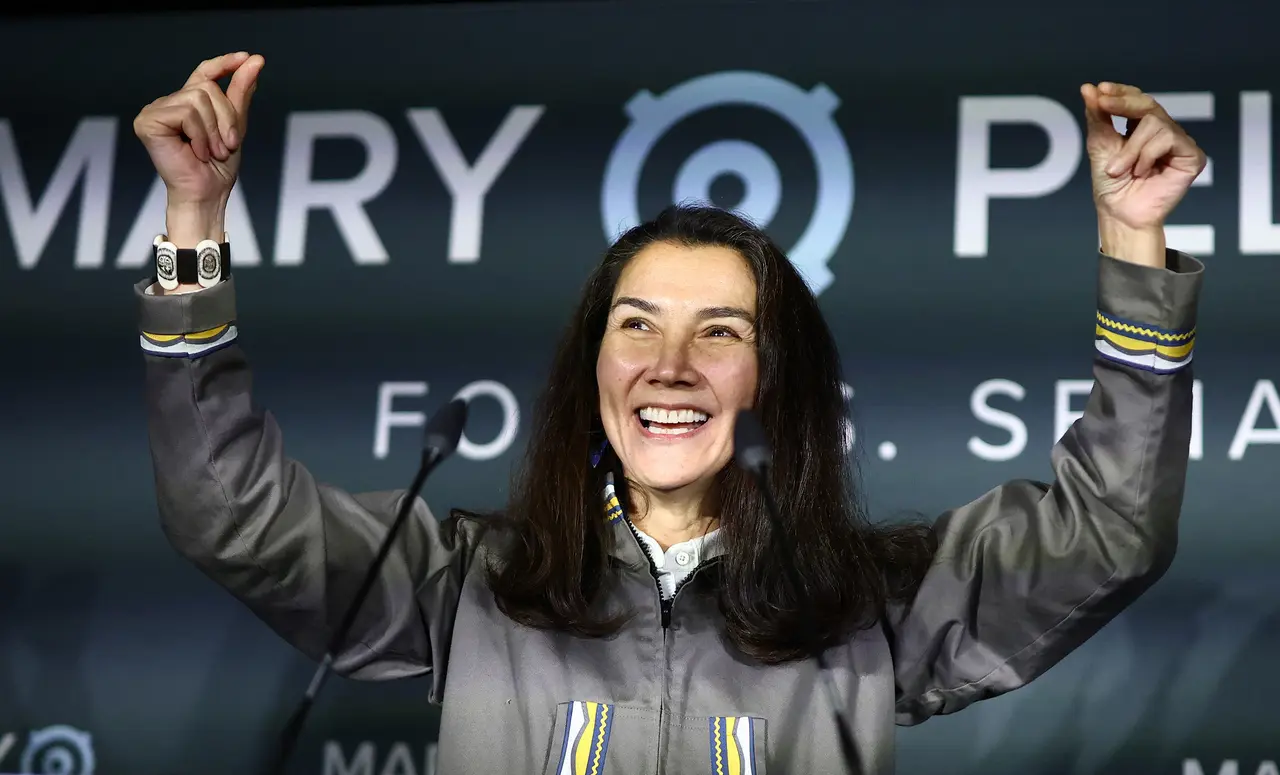
Democrat senatorial candidate Mary Peltola speaks during a midterm election night party at the Sheraton Anchorage in Anchorage, Alaska, on Nov. 3, 2026.
Charly Triballeau/AFP/Getty Images North America/TNS
ANCHORAGE, Alaska — In the end, a U.S. Senate race that had grown increasingly bitter and focused on character attacks came down to how voters felt about President Donald Trump, helping Alaska Democrat Mary Peltola unseat two-term Republican Sen. Dan Sullivan.
"Alaskans say we do things differently up here and we do," said Ian Hartman, head of the University of Alaska Anchorage's Institute of Social and Economic Research. "But at the same time, the same issues affecting these other races nationally, whether it's affordability or the war in Iran, created a really difficult environment for politicians that were aligned with the Donald Trump administration."
Peltola earned 50.1% of the vote in the race, enough to avoid a round of ranked choice tabulation and put her on track to be the first Alaska Native to serve in the U.S. Senate after she's sworn in Jan. 3.
Despite days of nail-bitingly close results in Alaska's trickling ballot count over the past two weeks, she managed to beat Sullivan by more than four points, toppling a prominent political figure in a state that had long leaned Republican and voted for Trump by large margins.
Observers say Sullivan, who pointed to numerous Senate accomplishments on the campaign trail, ran a strong campaign but ultimately fell victim to a national wave that heavily favored Democrats, presenting further challenges after Sullivan had aligned himself closely with the increasingly unpopular president.
That made the senator an easy target for Peltola, who called affordability "the only plot line that matters" and centered much of her pitch on high costs caused by the war and Trump's tariff policies.
Sullivan's loss came after Trump fought aggressively in the campaign's closing weeks to help the senator win Alaska, rallying for him in Wasilla after the vice president had done the same in Fairbanks, and claiming, incorrectly, that South Korea was paying for the state's long-sought $50 billion gas line project.
Sullivan's loss also came despite New York Times exposés that handed him easy talking points.
The Times first reported in October about allegations of Peltola's improper treatment of staff and her use of slurs. A second story published by the paper in the days leading up to the election reported her campaign's alleged involvement in a ballot-stacking ploy that recruited spoiler candidates onto the ballot to hurt the senator, including Dan J. Sullivan, the namesake challenger from Petersburg.
Peltola has denied any involvement in the alleged scheme and in a post-win interview Wednesday called it "nothing but an unfortunate distraction" in the race.
Still unresolved is the potential effect of ongoing state and federal investigations, requested by outgoing Republican Gov. Mike Dunleavy and supported by Trump, into the alleged ballot-stacking scheme. Authorities this week declined to disclose details about the ongoing probes.
Political observers and legal experts say ballot-stacking efforts don't appear to be unlawful. Sullivan, whose campaign has declined to provide comment after the Associated Press called the race Tuesday, previously called the alleged scheme "the biggest election cheating scandal in the history of the state."
Carol Gray, an assistant professor of public law in the University of Alaska, Fairbanks' political science department, said the articles in The New York Times appeared to make little difference in the race's outcome, compared to issues such as persistently high inflation and the Trump administration's deadly immigration enforcement efforts carried out by Immigration and Customs Enforcement, or ICE.
"Economics drove a lot of what voters decided to vote about," she said. "The cost of living is higher here than in the Lower 48, and so I think this was a referendum on President Trump. I think that people around the country, including in Alaska, feel like a lot of his initiatives have been harsh and unwise and bad for their pocketbooks."
Sullivan, a retired U.S. Marine Corps reserve colonel, has been a well-known name in Alaska since becoming the state's attorney general in 2009, and later its commissioner of Natural Resources. He unseated Democrat Sen. Mark Begich in 2014 and won again in 2020, despite being outspent by his opponents.
Along the way, Sullivan has helped facilitate what many call a renaissance in Alaska's oil and gas industry that has led to large new oil discoveries and increased interest in the state's oil patch, a key part of the economy.
During the campaign, Sullivan highlighted efforts that brought billions of dollars to the state for what he called an "historic military buildup"; increased future royalty revenue to the state from oil and gas production on federal lands; and cut taxes on tips, overtime and for seniors as part of the One Big Beautiful Bill, among other actions.
But the Republican-backed federal reconciliation package also made huge cuts to food benefits and Medicaid, angering many Alaskans.
While Sullivan acknowledged that Alaskans were struggling with high fuel prices, he continued to support the Iran war launched by the Trump administration, with his campaign blaming Iran for the high costs, rather than the war effort itself.
That helped open the door for attacks from Peltola, who described Sullivan as an elite multimillionaire more interested in helping corporations than everyday Alaskans. Sullivan shot back that she defined the rigged system in D.C. after she took a highly paid job with a national law firm that has a lobbying arm, after her tenure in the U.S. House.
Hartman said that Sullivan generally ran a strong campaign.
"But there was such an appetite for change that there really wasn't a lot that somebody like him could have done," he said. "So much of this election turned on opposition to the status quo, and so I'm not yet sure if this is about support for Mary Peltola or opposition to highly Trump-aligned Republicans."
John-Henry Heckendorn, founder of Ship Creek Group, a campaign management company that provided strategy support to pro-Peltola super PACS, said that Peltola has been a uniquely successful candidate in Alaska, outperforming her Democratic peers in her runs for statewide office.
She became the first Alaska Native to serve in the U.S. House after winning a special election in 2022 to fill the state's lone seat following the death of longtime Rep. Don Young, a Republican.
The Senate race saw a record amount of spending from candidates and committees that exceeded $150 million, and Peltola heavily outspent Sullivan, after raising $36 million to his $11 million.
Peltola benefited from that strong financial support, which helped with advertising and door-knocking efforts, Heckendorn said.
The money also helped her campaign in dozens of rural communities, where she capitalized on her unique pro-family and pro-fish message that focused on issues like wasteful trawling bycatch of salmon, affordability and "rural sustainability," he said.
Rural areas of the state broke heavily for Peltola, a Yup'ik from Western Alaska, in many cases choosing her by more than a 2-1 margin. Sullivan performed well in many urban areas, but won by smaller percentages.
"I think Mary's success is reflective of a coalition across party lines that has emerged in Alaska with steadily growing success over the last decade," Heckendorn said.
The coalition includes Democrats but expands beyond that, he said.
"I think Mary was able to make the campaign, and has been able to make her brand, about something other than partisanship," he said.
Meanwhile, Sullivan is a competent candidate who ran a good campaign, Heckendorn said.
But at times he seemed to be overly cautious, such as declining to appear at a debate in one of the state's most prominent forums, the Alaska Federation of Natives annual convention, where he had faced a protest the year before over Trump administration cuts through the Department of Government Efficiency, or DOGE.
That decision allowed Peltola to make her case unchallenged, where she called the Trump-ordered lawsuit, which potentially sought to block certification of the Senate race results, "flagrant, flagrant corruption."
Sullivan in October also declined to answer questions posed in a voter guide organized by multiple Alaska news organizations, including The Anchorage Daily News. Topics reflected in the Senate race questions included the War Powers Act, the cost of living and ICE.
Avoiding those forums likely didn't make a difference in the results, but it may highlight a cautious approach on Sullivan's part that could have hurt him, Heckendorn said.
Those strategies can work "when you are in the lead and you just need to be the uncontroversial Republican," he said. "It doesn't work when your opponent is breaking ground across party lines."
Art Hackney, a longtime Alaska political consultant who created an independently operated pro-Sullivan super PAC, said that if he had one concern about the Sullivan campaign, it was that the campaign didn't fully respond to pro-Peltola attack ads.
Peltola ran "the most categorically relentlessly dishonest campaign that I have ever looked at," Hackney said. "So this is just a sad reflection on the political process that disrespects the general public because you've got people celebrating that Mary, as an Alaska Native, got elected to the U.S. Senate. But we have just lost an unbelievably valuable resource (in Sen. Sullivan)," he said.
Hackney said he does not know whether the state and federal criminal investigations into the alleged ballot-stacking will reveal a criminal conspiracy, and what that will lead to if so.
In addition to Dan J. Sullivan, people involved in the effort also allegedly managed to recruit Republican Gerald Heikes, another fringe candidate, onto the Senate ballot. Political groups spent heavily to boost Heikes, including the progressive organization Sixteen Thirty Fund, based in Washington, D.C., with social media ads touting Heikes as a more socially conservative alternative to Sullivan and encouraging voters to rank only Heikes on their ballot, instead of ranking multiple choices.
Heikes and Dan J. Sullivan together received more than 10,800 first-choice votes, or 3.8% of the total.
"Sure, (the results have) a lot to do with people's opinions of Trump," Hackney said.
"But I think this goes back to what degree did a very basic strategy that started back in the summer of 2025 cross a legal line by having groups that cannot coordinate," Hackney said of the alleged ballot-stacking scheme.
"This has ugly written all over it," he said. "The question is just where ugly goes at this point."