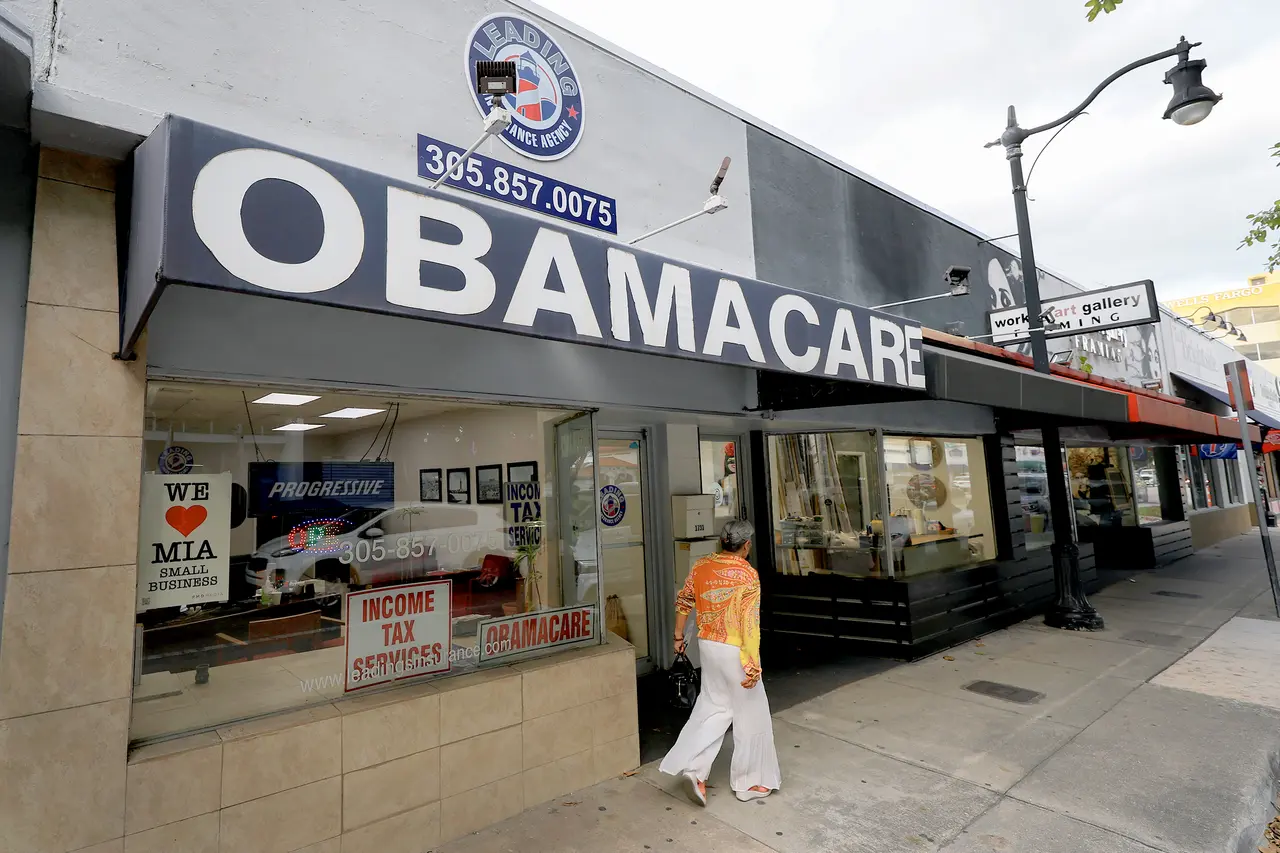

As Affordable Care Act premiums skyrocket, catastrophic coverage is having a moment
Jason Miller watched his monthly health insurance premiums quadruple to $374 from $80 for a silver-level plan when the Affordable Care Act’s enhanced tax credits ran out in December. “That’s just not functionally doable,” the married father of four children said about the increase. Worse, he said, “the coverage you’re paying for is not great.” Miller, 43, a software developer who lives in ...
House Democrats are said to be looking at steps to force a vote on extending the expiring Affordable Care Act tax credits after Republicans did not address the issue as part of a deal to reopen the federal government.
Joe Raedle/Getty Images North America/TNS
Jason Miller watched his monthly health insurance premiums quadruple to $374 from $80 for a silver-level plan when the Affordable Care Act’s enhanced tax credits ran out in December.
“That’s just not functionally doable,” the married father of four children said about the increase.
Worse, he said, “the coverage you’re paying for is not great.”
Miller, 43, a software developer who lives in Monroeville, Pennsylvania, said he was forced to drop individual Affordable Care Act coverage for 2026, choosing instead to pay cash for the sleep apnea supplies he was prescribed and use telehealth for other medical care, where a consultation can cost as little as $29. He is among 60,000 Pennsylvanians who’ve dropped health insurance since January because they can’t afford premiums that have ballooned without the federal government’s enhanced tax credits.
The average Affordable Care Act marketplace deductible experienced the steepest increase in history this year, up 37% — or over $1,000 — to $3,786 in 2026 with the expiration of the enhanced premium tax credits, according to a new analysis by San Francisco-based KFF, an independent nonprofit and nonpartisan policy research firm.
The average increase per policy in Allegheny County, Pennsylvania, where Miller lives, was 75% — 125% in nearby Indiana County and 103% in Armstrong County.
Stung by the cost increases, consumers shifted to lower premium, higher deductible plans — with sign-ups for bronze plans jumping to 40% of total plan selections in 2026 from 30% last year, growing enrollment to 9.2 million from 7.3 million people.
Since then, the government has rejiggered the Affordable Care Act through 2028, saying tweaks were needed to give insurers more flexibility in designing plans and to make health insurance more affordable.
What’s clear is that Affordable Care Act enrollees will soon see some of the biggest changes in the program since the large-scale health insurance reforms were rolled out in 2014.
Spoiler alert: Higher costs are in the works.
“There’s just massive changes in the healthcare industry, and nobody knows where to turn,” said Shelley Bloom, a 40-year industry veteran and director of compliance at Valhalla, New York-based Emerson Rogers LLC. “I don’t want to say the changes are all bad, but they’re not what we’ve seen for many, many years.”
‘Less usable and less affordable’
In announcing the policy shift in February, Centers for Medicare & Medicaid Services Administrator Mehmet Oz said in a news release that it “puts patients, taxpayers and states first by lowering costs and reinforcing accountability for taxpayer dollars.” Those changes became law in May in a 1,121-page final rule.
Pennsylvania Insurance Department Commissioner Michael Humphreys was less sure about the advertised benefits, even as families like the Millers scramble for affordable options.
In commenting on the changes to the ACA, Humphreys questioned whether the result would really be more affordable health care. His comments to the Centers for Medicare & Medicaid Services addressed the government’s plan to expand access to catastrophic coverage — health insurance with big deductibles, lower premiums and limited coverage — as an alternative to more costly but more comprehensive plans.
“The burden of health insurance costs is still on the consumer, and directing consumers to catastrophic plans would put additional costs on the consumer through substantially higher cost-sharing responsibilities,” Humphreys wrote in a March 13 letter to the Centers for Medicare & Medicaid Services. “CMS has not demonstrated how these proposals will be meaningfully affordable for typical consumers.”
Out-of-pocket medical expenses for some low-income enrollees could nearly eclipse their annual income, Humphreys said in his letter to the federal government.
“CMS proposes maximum out-of-pocket expenses for bronze and catastrophic plans that are not affordable,” he wrote. “These proposed cost-sharing levels would therefore worsen underinsurance and make coverage less usable and less affordable in practice.”
Consumers could be forgiven for missing the bare-bones terms of catastrophic plans, but the out-of-pocket sums they must pay before full coverage kicks in are eye-popping: $12,000 for an individual and $24,000 for a family in 2027.
That’s up 13.2% from this year.
Beginning next year, bronze-level plans will also have higher deductibles, $15,600 for an individual and $31,200 for a family — a 47% increase from this year — but states can prohibit insurers from offering the plans with excessive deductibles.
‘Where do you find the savings?’
What to do?
In its guidance, the U.S. Department of Health and Human Services suggested that insurers offer enrollees loans for the predeductible healthcare expenses. A Health Affairs analysis published in May called the prospect of such loans “striking.”
How the loans would work is still being studied.
Like all Affordable Care Act plans sold on state and federal exchanges, catastrophic health plans provide the required essential health benefits, but they are ineligible for government subsidies for premiums.
Previously, enrollees in catastrophic plans were mostly limited to people under age 30 who often have fewer chronic or serious health problems.
Starting next year, the federal government will expand the income guidelines required to sign up for the coverage, which is expected to further boost in those types of plans enrollment.
“Those in government are looking for ways to reduce costs,” said Scott Ingalls, owner of Cognizant Benefits Solutions Inc., a Butler, Pennsylvania, brokerage. “Catastrophic plans are a way to do it,” providing coverage that could save consumers from a financial catastrophe.
“Basically, if it really hits the fan, I’m not going to have to sell my 401(k) or my house to save my life,” he said.
Another big change is coming in 2028, when CMS opened the door to an uncommon kind of health insurance that can be sold on state and federal exchanges, called non-network plans. They could become an option for Affordable Care Act plan members in 2028 on Pennsylvania’s Pennie online platform.
Instead of a panel of doctors and hospitals that usually accompany coverage as in-network providers, these plans set percentage amounts that will be paid for medical services, such as emergency room visits and surgery, regardless of where the care is rendered.
The plans often use Medicare reimbursement rates as the reference metric, such as 100%, 150% or 200% of what Medicare pays doctors and hospitals. The insurance can be used anywhere in the U.S. where medical providers accept the reimbursement rate, but there’s a hitch: Consumers can be balance-billed for the amounts that are not covered by the plan.
Non-network health plans may offer another way to control costs.
Group health plans generally pay doctors and hospitals 200% to 400% of Medicare’s reimbursement rates, Cognizant Benefits owner Ingalls said.
Non-network plans can be a “lot less expensive than your standard network plan,” even though the structure of the coverage is not well understood by employers.
“Where do you find the savings? It won’t be in claims. You can’t control that,” said Ingalls, a health insurance broker for 37 years. “But you can control the structure of health insurance. That’s where it is.
“They’ll become more popular because people will become aware of what they really are,” he said about non-network plans.