
Poll shows Gov. Josh Shapiro with a 25-point lead over Republican challenger Stacy Garrity
Less than a month before the midterm elections, a new survey found Gov. Josh Shapiro has opened an expansive lead over his Republican challenger — one that, if it holds, would be the most lopsided victory in a Pennsylvania governor’s race in decades. The Quinnipiac University poll found that 59% of likely voters backed the incumbent Democrat, compared to just 34% who supported the Republican, ...
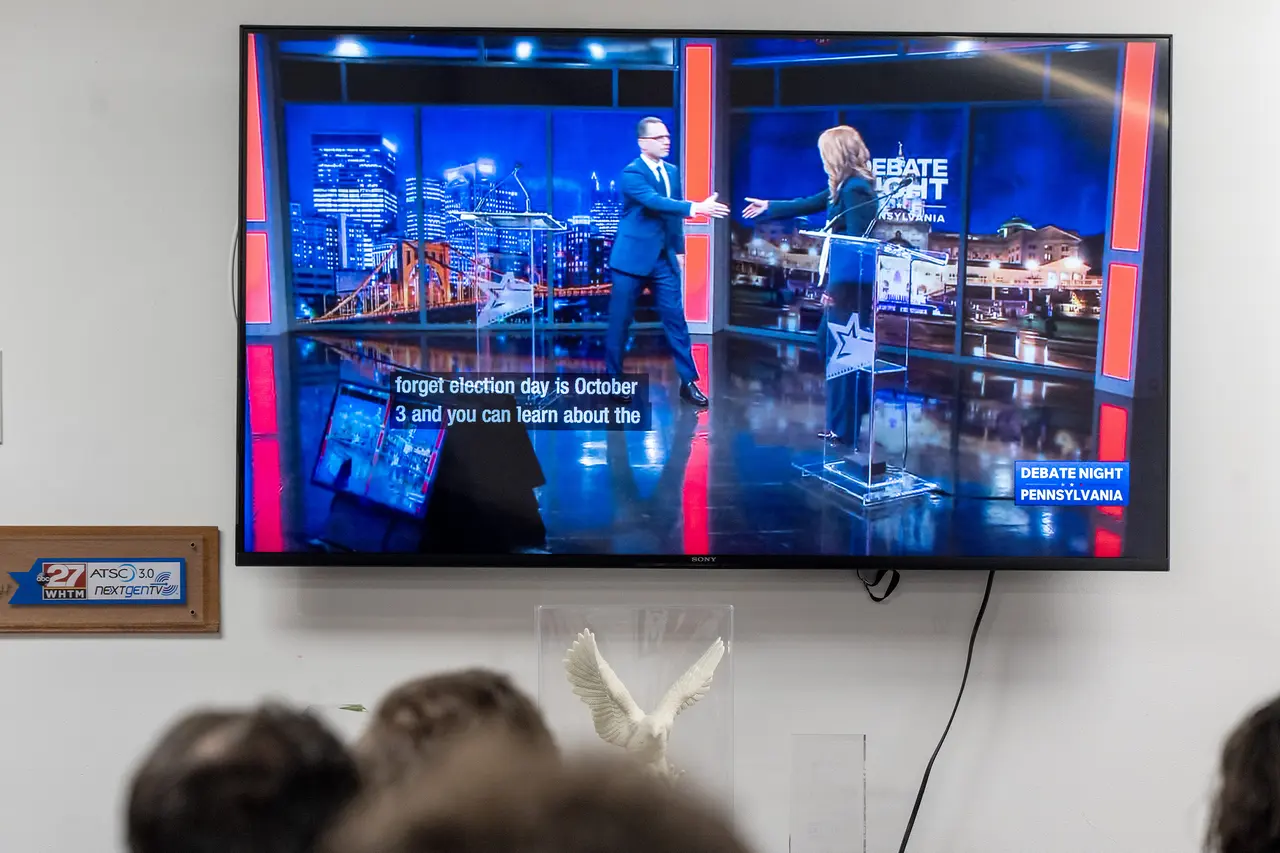
Monitor at the WHTM-TV studios in Harrisburg, Pennsylvania, on Oct. 7, 2026, at the conclusion of the lone debate between Gov. Josh Shapiro and Republican challenger Stacy Garrity ahead of next month's gubernatorial election. There was no live audience but the one-hour debate was televised on several local stations statewide and streamed on their websites and...
Tom Gralish/The Philadelphia Inquirer/TNS
Less than a month before the midterm elections, a new survey found Gov. Josh Shapiro has opened an expansive lead over his Republican challenger — one that, if it holds, would be the most lopsided victory in a Pennsylvania governor’s race in decades.
The Quinnipiac University poll found that 59% of likely voters backed the incumbent Democrat, compared to just 34% who supported the Republican, state Treasurer Stacy Garrity.
The poll — released hours before the two were set to face off in their first debate Wednesday night — was the latest evidence of Shapiro’s dominance in the race, which includes him spending more than 10 times as much money as Garrity.
The overwhelming cash advantage has allowed an already-popular governor — running in a year where the political environment is favorable to Democrats — to blitz the state’s airwaves with negative advertisements about Garrity and positive commercials highlighting his three-plus years in office.
The poll shows that, even in a highly polarized political era, about 1 in 6 Republicans plans to vote for Shapiro, compared to 1 in 50 Democrats who say they’ll vote for Garrity.
The picture that emerges from the survey, according to Quinnipiac polling analyst Tim Malloy, is that “one of the county’s most popular governors gets a rousing endorsement from Pennsylvania’s likely voters in a race that looks like a rout.”
For Shapiro, the strong support from voters in the country’s largest swing state comes about four years after he was on the short list to join former Vice President Kamala Harris in the No. 2 spot on the Democrats’ presidential ticket — and two years before a possible White House run of his own.
Of the five politicians people were asked about in the survey — Shapiro, Garrity, U.S. Sens. Dave McCormick and John Fetterman, and President Donald Trump — the Pennsylvania governor had the highest approval rating at 63%.
The politician with the lowest: Trump, who is Garrity’s highest-profile supporter. Just 37% approve of the job he’s doing, with 60% disapproving.
Among the top issues driving voters are concerns over whether the state should allow data center development. The rapidly shifting public opinion about the sprawling projects and their potential effects on communities has pushed both candidates to change their viewpoints on where and how data centers should be developed.
Shapiro, who previously supported rapid development, removed data centers from the state’s fast-track development program, which allows builders to expedite permits. Garrity, who had also been more supportive of the centers, has called for a pause on their development in the commonwealth, saying it would give local governments time to update zoning laws and upgrade utilities to meet the needs of both the centers and residents.
The majority of voters in the survey said data centers would do more harm than good, although opinions diverge within the parties.
About 80% of Democrats see the centers are harmful, while Republicans are split, with 40% in favor of them and 44% against.
While Shapiro’s favorability continues to trend upward, the opposite is true for another prominent Democrat in Pennsylvania.
Fetterman is not up for reelection until 2028, but the recent Quinnipiac polling tracks with what the organization and other pollsters have been seeing since early summer: Republicans are far more favorable toward the senator than his own party.
About 70% of the Republicans polled had a favorable opinion of Fetterman, while only 13% of Democrats did, and about half the people identifying as independents said they had an unfavorable view of the senator.
His declining support among Democrats has led some to speculate whether Fetterman would switch parties — something he has adamantly denied.
At the same time, Fetterman has developed a close relationship with McCormick, who in Wednesday’s Quinnipiac poll had a favorability rating about 4% lower than his Democratic colleague’s.
But unlike Fetterman, who became one of the most prominent politicians in the country as he rose from mayor of Braddock to the U.S. Congress, almost 1 in 3 voters said they had no opinion of McCormick.
In all, half of likely voters surveyed said they disapproved of the job Fetterman was doing, while only 35% felt the same about McCormick.
There are already likely challengers to Fetterman’s seat come 2028, but both parties are focused on critical races in the upcoming midterms that will decide the balance of power in Washington.
Republicans hold a slim majority of the U.S. House of Representatives after taking control back from Democrats in 2022, but 54% of the people surveyed said they would like to see Democrats regain control this year.
The Republican Party has recently shifted its focus to defending seats in deep-red areas such as South Carolina and Kansas, according to reporting from Politico.
Independents surveyed in the Quinnipiac poll also showed a strong tilt toward the Democrats. More than half of them — 56% — want to see a Democratically controlled House, the results showed.
_____