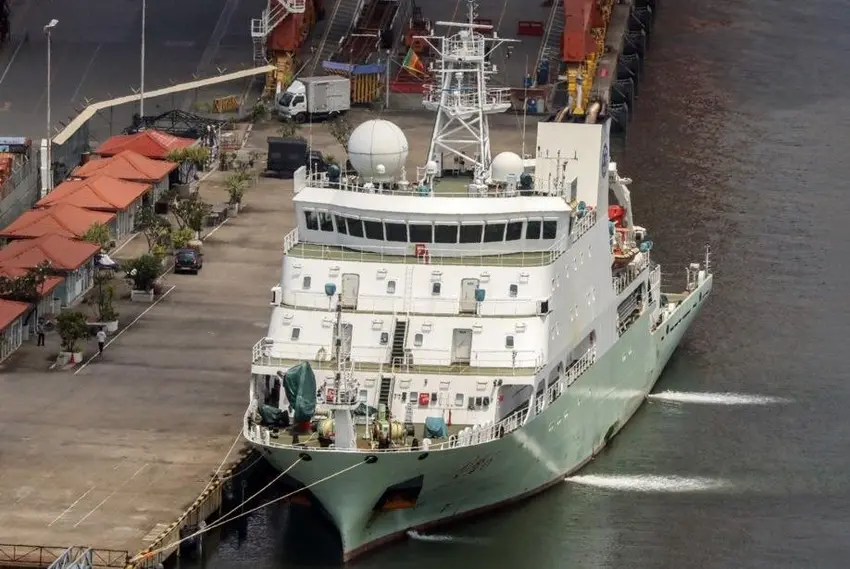

Chinese research fleet creates strategic presence in Asian waters
Chinese research ships help China normalize its presence, strengthen maritime claims and expand operational awareness without deploying naval force.
July 9 (UPI) -- China's expanding marine research fleet is giving Beijing a powerful new instrument in the South China Sea and western Pacific: ships that sail under the banner of science but collect data with strategic value.
From Philippine waters near Scarborough Shoal and Reed Bank to Vietnam's exclusive economic zone and the waters around Taiwan-controlled Pratas Island, Chinese research and survey vessels are increasingly operating in contested maritime spaces.
Their stated missions often involve marine biology, hydrology, meteorology, seabed mapping, environmental monitoring and studying marine species that range from fisheries to dolphins and whales.
But for neighboring governments, these missions are rarely viewed as neutral scientific endeavors. Instead, they are increasingly seen as part of a broader gray-zone strategy -- non-military activities that help China normalize its presence, strengthen maritime claims and expand operational awareness without deploying naval force.
The result is a growing debate across Asia about whether China's scientific fleet represents a contribution to global ocean knowledge or a new form of strategic competition conducted under civilian cover.
"Research crosses into statecraft when it is used to map vulnerabilities rather than advance science," Ben Gorman, co-founder of the Taiwan Policy Center, told UPI. "That includes identifying critical infrastructure, gathering intelligence and testing how a targeted state's maritime and coast guard forces respond."
Consent required
Under the United Nations Convention on the Law of the Sea, or UNCLOS, marine scientific research conducted within another country's exclusive economic zone generally requires the consent of the coastal state. Article 246 of UNCLOS states that such research should be conducted only with the express consent of the coastal state.
That legal requirement has become central to a series of disputes involving Chinese research vessels operating in contested waters.
"The legitimacy of marine scientific research depends on its purpose and transparency," Robert Blasiak, of the Stockholm Resilience Center, told UPI.
"In regions where trust has eroded, it is increasingly difficult to separate scientific inquiry from strategic interest. UNCLOS recognizes that concern by allowing coastal states to deny consent for foreign research in their exclusive economic zones," he said.
In June, Taiwan accused a Chinese coast guard vessel and survey ship of conducting their first coordinated operation near Taiwan-controlled Pratas Island, saying the mission was aimed at challenging Taipei's administration and expanding Beijing's presence in the area.
"Beijing's ocean governance narrative and its behavior at sea are often viewed as separate issues," Gorman said, noting that Taiwan, the Philippines and Vietnam remain skeptical because of China's use of coast guard, maritime militia and fishing vessels in disputed waters.
Sovereign rights
Although the Philippines has raised concerns around Scarborough Shoal, where Manila objected to the presence of a Chinese floating platform. Chinese authorities described the structure as part of scientific research activities, while Philippine officials rejected that explanation and argued the area falls within waters where the Philippines exercises sovereign rights.
Vietnam also has repeatedly protested Chinese survey operations. In 2025, a Chinese research vessel reportedly spent weeks operating within Vietnam's exclusive economic zone, surveying approximately 770 square miles in disputed waters.
"The line between marine scientific research and strategic data gathering is often blurred in the South China Sea," Professor Zhiqun Zhu, director of the China Institute at Bucknell University told UPI.
"Because trust among regional states remains low, even routine research missions can be perceived as serving broader security or military objectives," Zhu said.
Oceanographic data has broad civilian applications, supporting climate research, fisheries management, marine biodiversity studies and ecosystem monitoring. Information on ocean currents, salinity, water temperature and species distribution is also used to inform conservation efforts and sustainable management of marine resources.
Strategic value
Many of the datasets collected during marine research missions also carry strategic value. Information on seabed terrain, ocean currents and underwater conditions can support submarine operations, undersea surveillance and the mapping of critical infrastructure such as communications cables.
As a result, analysts increasingly view marine scientific research as dual-use, with applications that extend beyond civilian science into the security realm.
"The dual-use nature of China's research vessel operations has become increasingly systematic," Benjamin Blandin, a visiting research fellow at the Institute for National Defense and Security Research, told UPI. He said Chinese vessels have operated near undersea communications cables and that Beijing has expanded its capabilities in the use of subsea drones and remotely operated vehicles.
The scale of China's maritime capabilities has heightened concerns among regional governments and security analysts. Researchers at the Center for Strategic and International Studies have identified more than 60 Chinese research and survey vessels operating globally since 2020, making China's oceanographic fleet the largest civilian research fleet in the world.
Much of the concern centers on the potential dual-use of the data these vessels collect.
"The collection of dual civil-military data is extremely sensitive," security analyst Carl Thayer said, noting that hydrographic surveys that map seabed terrain, water temperature, salinity and ocean conditions can support submarine detection, improve underwater navigation and enhance maritime military operations.
Expanding presence
China's research fleet, operated by government agencies, universities and state-affiliated scientific institutions, supports Beijing's expanding maritime presence from the South China Sea and Indian Ocean to the Pacific Islands and polar regions.
Chinese officials maintain that these activities are consistent with international scientific cooperation and contribute to global understanding of the oceans.
In recent years, Beijing has increasingly incorporated marine science into its broader diplomatic narrative. Chinese leaders frequently link ocean research to concepts such as "ecological civilization," sustainable development and a "maritime community with a shared future."
"Distinguishing between civilian and military uses is increasingly difficult in many areas of technology and information gathering," said Bates Gill, a scholar of Indo-Pacific security and strategic affairs. "Like many dual-use capabilities, these activities often carry both scientific and strategic value."
That narrative has become particularly important as China seeks a larger role in global ocean governance.
Greater leadership seen
Beijing ratified the High Seas Treaty in late 2025 and has emerged as a candidate to host the treaty's future secretariat. Chinese officials have highlighted the country's investments in marine conservation, biodiversity protection and scientific research as evidence that China is prepared to assume greater leadership in international ocean affairs.
Supporters argue that China's growing scientific capabilities could contribute significantly to global efforts to better understand and protect marine ecosystems.
"China believes ocean sustainability depends on international cooperation, scientific innovation and shared responsibility," said Zhang Shu, director of the Research Division at the Huayang Center for Maritime Cooperation and Ocean Governance.
"Our investments in marine science, conservation and global ocean governance are intended to protect marine ecosystems and support sustainable ocean management," Shu said.
China has expanded marine protected areas and invested in ocean observation, fisheries management and climate research, backed by an advanced fleet of research vessels, deep-sea submersibles and marine monitoring systems. But for many Southeast Asian governments, those scientific advances are viewed through a strategic lens.
Contested region
The South China Sea remains one of the world's most contested maritime regions. China claims sovereignty over most of the waterway through its so-called nine-dash line, claims rejected by a 2016 international arbitration ruling initiated by the Philippines.
"China's sweeping claims in the South China Sea are likely to remain a source of friction, particularly as neighboring countries view Chinese marine research activities as encroaching on their exclusive economic zones and seabed rights," Lucio Pitlo III, a Manila-based regional security scholar, told UPI.
"Limited surveillance and enforcement capabilities also make it difficult for many Southeast Asian coastal states to monitor foreign marine scientific research in their waters," Pitlo said.
Questions about transparency have become increasingly important. Regional governments often complain that they receive limited information regarding research objectives, methodologies or the ultimate use of collected data.
Issue is about trust
Some analysts argue that the issue is less about marine science itself and more about trust.
"China's practice of civil-military fusion means that the label tells you nothing about where the data may end up. The same ship conducting scientific research or mineral data along the seabed can also help map an undersea transit lane; the same acoustic data tracks marine mammals helps you hear or hide a submarine; one survey, two prizes," said Ray Powell, executive director of Sealight Foundation.
The issue highlights a challenge for Beijing's efforts to project itself as a responsible maritime power and ocean steward. While Chinese scientists contribute to marine and climate research, the presence of research vessels in disputed waters can complicate that narrative.
Some experts said expanding scientific cooperation among South China Sea claimants could help build trust and reduce tensions despite unresolved sovereignty disputes.
Such efforts could include scientific expeditions, shared oceanographic databases and collaborative marine conservation initiatives that would provide confidence-building mechanisms while addressing common environmental threats.
Others remain skeptical, arguing that scientific cooperation cannot succeed unless accompanied by greater transparency and respect for international law.
"China does not tolerate activities by other claimants in disputed waters, but it expects them to accept all Chinese s operations in those same waters, including marine scientific research," Bonnie Glaser, managing director, of the Indo Pacific Program at the George Marshall Fund of the United States, told UPI.
As competition intensifies across the Indo-Pacific, knowledge itself has become a strategic resource. Understanding ocean currents, underwater terrain, marine ecosystems and climatic conditions offers advantages that extend well beyond scientific discovery.
James Borton is a non-resident senior fellow at Johns Hopkins SAIS Foreign Policy Institute and the author of Harvesting the Waves: How Blue Parks Shape Policy, Politics, and Peacebuilding in the South China Sea. Borton is the editor-in-chief of the South China Sea NewsWire. The views and opinions expressed in this commentary are solely those of the author.