
Kristy Curry coached Power 4 schools for 27 years. USF lured her away.
TAMPA, Fla. — Earlier this month, South Florida women’s basketball ended a nearly half-century drought. The Bulls had not beaten the Florida Gators since 2005, and they hadn’t done so in Gainesville since 1977. But in this game — only their fourth win against Florida in program history — they never trailed. They grew their lead to 16 in the third quarter, withstood Florida’s late-game surge ...
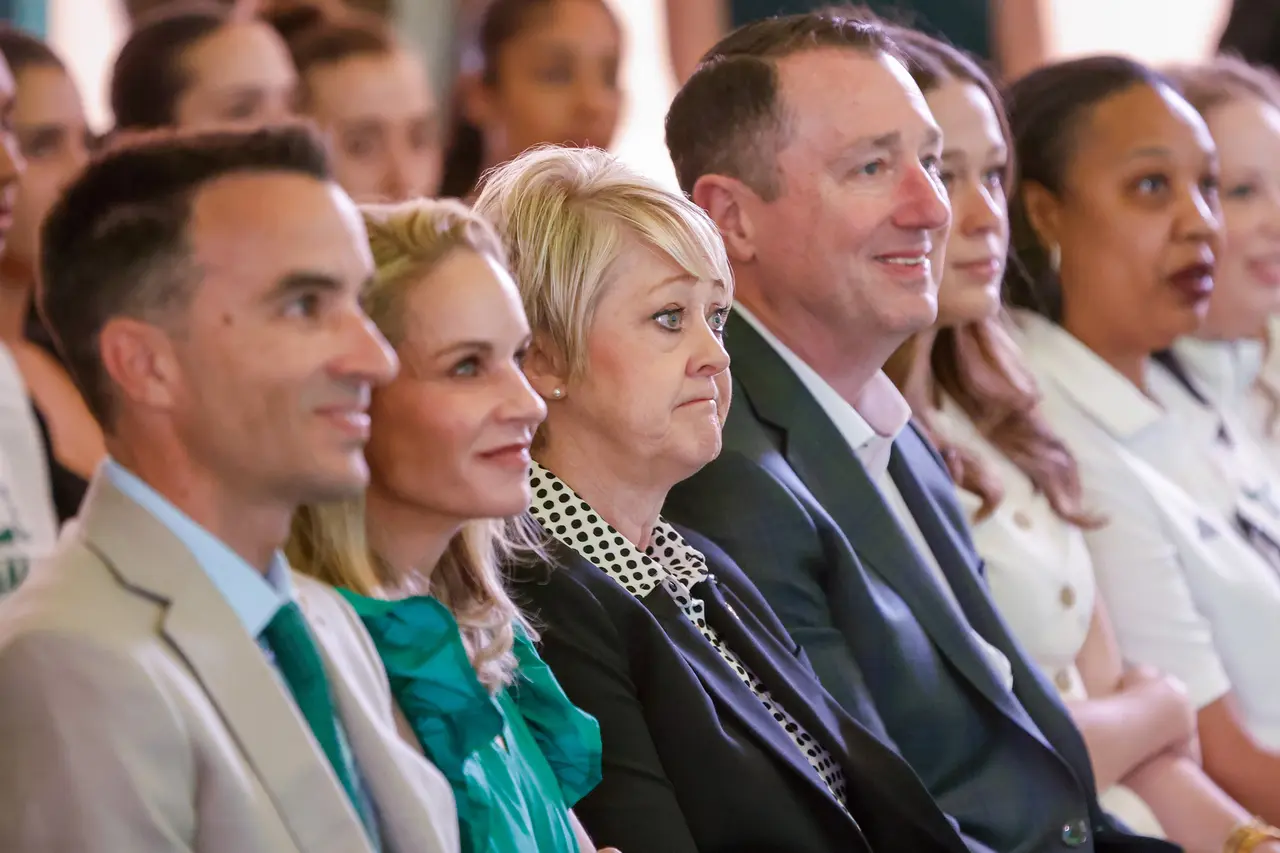
Kristy Curry, center, and husband Kelly, at her side, are a dynamic coaching duo. "I'm blessed to work with my husband," Kristy Curry says. "We just love to double team this whole situation.
Jefferee Woo/Tampa Bay Times/TNS
TAMPA, Fla. — Earlier this month, South Florida women’s basketball ended a nearly half-century drought. The Bulls had not beaten the Florida Gators since 2005, and they hadn’t done so in Gainesville since 1977. But in this game — only their fourth win against Florida in program history — they never trailed. They grew their lead to 16 in the third quarter, withstood Florida’s late-game surge and won 72-70.
At the helm was a coach for whom the result was not uncommon. Kristy Curry hails from a Hall of Fame coaching lineage and carries a resume few of her active peers can compete with. She’s won more than 550 games as a head coach and reached 14 NCAA tournaments, including a run to the national championship game with Purdue in 2001. She spent the previous 13 seasons at Alabama, where she won 245 games and had five players selected in the WNBA draft. Many of the game’s most renowned coaches say she is worthy of similar esteem.
In March, Curry challenged clear-cut college and conference calibers by leaving Tuscaloosa for Tampa. Moving to a mid-major from a Power Four school, particularly one with as much athletic prestige as Alabama, has long been regarded as a downgrade, often the result of a firing. In plenty of instances, it still is. But Curry doesn’t believe her decision fits that billing.
She believes USF’s combination of program strength and administrative support has it primed to contend as if it were a traditional power. Consider Kate Novik’s layup with 24 seconds remaining against Florida, a look she earned with a sudden stop and shot fake, early proof of concept.
“I was surprised, definitely. You don’t see coaches make that move a lot,” Stefanie Ingram, a fifth-year guard who poured in 25 points against the Gators, told the Tampa Bay Times. “But I’m sure she had her reasons. I’m sure she saw something in South Florida — the same thing that I see in it.”
Hall of Fame lineage
A mid-major program hasn’t won the national championship since Leon Barmore’s 1988 Louisiana Tech team. Over a 20-season span, Barmore, now a basketball Hall of Famer, reached another eight Final Fours and raised an array of understudies.
In 1996, he hired Curry. Nell Fortner, a Tech assistant coach who would go on to lead the national team, had left for a head coaching position. Kim Mulkey, an assistant to Barmore for a decade, had been promoted to associate head coach. Curry, raised in a town of fewer than 2,000 about an hour from Tech’s campus, joined Barmore’s staff after nearly a decade as a high school head coach and collegiate assistant in Louisiana and Texas.
“The first thing was, ‘Oh I’m not gonna have the worst accent on our staff,’” joked Mulkey, also raised in Louisiana. “I said, ‘She’s more country twangy than I am.’ And we’d laugh about that.”
Curry would continue to distinguish herself on Barmore’s staff. He remembers her as a fierce competitor — “I’ve had a lot of good coaches. Nobody outworked Kristy” — and authentic in her care for players. Mulkey counts Curry as one of her closest friends, and Barmore considers her one of his best finds.
“To be honest with you, she turned out better than I anticipated,” he told the Tampa Bay Times. “I pat myself on the back for hiring that girl.”
In three seasons under Barmore, Curry helped Tech achieve a 92-11 cumulative record and reach a national championship game and a Final Four. Seven days after beating Tech in the 1999 national semifinal, Purdue introduced Curry as its next head coach, the start of a nearly three-decade career leading major programs.
“I had a double loss, didn’t I?” Barmore said with a laugh.
Kristy and Kelly
Kelly Curry met then-Kristy Sims while he was coaching high school basketball and she was an assistant coach at Texas A&M. Shortly after their wedding, Kristy joined Barmore’s staff and Kelly found a high school coaching job nearby.
Their coaching partnership was born when Barmore proposed hiring Kelly in 1998. He spent a season as an assistant alongside Kristy and Mulkey before Purdue hired Kristy. She brought Kelly on as an assistant coach, and they’ve maintained that dynamic ever since.
“I just thought they were a beautiful combination,” Mulkey said.
Kristy says they’re “really co-head coaches” and that Kelly “deserves as much credit as I do.” He works as the “offensive coordinator,” while Kristy says she manages the program at a more sweeping scale. Sarah Ashlee Barker, who played for the pair at Alabama and was the ninth pick in the 2025 WNBA draft, said they do an excellent job of separating their two dynamics.
“When they’re in the office and all that, I’m like, ‘Are y’all even married?’ And I don’t mean that in a bad way at all,” Barker said. “Seeing them be able to communicate but also have respect for each other, it was cool to be a part of.”
The two have raised two daughters — Kelsey and Kendall — across stops at Purdue, Texas and Alabama, where they both graduated from.
...