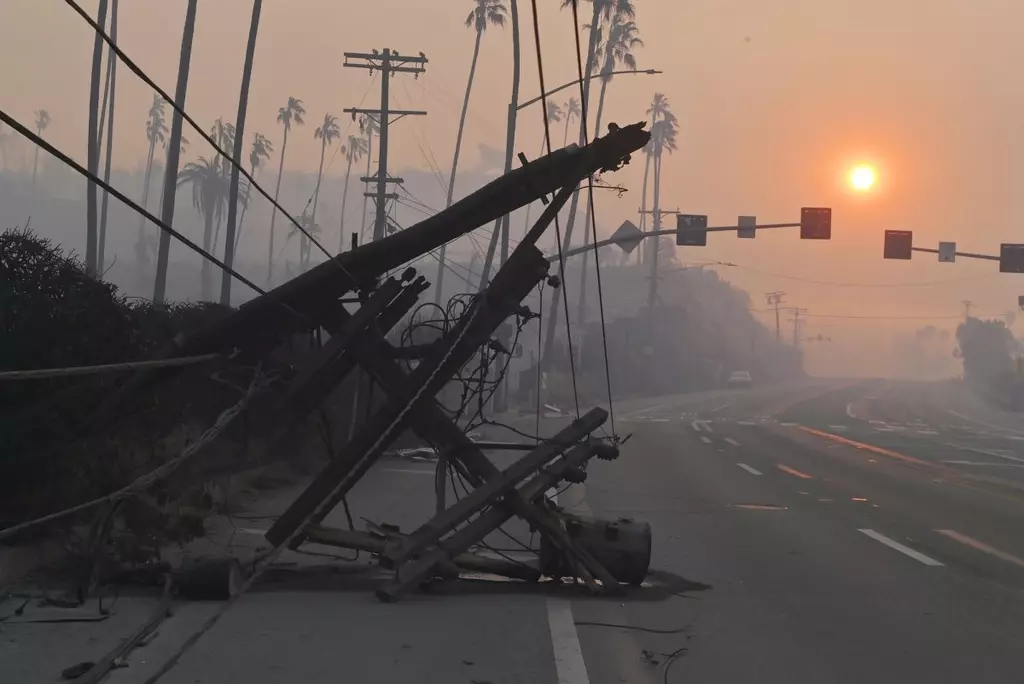

Blackout risks are rising -- why neighboring power grids can't help
Neighboring power grids can't just send extra electricity where it's needed over transmission lines because the U.S. grids aren't all connected.
Extreme weather is posing a growing threat to the power supplies Americans rely on.
In 2021, a fierce winter storm left millions of Texans without electricity and water for days. Hurricane Helene in 2024 knocked out power to about 5 million customers across the U.S. Southeast.
Beyond the immediate human and economic toll, major blackouts like these often leave behind the same unsettling contrast: One region goes dark while nearby places still have power.
This raises a question: If electricity is still available somewhere nearby, why can't it be sent where it is needed most?
There has to be a wire into the crisis
The U.S. bulk power system is not one seamless national grid, but three major grid regions known as interconnections -- the Eastern, Western and ERCOT -- Electric Reliability Council of Texas -- systems. There are very few transmission lines between them, so if one has too little power, the others may not be able to help much.
That limited connectivity made the 2021 Texas blackout far more severe: As the storm knocked out gas lines and power generators, ERCOT was forced into the largest deliberate electricity shutoff in U.S. history. Operators cut power to millions of customers to avoid a total grid collapse.
More than 4.5 million Texans lost power, and hospitals across the state struggled with electricity and water shortages. At that time, the total power ERCOT was able to import from the neighboring systems could cover only about 6% of the demand.
Today, there are proposals to build more transfer capacity between Texas and neighboring grids. The Southern Spirit Transmission project, announced by the Department of Energy in 2024, would include a 320-mile transmission line connecting Texas with Louisiana and Mississippi. According to the DOE, the project could improve the Texas grid's resilience during periods of high demand and extreme weather. If this line had existed in 2021, it could have reduced the scale of the power losses by roughly 15%, enough to keep electricity flowing to 600,000 additional Texas homes during peak demand.
The wire has to survive the disaster
That physical constraint on where power can flow begins with how the U.S. grid is organized.
At the broadest level, it is divided into the three independent interconnections. Within those larger networks, multiple regional grids can share power with one another. But moving electricity across them still depends on the availability of transmission paths.
Extreme weather can damage transmission lines and substations, making it impossible to bring in additional electricity.
Hurricane Ida showed why this matters.
In August 2021, all eight transmission lines feeding New Orleans were damaged by the storm and knocked out of service. That left the whole city without normal grid power and set the stage for a recovery that took weeks in some of the hardest-hit areas. Across the wider network, the storm also disabled 216 substations and more than 2,000 miles of transmission lines. When the main lines for electricity are broken, nearby power cannot flow in.
The answer to bolstering power grids is not just to build more high-voltage transmission lines. It is also important to harden the transmission corridors that already exist so they can withstand extreme weather and be restored more quickly after a disaster.
In New Orleans, that is already shaping investment. Entergy New Orleans, the city's main electric utility, has an accelerated grid-hardening plan that aims to replace existing utility poles with more fortified poles to withstand higher winds and selectively move some lines underground in high-risk areas. The first phase, scheduled through 2026, covers about 63 miles of power lines at a cost of $100 million.
At the federal level, the Federal Energy Regulatory Commission has required transmission providers to report how they assess risks to transmission assets, how those risks affect system operations and how they plan to reduce them, including under extreme heat and cold.
The hidden regulatory rules for sharing power
When the power goes out in one area, a nearby grid may look fine and keep its own lights on, but that does not mean its surplus power can be easily shared. Federal standards require transmission providers to have enough electricity available in reserve to serve their own local homes and businesses safely. In plain terms, only excess electricity above that safety threshold can realistically be treated as power available to help neighboring grids during an outage.
Decisions also have to be made quickly, and the logistics for sending power from one company have to be arranged before the blackout begins. The grid facing power shortages must know which sources will send extra power, which lines can carry it and what to do if the transfer creates overloads elsewhere.
The emergency operations manual used by PJM, which coordinates electricity flows across large parts of the Midwest and mid-Atlantic region, says operators are expected to act immediately when their power demand exceeds the supply to stabilize the grid. If the shortage lasts too long, protective systems begin disconnecting parts of the grid to stop a wider collapse. Once those systems are disconnected, even power that arrives later may no longer reach the areas where it is needed most.
Neighboring grids to the rescue
In early September 2022, a brutal heat wave pushed California's power grid to the brink. On Sept. 6, the state hit an all-time record power demand of 52,061 megawatts.
That same evening, when the system was most strained, a crucial lifeline of about 8,000 MW of electricity flowed in from neighboring areas. This massive external support met 12.5% of the local demand, successfully maintaining the power supply for millions.
Analyses after the heat wave confirmed what had averted the crisis. The California Independent System Operator, or CAISO, concluded that "imported electricity from neighboring balancing authorities played a key role in maintaining system reliability" during those critical hours.
Crucially, this rescue relied on established sharing agreements. Beyond prescheduled transfers, CAISO reported that power generators in the Western Energy Imbalance Market -- a system launched in 2014 to help Western power systems share electricity in emergencies -- dynamically delivered an extra 1,000 MW of emergency power.
That event proved how having real-time, cross-regional coordination mechanisms already in place can ultimately save a grid under siege. Similar arrangements already exist elsewhere in the United States. PJM and MISO, the Midcontinent Independent System Operator, have a process for scheduling electricity flows when the regions know help will be needed. Utilities in the Southeast use an exchange platform to trade power closer to the time it is needed.
While different regions use different designs, the broader lesson is the same: Outside help is most likely to work when the grid has a usable transmission path, spare electricity to share and a system for moving that power before the emergency begins.
Yan Wen, a postdoctoral research scientist in electrical engineering at the University of Tennessee, contributed to this article.
Sufan Jiang is a research Scientist at the University of Tennessee and Nanyang Technological University and Fangxing Fran Li is a professor of electrical engineering at the University of Tennessee. This article is republished from The Conversation under a Creative Commons license. Read the original article. The views and opinions expressed in this commentary are solely those of the authors.