
As FIFA's riches grow, can it still protect the beautiful game?
Soccer fans around the world are witnessing a tournament on a scale never seen before as the FIFA World Cup features 48 teams playing 104 matches.
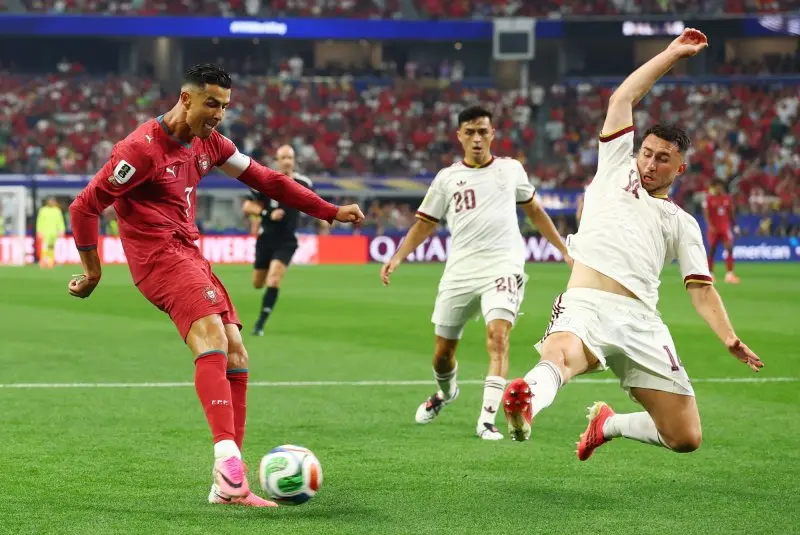
Portugal's Cristiano Ronaldo (7) makes an attempt on goal as Spain's Aymeric Laporte tries to block during the first half of their Round of 16 FIFA World Cup match at Dallas Stadium in Dallas, Texas, on Monday. Photo by Christian Brunskill/UPI UPI
July 6 (UPI) -- Soccer fans around the world are witnessing a tournament on a scale never seen before. The 2026 FIFA World Cup features 48 national teams playing 104 matches across Canada, Mexico and the United States.
The expanded competition has opened the game to more countries, players and supporters, extending FIFA's commercial reach considerably.
FIFA has raised its revenue target for the 2023-2026 financial cycle to $13 billion. The organization says more than 90% of its budgeted investments will be directed back into football.
Whatever one thinks of FIFA, it has become one of the most commercially powerful institutions in global sport.
Financial success, however, is only one measure of institutional achievement. FIFA must also protect the integrity of the sport it governs. Its history provides ample reason for continuing vigilance.
A legacy of controversy
FIFA's commercial ascent was accompanied by repeated controversies over governance, conflicts of interest and the conduct of senior football officials.
Those concerns became particularly intense during the bidding processes that awarded the 2018 World Cup to Russia and the 2022 tournament to Qatar.
In 2012, FIFA appointed Michael Garcia, a former U.S. attorney for the Southern District of New York, to chair the investigatory chamber of its Ethics Committee. He subsequently investigated the bidding and selection processes for both tournaments.
Garcia said his investigation identified "serious and wide-ranging issues" with the process, including conduct that raised questions under FIFA's ethics rules.
FIFA initially published a 42-page statement by Hans-Joachim Eckert, chairman of the adjudicatory chamber of its Ethics Committee, rather than Garcia's complete report.
Garcia objected that Eckert's statement contained materially incomplete and erroneous representations of his investigation. He resigned in December 2014, criticizing what he described as a lack of leadership within the organization.
FIFA published the complete report in June 2017, shortly after the German newspaper Bild announced that it had obtained a copy and began reporting on its contents.
By then, FIFA and the wider world of international soccer had already confronted a much larger crisis.
In May 2015, U.S. Attorney General Loretta Lynch announced federal charges against senior football officials and sports marketing executives.
Prosecutors alleged a 24-year scheme involving racketeering, wire fraud and money laundering. They accused officials of soliciting bribes and kickbacks connected principally to media, marketing and sponsorship rights.
The charges were followed by numerous guilty pleas and convictions. By 2022, the U.S. Justice Department reported that the investigation had resulted in 27 individual guilty pleas, four corporate guilty pleas and two trial convictions.
Those cases established corruption in international soccer involving commercial intermediaries that was systematic in scope.
A new integrity challenge
FIFA has introduced governance, compliance and integrity reforms since then. It has also developed programs intended to detect match manipulation.
Through a partnership with Sportradar, FIFA says it monitors football matches and betting markets for suspicious behavior across international and domestic competitions.
Such measures are necessary. But the environment surrounding soccer has continued to evolve.
The rapid growth of regulated sports betting may now present one of the greatest integrity challenges facing the international game.
The 2026 World Cup is on track to become the largest betting event in sports history. Macquarie has projected that more than $50 billion will be wagered globally during the tournament, compared with an estimated $35 billion during the 2022 World Cup in Qatar.
FIFA is not standing on the sidelines of this growing marketplace.
In January 2026, FIFA appointed Stats Perform as its first official worldwide distributor of betting data and betting-streaming rights. The agreement covers selected FIFA competitions, including the men's World Cup.
Stats Perform holds the right to distribute official World Cup betting data to licensed sportsbooks and, in selected territories, live match streams to customers of licensed betting operators.
Nothing about this partnership, by itself, demonstrates wrongdoing. Regulated betting backed by official data may be easier to monitor than an underground market beyond the reach of sporting authorities.
Nevertheless, the arrangement raises a legitimate governance question.
FIFA is responsible for protecting soccer from betting-related manipulation while also entering commercial agreements that provide official data and streaming rights to the regulated betting industry.
It therefore occupies two distinct roles: guardian of the game's integrity and commercial rights-holder for services used by betting operators.
That dual responsibility demands exceptional transparency.
FIFA should publicly itemize the revenue it receives from betting-related rights and the resources it devotes to integrity monitoring. It should also publish clear safeguards separating its commercial operations from officials responsible for investigating suspicious betting activity.
This is not a question of whether betting can be eliminated from soccer. It cannot.
The question is whether FIFA's integrity safeguards are expanding as quickly as the commercial opportunities surrounding the game.
Latin America's stake
Few regions have more at stake than Latin America.
Soccer in Latin America is not merely entertainment. It is woven into national identity and community life. The region has produced many of the world's greatest players, while its clubs and training systems continue to supply talent to wealthier leagues abroad.
Latin American supporters, therefore, have every right to ask whether the growing wealth generated by their sport is being managed responsibly. They should expect regional football authorities to uphold the same standards of transparency demanded of FIFA.
The world's most popular sport has become an immense business, but its commercial value still depends on something that money cannot manufacture - public trust.
FIFA's challenge in the years ahead will not be finding new sponsors or increasing revenue. Its challenge will be demonstrating that commercial expansion remains compatible with the integrity of the competition.
Generations of players and supporters celebrate soccer as jogo bonito, the beautiful game. As the enterprise surrounding it becomes more lucrative, FIFA must ensure that the beauty does not belong only to the balance sheet.
Beatrice Rangel is managing director of AMLA Consulting, where she negotiates and implements corporate investment strategies and acquisitions in Latin America and the Caribbean. She is a former executive fellow at the University of Pennsylvania's Wharton School and holds a master's degree in development economics from Boston University and a master's in public administration from Harvard Kennedy School. The views and opinions expressed in this commentary are solely those of the author.