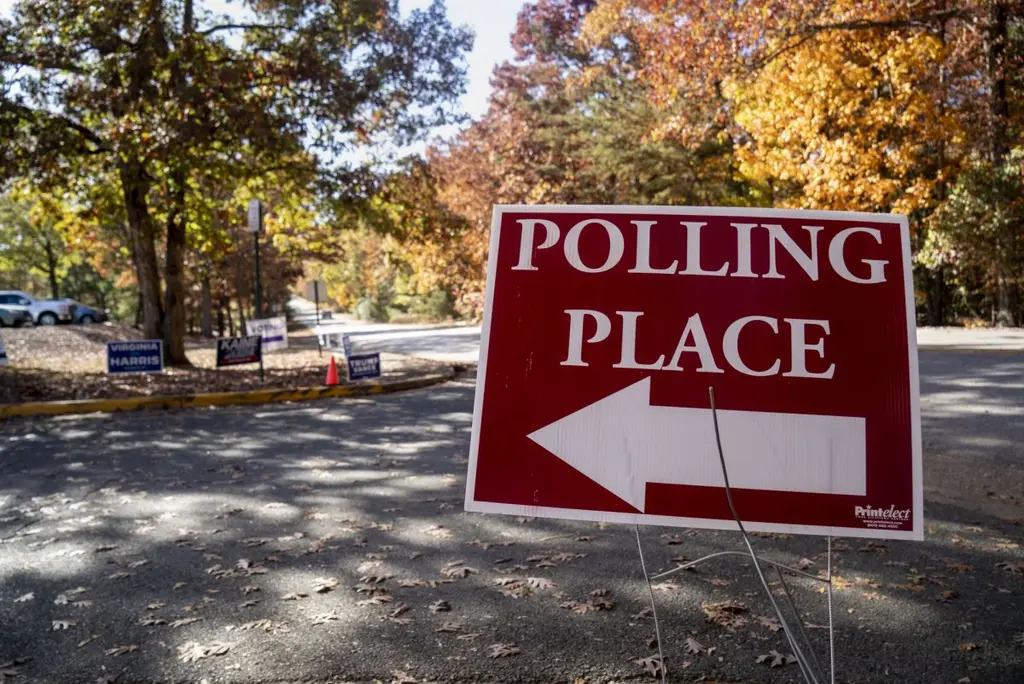

Legal experts warn of potential for federal agents at polling places
Missing guidance, public statements by the Trump administration and a DHS memo have sparked fears of the potential for federal agents being deployed at polling places.
Sept. 24 (UPI) -- Legal experts and lawmakers are warning that the Trump administration may be planning to send federal agents to the polls ahead of the Nov. 3 midterms.
Non-profit government watchdog American Oversight released a memo from the Department of Homeland Security to states' attorneys general, sharing a legal theory to circumvent the Posse Comitatus Act to allow the use of military forces for domestic law enforcement.
With President Donald Trump and his administration's unfounded claims of rampant election fraud and non-citizen voting, the organization warns that this legal theory offers a playbook for putting government agents near polling places.
DHS Secretary Markwayne Mullin said during an appearance on Fox News last weekend that the department is investigating more than 300,000 cases of suspected non-citizen voting.
Peter Kenny, vice president of litigation and investigations with American Oversight, told UPI that the focus of the Trump administration on non-citizen voting, paired with the memo outlining a legal theory for deploying armed troops to polls, has drawn the attention of legal experts.
"What we've been focused on, especially here we are in the run-up to the midterm election, is that we're seeing more and more claims of non-citizen voting," Kenny said. "We're seeing more and more federal officials at the most senior levels opening the door to deploying armed officers at polling locations, ostensibly to enforce immigration laws."
"Truly, this is an extraordinary use of the National Guard, and as many legal experts have noted, quite an unprecedented application of the specific legal provisions that they are citing," he continued.
Federal forces are banned from polling places by federal law as their presence may intimidate and deter voters from exercising their constitutional right to vote.
The memo that American Oversight received as part of a Freedom of Information Act request outlines circumstances that it says would allow states' National Guards to carry out immigration policing functions outside of their own states. It argues that if the National Guard is activated under Title 10 of U.S. Code and deputized by the Secretary of Homeland Security, it would not "run afoul" of the Posse Comitatus Act, a law that prohibits the use of military forces to enforce domestic laws without Congressional approval.
"When National Guard members are activated in a federal status under Title 10, they are employees of the United States," the memo reads. "This is supported by a fair reading of the statute's plain language, its broad grant of authority to the Secretary of immigration enforcement, use of the term 'employee' in other areas of federal law, and Article 1 of the Constitution, which provides that activated State militias are 'employed in the service of the United States.'"
Kenny said the memo is important, particularly in light of an approaching election, because it shows the department's thinking on Posse Comitatus and the use of the National Guard.
"It really shows a lack of any barrier to them accomplishing their goals in deploying National Guards in truly unusual and extraordinary ways," Kenny said.
Mary McCord is the executive director of the Institute for Constitutional Advocacy and Protection at Georgetown University and a former acting assistant attorney general for national security at the Justice Department beginning under the Obama administration through May 12, 2017, under the Trump administration. She told UPI that the DHS memo is part of a "constellation" of actions that have legal experts on alert about the midterms.
"I've been looking at this now for a year and there's nothing that the administration has said to quell the concerns or the fears that people would be intimated from voting and worse, that people would be potentially stopped, detained unlawfully, potentially U.S. citizens attempting to vote," McCord said.
One of the more recent actions that caught the attention of McCord, as well as Democrats in the Senate, was the Justice Department's removal of a 281-page manual "Federal Prosecution of Election Offenses" from its website without notice or explanation.
The document was removed in June.
A group of Senators issued a letter to then-Acting Attorney General Todd Blanche to explain the decision to remove the guidance. Blanche has yet to provide an explanation publicly.
Public statements by Blanche, the president and more recently FBI Director Kash Patel have not eased concerns about the election.
Patel, during his testimony before the Senate Judiciary Committee last week, declined to directly rule out sending agents to the polls when asked by Sen. Amy Klobuchar, D-Minn., and Sen. Richard Blumenthal, D-Conn.
"So would you agree with me that deploying FBI agents to the polls on Election Day would be contrary to the law?" Blumenthal asked, repeating his question after a response from Patel.
"I don't know that we can't legally do it. I'm telling you we're going to house our agents and intel officers in our field offices for election security purposes," Patel answered.
"I'm dissatisfied that you are unwilling to give us an unequivocal, clear, unambiguous commitment that the FBI will be kept out of election interference," Blumenthal said. "You are involved in seven voter-related subpoenas issued to the Nevada Secretary of State's Office. You were involved in the seizure of election records from Fulton County Georgia. Clearly the FBI has been involved in possible election interference. That is why your committing to avoiding that kind of interference moving forward is so important today."
In January, Trump told The New York Times that he regrets not directing the National Guard to seize voting machines after his loss in the 2020 presidential election. Though Trump questioned the capability of the National Guard to carry out such a task.
"I don't know that they are sophisticated enough," Trump said of the National Guard. You know, they're good warriors. I'm not sure that they're sophisticated enough in the ways of crooked Democrats and the way they cheat to figure that out."
McCord said that legal teams for voting rights and civil rights organizations have prepared to act in the case that federal agents or military members are sent to the polls on Election Day.
Two lawsuits have been filed in the last two weeks to block the Trump administration from deploying federal officers to the polls.
The lawsuit from a coalition including the League of United Latin American Citizens and Common Cause argues that the Trump administration, specifically DHS Secretary Mullin, have made enough public comments and taken enough action to warrant the court's intervention.
The lawsuit points to Mullin publicly stating that the administration has a policy authorizing Immigration and Customs Enforcement officers to go to polling places to serve warrants and detain people for suspected immigration violations. It adds that the department, under Mullin and acting ICE Director David Venturella, have adopted and are implementing a Polling Place Policy to direct agents in performing immigration enforcement activities at polling places.
The second lawsuit brought by the NAACP and a coalition of other organizations argues that the administration's purported plans violate the Voting Rights Act as it will intimidate voters, particularly minorities who may fear being confronted by immigration officers regardless of legal status.
For the service members who face the prospect of being asked to perform immigration duties around polling places, they and their commanding officers would first look for guidance from Judge Advocates General.
Eugene R. Fidell teaches military justice at Yale Law School. He is also a former JAG officer for the U.S. Coast Guard.
"If an order were disseminated to send federal troops to suppress disorder at the polling places, a JAG would be duty-bound to say you can't do that unless the president declares an insurrection," Fidell told UPI. "If the president does that, the constitutional fat will be on the fire. We will be watching a legal civil war go on."
In February 2025, Defense Secretary Pete Hegseth fired two of the top JAG officers in the armed forces, Lt. Gen. Joseph B. Berger III of the U.S. Army and Lt. Gen. Charles Plummer of the U.S. Navy. He did not note any conduct or other reason for their firings.
Like McCord, Fidell said that between public statements from administration officials, Trump's continued claims of rampant election security issues and actions taken by the administration on immigration, there is plenty of reason people to be concerned about the administration's actions around the election in November.
However, Fidell added that the judicial system is equipped to act swiftly if voting rights are violated.
"The protections against the plot against the election are several. One is the courts," Fidell said. "An alert civil society and state attorneys general and local authorities who are ready, willing and able to proceed immediately to court at the first sign of trouble. It's going to be touch and go but three will be people racing to courthouses. The very effective core of lawyers who have been carrying the banner so effectively in our country have long since drafted the necessary legal papers and they'll be coming into court at a time when the federal government will defend at the hilt anything the government does here."