
Law adds big cats, bears and primates to Illinois ban on traveling animal acts
CHICAGO — When Marc Ayers attended the Sangamon County Fair in New Berlin last year, he was on a mission to stop one attraction from returning to the state: the Banana Derby. Ayers, the Illinois state director for Humane World for Animals, said the welfare group has been tracking the show for years. When he went to see it firsthand, he watched in horror as two capuchin monkeys, Gilligan and ...
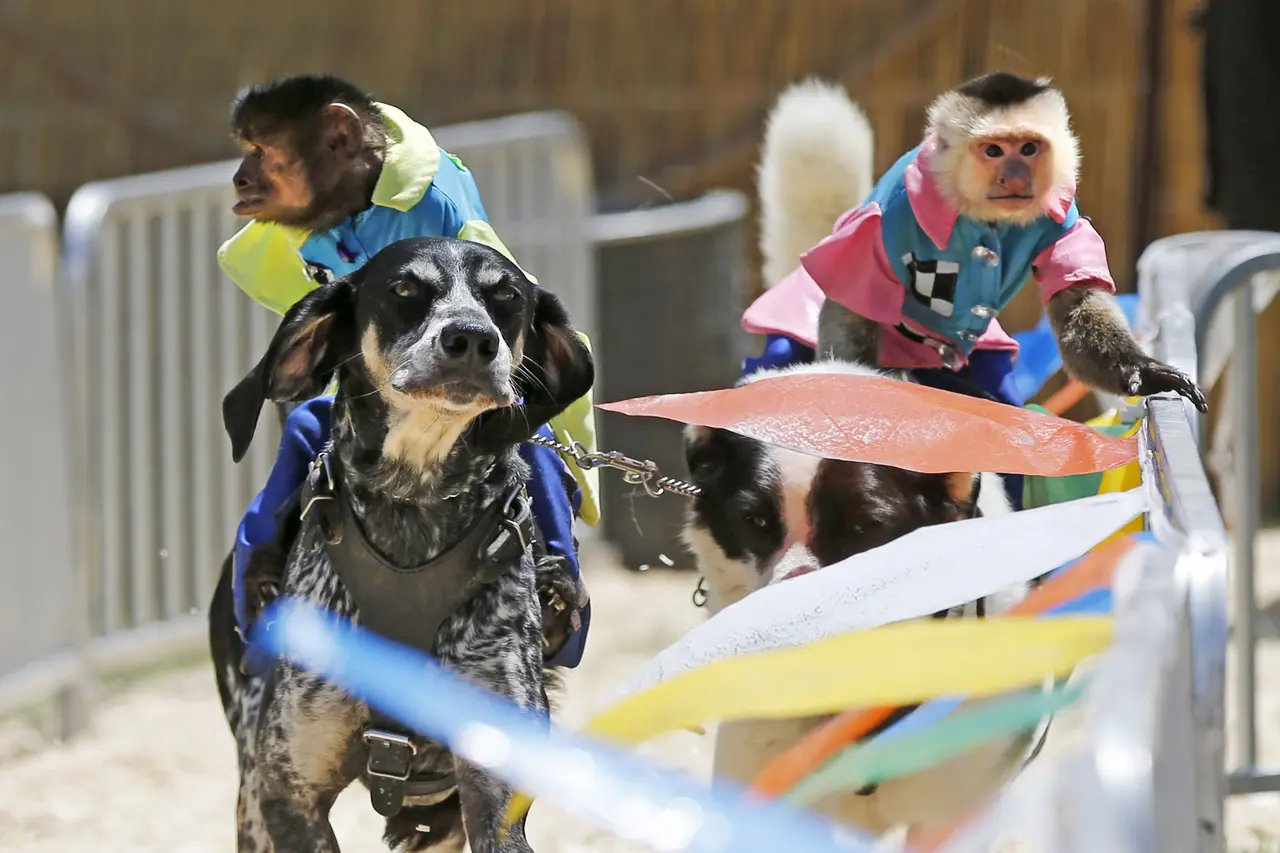
Burt, left, rides Scooby Blu as Bobo follows aboard Sasha at the Banana Derby race at the Lake County Fairgrounds in Grayslake, Ill., on July 29, 2015.
Jose M. Osorio/Chicago Tribune/TNS
CHICAGO — When Marc Ayers attended the Sangamon County Fair in New Berlin last year, he was on a mission to stop one attraction from returning to the state: the Banana Derby.
Ayers, the Illinois state director for Humane World for Animals, said the welfare group has been tracking the show for years. When he went to see it firsthand, he watched in horror as two capuchin monkeys, Gilligan and Bert, dressed in children’s clothing, were tethered to the backs of dogs as they raced around the show ring, he recalled.
“Gosh, those primates, the facial expressions they were making,” Ayers said. “That’s not a natural thing to see, monkeys riding dogs. They were desperately grabbing the rail to try to get off, and they couldn’t.”
After leaving the fair that June day, Ayers said, he promised himself that would be the last time the show came to Illinois.
“These awesome creatures that you see in the wild have been reduced to a bear riding a tricycle because a family thinks it’s funny or entertaining,” Ayers said. “It’s all there to exploit them so that the carnival can make money hand over fist off the exploitation of that species.”
A traveling show based in South Carolina, the Banana Derby has appeared at county fairs across Illinois for nearly two decades, according to owner Phil Dolci.
That run is coming to an end.
On June 26, Gov. JB Pritzker signed the expansion of the state’s Traveling Animals Act into law. The act already banned elephants in traveling shows and circuses — now the ban applies to big cats, bears and primates as well.
“In signing this bill, Governor Pritzker advanced the dignified and compassionate care of our wild animals,” said a spokesperson for the governor’s office.
The law took effect Wednesday.
But Dolci and some rural communities say the legislation casts too wide a net and should just target bad actors.
Gilligan and Bert have been well taken care of for over 20 years, Dolci said.
“They enjoy it, and I enjoy it,” he said. “I’d be a liar if I didn’t see these kids laughing and smiling and sitting with their grandparents. I know people and I see people, and it’s a beautiful thing.”
While agricultural and fair groups previously argued such attractions were important revenue generators for county fairs, animal welfare advocates say their popularity has declined.
Alyssa Berman-Cutler, senior director of government affairs at Lincoln Park Zoo, said she grew up attending circuses in Illinois. But she said public understanding of animal welfare has changed in her lifetime.
“We as humans can learn and evolve, and we can say we thought that was OK, and now we know better,” she said. “We can celebrate our communities, in the case of county fairs, in the case of coming together in circus performance and other forms of circus arts, and do this in ways that don’t impact animal welfare.”
State Rep. Kelly Cassidy, a Democrat from Chicago and the bill’s lead sponsor, said protecting animal welfare in Illinois, not the livelihood of exhibitors, was a key priority.
“I’m not here to help make it easier for you to harm animals,” she said.
Closing the gap
Illinois became the first state to ban elephants in traveling acts when lawmakers passed the Traveling Animals Act in 2017. Ayers helped lead that legislative effort.
Since then, several states have adopted similar restrictions. But Ayers said Illinois’ original law left out many of the animals most commonly used in traveling entertainment, allowing shows such as the Banana Derby to continue operating in the state.
In pushing for legislation to close that gap, the Humane World for Animals, Lincoln Park Zoo and other animal welfare advocates, argued that highly intelligent and social species such as primates, bears and big cats suffer when transported continuously between performances.
“They’re not given proper veterinary attention because they’re constantly in travel, they don’t have a home that is expansive or dynamic or a habitat of any sense,” said Maureen Leahy, senior vice president of animal care, horticulture and facilities at Lincoln Park Zoo.
Leahy said captive animals, particularly primates, can experience significant psychological effects from prolonged confinement, frequent transport and repeated performances.
When she reviewed footage of the Banana Derby, she said the monkeys’ facial expressions immediately stood out.
“When they’re baring their teeth, they’re scared,” Leahy said. “When it’s sort of the curled lips back, it is a full-on fear grimace of, ‘I am in discomfort right now.’”
In testimony supporting the legislation, representatives from Humane World and Lincoln Park Zoo cited years of U.S. Department of Agriculture inspection reports of animal welfare violations by the Banana Derby and Oklahoma-based circus Culpepper & Merriweather.
“We’re fed up with the constant cycle of abuse that we see in the records with these exhibitors,” Ayers said. “It’s year after year with the same exhibitors. We were seeing life on the road, egregious USDA violations, animal exploitation for human entertainment. And it’s got to stop.”
Culpepper & Merriweather had its license suspended for six months in 2011, according to a USDA order, after the owner was found to be operating without a veterinarian and had provided inadequate care for a wounded tiger cub.
The circus served the suspension, and the tiger cub was confiscated by the USDA, according to USDA records. Culpepper & Merriweather has been operating ever since, performing in Illinois as recently as April 25 at the Williamson County Fairgrounds.
But the circus’s August show at the Dwight Rotary Club in Dwight has been canceled due to the new state ban on big cats in circus performances, said Donald McClarey, incoming president of the club.
A representative of the circus declined to comment on the violation or the Illinois ban.
In an email to the Tribune on June 23, McClarey said the circus act has come to Dwight for 22 years, performing for packed audiences in the Livingston County village of less than 4,000.
McClarey said he’s saddened the circus won’t be returning.
“We are a rural community, and no one that I am aware of in Dwight would tolerate mistreatment of any animal,” he said. “I wish the legislature instead of a blanket ban, had focused in on those found guilty of mistreatment of animals.”
He said he was made aware of the circus’s animal welfare violations through email outreach from People for the Ethical Treatment of Animals, an international animal rights organization, but that didn’t affect the Rotary Club’s decision to continue sponsoring the circus.
McClarey said activist groups “have been targeting circuses for years.”
According to USDA reports, the Banana Derby has never been suspended but has been cited for inadequate space, lack of psychological enrichment and improper transport.
Ayers said that because traveling acts frequently move between states, enforcement can be difficult.
“The main issue with this industry is they’re mobile,” he said. “When a complaint comes in, well, they’re gone the next day, typically to somewhere else.”
For advocates, that reality made a ban on multiple species necessary. Ayers said his team at the Humane Society tracked county fair records year over year and saw them continuing to book acts despite USDA violations.
Cassidy said she believes growing bipartisan support for animal welfare helped clear the way for the legislation.
“There was very little opposition,” she said, noting that even representatives from county fairs and the circus industry largely stayed out of the debate.
“Are you going to sit at the table and try to defend some of these actions?” Cassidy said. “Whether it’s a monkey riding a dog or a majestic creature like a big cat in a tiny cage, none of these things is defensible.”
Illinois joins states including California, Colorado, Massachusetts and New Jersey in prohibiting lions, tigers, bears and primates from performing in traveling acts.
Berman-Cutler, from Lincoln Park Zoo, said state restrictions on species in traveling shows can also help reshape public perceptions about keeping exotic animals as pets. She pointed to a study released last year by the Association of Zoos and Aquariums that found an increase in primates entering the nation’s pet trade.
“When people see animals in environments where they are not in their natural environment, being dressed as jockeys and looking very humanized, that gives them the impression that they make good pets,” she said.
Social connections
Dolci, who previously lived in Illinois for 34 years, said he didn’t book the Banana Derby at any Illinois fairs this year as he expected the legislation to pass.
“I saw the writing on the wall,” Dolci said, criticizing “radical left actors down there in Springfield.”
Each year, Dolci said he travels with Gilligan and Bert from their home in Greenville, South Carolina, to fairs across the Midwest and South, including events in Indiana, Iowa and Tennessee.
In Illinois, the Banana Derby previously appeared in counties including Lake, DuPage, McHenry, Boone, Winnebago and McLean.
“I feel sorry for the children of Illinois,” Dolci said. “I grew up going to the Brookfield Zoo, touching a baby elephant. Those kids in Illinois never see an elephant. It’s horrible. It’s a shame, it’s a real shame.”
Dolci said he’s addressed USDA inspection findings over the years and questions whether an entire species ban is justified because of concerns involving a relatively small number of exhibitors.
Soon after purchasing his monkeys, Dolci said Gilligan naturally began riding on the back of his family dog. This became the inspiration for his Banana Derby act.
“It’s a natural behavior,” he said. “You look at capuchin monkeys, they ride on their mom or other family members for almost the first two years of their life. It’s not brain surgery to teach one to ride on a dog.”
Animal welfare experts disagree.
“I’m not surprised a monkey would be in desperation for that social connection, whether that be to a human or a dog,” Leahy said. “Their well-being depends on their social connections. They don’t have the opportunity to engage in normal species-typical behaviors.”
Leahy pointed to Eli and Susie, two chimpanzees at Lincoln Park Zoo who previously worked as animal actors in Hollywood film productions, considered the last of Hollywood’s chimps.
When Eli first arrived at the zoo, she said he exhibited prolonged self-rocking behavior, a common sign of psychological stress.
“That’s the case for a lot of these traveling animal acts,” she said.
A broader effort
With county fair season in full swing, the Banana Derby continues to tour.
“There’s plenty of other states,” Dolci said. “Illinois is the loser, not me.”
Because Illinois has long been a major stop for traveling animal acts in the Midwest, Ayers said he believes the legislation could influence neighboring states to adopt similar restrictions.
“It will send a signal to the Midwest states, especially surrounding Illinois, that we did our part,” he said. “You now need to do your part to make sure that your states are no longer going to be hosting these cruel events and follow Illinois’ lead.”
For animal welfare groups, it is the beginning of a broader effort to stop the domestication of exotic animals.
Last month, Berman-Cutler and Leahy traveled to Washington, D.C., to advocate for the passage of the Captive Primate Safety Act, a law that would prohibit the private ownership of monkeys and apes as pets nationwide. Supporters argue the bill would help curb illegal wildlife trafficking, improve public safety and reduce the number of primates entering entertainment industries and other commercial uses.
Advocates say the Illinois traveling animal ban and the proposed federal primate pet ban are part of the same larger goal: discouraging the treatment of wild animals as companions or performers.
“Why do you think it’s necessary to put a monkey on a dog’s back?” Cassidy said. “Just because you can do something doesn’t mean you should.”
_____