
Minneapolis diverted thousands of mental health calls from police. Its costs and oversight are under scrutiny.
MINNEAPOLIS — Alex Anderson and Meg Nohner were driving through the heart of Minneapolis on a recent weekday when they got a call from headquarters: A woman was talking to herself outside a business on Lake Street. Part of the city’s behavioral crisis response team, Anderson and Nohner arrived to find a tall woman wearing bright blue yoga pants and a white T-shirt with neon accents. She ...
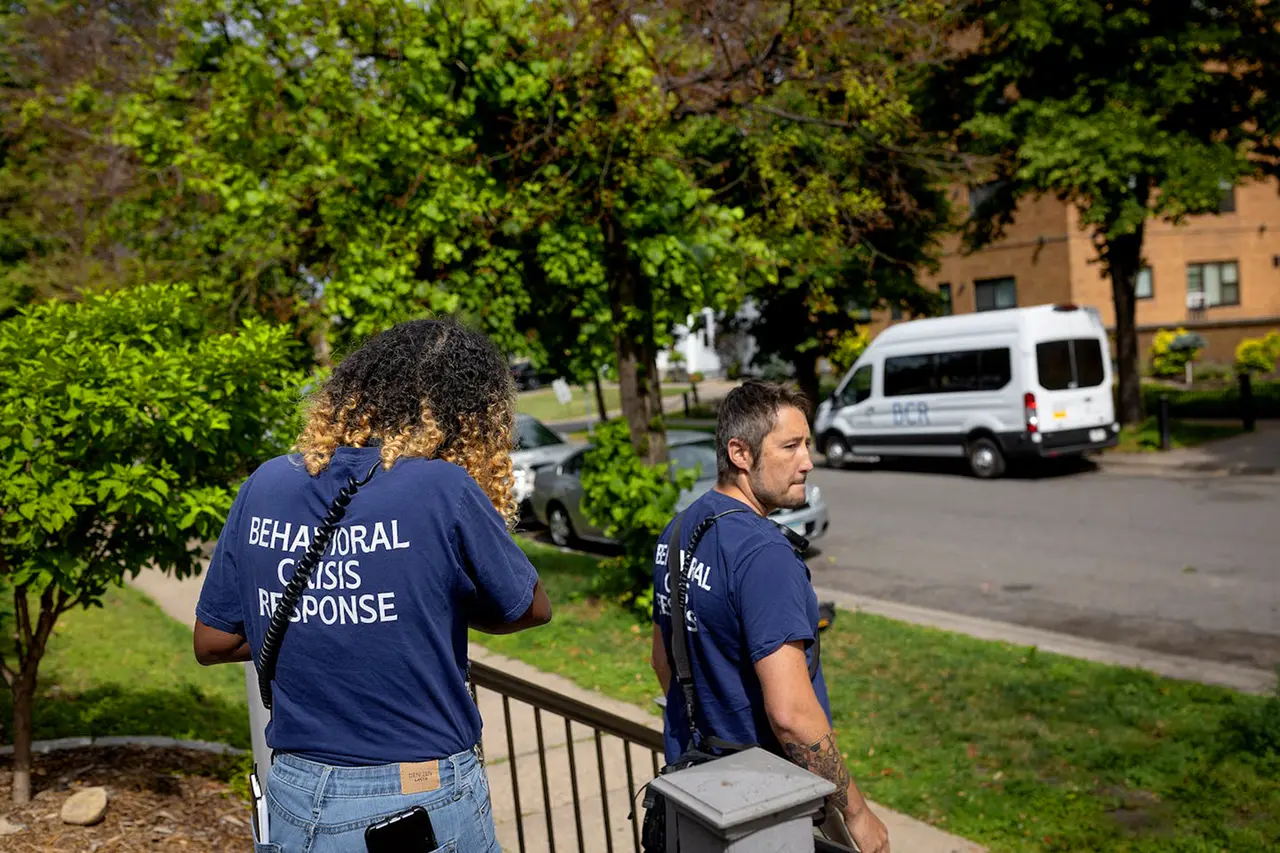
Shamso Iman, left, and Dane Haverly, with the Behavioral Crisis Response team, leave the scene after responding to a distress call in Minneapolis in 2023..
Elizabeth Flores/The Minnesota Star Tribune/TNS
MINNEAPOLIS — Alex Anderson and Meg Nohner were driving through the heart of Minneapolis on a recent weekday when they got a call from headquarters: A woman was talking to herself outside a business on Lake Street.
Part of the city’s behavioral crisis response team, Anderson and Nohner arrived to find a tall woman wearing bright blue yoga pants and a white T-shirt with neon accents.
She answered their questions by speaking into a sparkly, pink microphone, as if she were narrating the incident to a radio audience.
“Thank you Minneapolis!” she said into the mic before sauntering off across the street.
The use of unarmed mental health workers is one of the ways Minneapolis has moved away from using armed police to respond to all 911 calls, and part of a broader shift by law enforcement across Minnesota to respond to a growing number of mental health crisis calls.
The program has been lauded for freeing up police for other priorities and offering a more humane way to deal with people who have mental health issues.
Yet the cost of the behavioral crisis response teams has also ballooned since the program started four years ago, from $2.5 million the first year to about double that today. All told, the the city has spent more than $25 million on the program over the last five years.
At the same time, internal city documents show the program has been plagued by a lack of oversight, with a recent study finding that having a private contractor do the work appears to have “hindered” city control of staffing, response protocols, decision-making and personnel qualifications.
While no one is publicly accusing the program of misspending city money, officials have raised questions about the lack of details on invoices and varied costs for staffing.
Run since 2021 by the for-profit company Canopy Roots, the program is under fresh scrutiny as the city is in the midst of a competitive bidding process for a company to staff what it now calls the “mobile crisis team” beginning next year.
Eight companies have applied, and the city wants the winning bidder to respond to more calls and do more follow-up work with recipients about their services.
It’s unclear what metrics the city has for gauging the success of the program besides diverting an average of 10,000 calls per year from police.
The study of the program, released in April, said the city must do more to track the program. “Without that level of oversight, the city may be funding a critical service without sufficient control over how it is delivered, by whom, and whether outcomes meet expectations,” the report said.
When Canopy Roots launched the behavioral crisis response program, it was a startup therapy practice founded by several members of a family from Georgia.
The program began with two supervisors, a program manager and 14 responders. Over the last five years, it has grown to provide services 24/7 and now has nearly 70 full-time employees, 55 of them responders.
From the beginning, the company had issues with billing and invoices. Internal city emails reviewed by the Minnesota Star Tribune show Canopy Roots didn’t routinely include documentation with invoices, such as itemized receipts and payroll records.
A September 2024 email from an assistant city attorney to Canopy Roots said the city needed more details on invoices. Officials found a significant difference in what Canopy charged for services. One month, the company charged an average of $70 per hour for staffing, and the next month, $25 per hour. The city wanted an explanation for the difference and encouraged the company to set a standard rate.
In 2024, the city told Canopy Roots it would stop reimbursing the company for things like sunscreen, menstrual supplies or vacuum accessories, noting the city doesn’t supply those items to its own employees. The city also began to require that Canopy Roots provide receipts for “program supplies” such as snacks, clothing and water as part of the settlement of a lawsuit that alleged the city paid millions to community organizations without using standard accounting practices to prevent fraud.
Canopy Roots Program Manager Cherie Hanson said, although there were “bumps in the road” getting the program off the ground, the company is proud of the work it has done for the city. (Hanson’s sister is the executive director of Canopy Roots and her brother is listed as an owner on the company website.)
“We know how many storms we weathered,” she said. “And so we’re confident that we can work together with the city to run a new program.”
She noted oversight of the program has moved from department to department and said the city has a “complex reimbursement process.” Internal emails show Canopy Roots staff brought up “ongoing confusion and unclear communication” to city staff as well as payment delays that brought the company “dangerously close to service interruptions.”
“They had received a lot of misinformation” from other city employees, said Luana Nelson-Brown, former director of the Neighborhood Safety department. “They did amazing work, but when it came to the compliance part, because there hadn’t been any, it was a struggle to try to get them up to speed and get them into compliance.”
She said if the city stopped paying Canopy Roots, the program would come to a halt, so it was a “moral dilemma because the work was making a difference.”
At one point, Nelson-Brown said she was ordered to pay invoices by the city. Community Safety Commissioner Toddrick Barnette, who oversaw Nelson-Brown part of the time she was in the role, said he didn’t know anything about that. Regarding payment delays, Barnette said any vendor that submitted the proper documentation got paid. He said after he arrived in late 2023, the city put “structure in place for oversight, accountability and transparency.”
During Barnette’s confirmation hearing earlier this year, Council Member Aurin Chowdhury said she repeatedly emailed Barnette asking about basic financial information on Canopy Roots, to no avail.
Council President Elliott Payne chastised Barnette in mid-April for being unresponsive to such “standard requests” for information.
Barnette said the city doesn’t ask Canopy Roots how much profit they make on the contract, just as it wouldn’t ask, for instance, an IT contractor.
Nelson-Brown, who now works for the state, said she had questions about every city contract she looked at, not just the one with Canopy Roots.
“When you’re spending taxpayer funds there is a strict regimen in how you do that properly,” she said.
Nelson-Brown said the city didn’t have good compliance protocols, and was dealing with new programs and contractors — some of them working on their first government contract — providing services to marginalized communities.
“I fought that battle the whole time I was there,” she said.