
The region: Home to steel mills, beaches and … the Bears?
CHICAGO — David Kubacki has lived in both places where the Chicago Bears are considering building a new stadium — and he knows which he prefers. Kubacki was born in Hammond, Ind., but when he was a child, his family moved to Arlington Heights, Ill. After returning to attend Purdue University, he never left Indiana, raising his family in Hammond. His friends and family were there, and it made ...
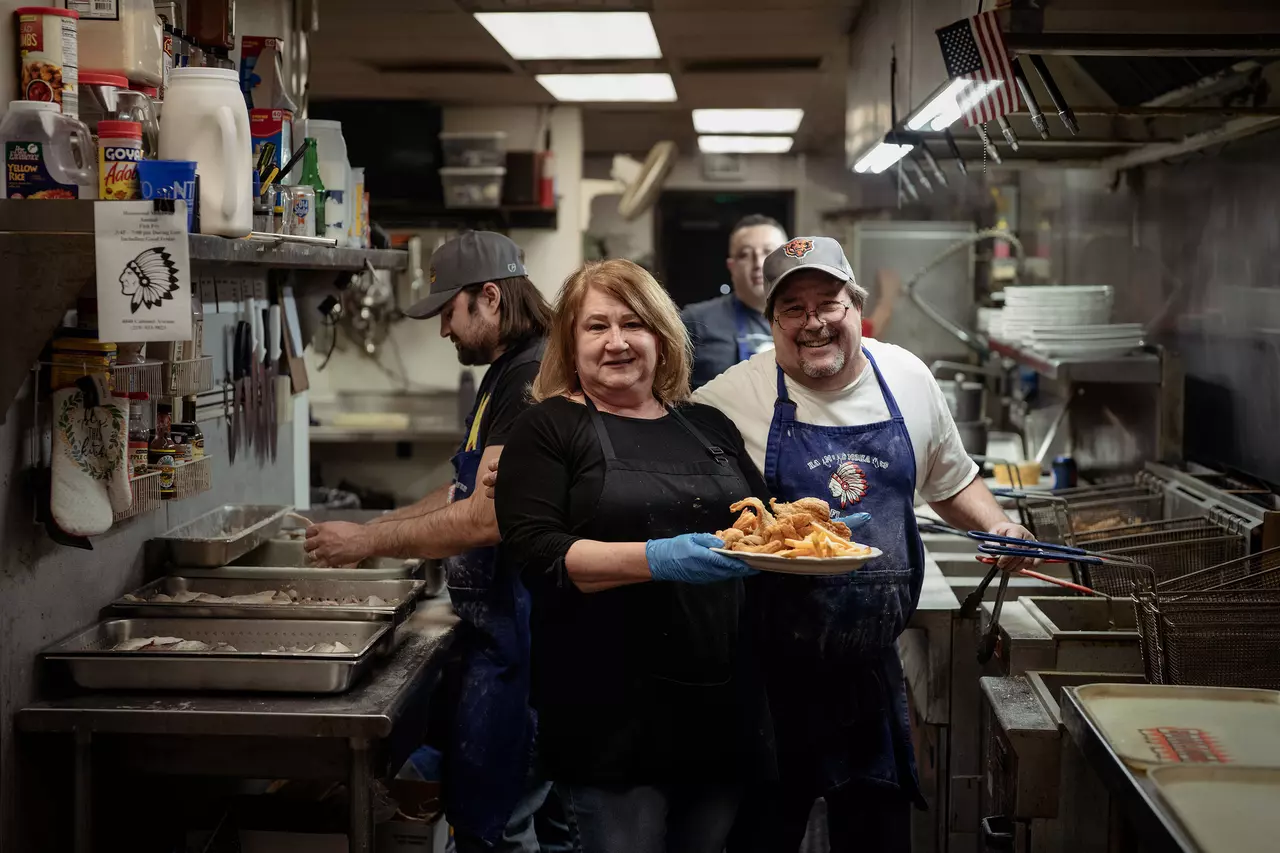
Suzette and David Kubacki have been running the Lenten Friday fish fry at Hammond Mohawks AC&C in Hammond, Indiana, for 18 years.
E. Jason Wambsgans/Chicago Tribune/TNS
CHICAGO — David Kubacki has lived in both places where the Chicago Bears are considering building a new stadium — and he knows which he prefers.
Kubacki was born in Hammond, Ind., but when he was a child, his family moved to Arlington Heights, Ill. After returning to attend Purdue University, he never left Indiana, raising his family in Hammond. His friends and family were there, and it made sense financially to stay in northwest Indiana, an area known as “the region.”
“If the wind blows in the wrong direction, you smell the refinery,” he conceded. “But we can be at the lakefront on our boat in five minutes. You can walk down the street at night. People wave. It’s a true community.”
If the Bears move to Indiana, they will become part of the region — a corner of the state that has much in common with both Chicago and Indiana, yet proudly protects its own identity.
“The region” can spark arguments among its own residents as to how the area is defined. Originally named for the Calumet region, bound by its rivers, it generally covers the northwest corner of the state, in Lake and Porter counties.
Many Chicagoans know the area only from driving through, and may think of it as the ruins of the Rust Belt, interrupted by the Indiana Dunes. The region rose from an industrial foundation, but like Chicago diversifying from its stockyard past, it now features a mix of quaint towns, luxury lakefront homes, booming suburbs and farmland.
Still, certain personal traits remain valued: a blue-collar work ethic, street smarts and a feeling of community.
Those characteristics could make it a good fit for the Bears. Many locals welcome the team, but are not thrilled about the rising taxes and costs that come with new development.
In February, Indiana lawmakers authorized building an enclosed stadium for the Bears in Hammond, on the state border at Wolf Lake. The Bears would contribute $2 billion, with the state aiming to spend about $1 billion, to be repaid through an admissions tax and other local taxes. Illinois lawmakers have yet to respond to the Bears’ request to negotiate tax breaks for an alternate site they own in Arlington Heights.
Whether the Bears relocate to Hammond or not, residents — some of whom proudly claim the label Region Rats, while others disdain the term — say they love their quirky corner of Indiana that’s closer to the big city than parts of the North Shore.
“We are considered a suburb of Chicago,” Kubacki said. “There’s pluses and minuses to it. The house I live in right now, my grandfather built it. The tax rate is much cheaper than Illinois. But everybody goes back and forth across the border all the time.”
David and his wife, Suzette Kubacki, help run the Friday night fish fry for the Hammond Mohawks social club. They love the family vibe.
“It’s a feeling of community and closeness,” Suzette said. “People here are really good. They’re raising families, it’s generational. Quite a few are still rooted here. You’re a rock’s throw from Chicago.”
Boom towns
The region has much in common with Chicago. Residents get Chicago TV and radio stations, many are fans of Chicago sports teams, and many commute to the city. Like Chicago, the area has a mix of white ethnic groups, Blacks and Hispanics. Unlike most of Indiana, the region runs on Central Standard Time.
Further reinforcing the overlap, businesses and residents increasingly are fleeing high taxes and prices in Illinois for a lower cost of living in Indiana.
Yet the southern end of the region is worlds away from Chicago. It has a rural feel, with miles of open farmland, livestock and grain silos.
In rural Lowell at the south end of the region, farmers were getting ready recently to plant crops. Roxie Antczak, who grew up on a dairy farm in the area, works at Harvest Tyme Family Farm, which opened for its annual tulip festival this weekend.
“People are very friendly and look after their neighbors,” she said. “It’s a wonderful place to visit or live. Our pace is a bit different from what you’d see in Chicago — it’s relaxing.”
Along Interstate 65 near Hebron, a billboard proclaiming “Hell is Real” is considered one informal landmark for entering the region, while a sign stating, “Jesus is Real” welcomes travelers to the rest of Indiana. The region is also home to the movie, “A Christmas Story.” Though set in the fictional town of Hohman, Indi., the film is based on author Jean Shepherd Jr.’s childhood in Hammond.
Parts of the area are booming. Lake and Porter counties have seen recent population growth to nearly 700,000 residents, especially in towns farther south near the border, including Crown Point, Cedar Lake and St. John, the latter with a median income of $131,000. Business and population also have moved farther east, to Valparaiso and Chesterton.
Meanwhile, a series of new developments is reshaping the area, for better or worse.
Amazon announced plans to invest $15 billion for new data center campuses for artificial intelligence and cloud computing in northern Indiana, creating 1,100 jobs.
A new commuter railroad spur opened this spring from the South Shore Line in Hammond to Munster and Dyer, which connects to Chicago.
In Michigan City along the lakefront, a new second track speeds up travel time to Chicago, and plans call for a $300 million luxury hotel and townhouse development to transform the city into a commuter and tourist destination.
The development is meant to capitalize on the Indiana Dunes state and national parks, which combined draw nearly 4 million visitors annually. Despite the region’s industrial reputation, the Dunes are among the most biologically diverse parks in the nation, and thousands of sandhill cranes migrate through since a recent habitat restoration.
The Marquette Greenway ties much of the area together via a 60-mile recreational path partially completed from Chicago’s Calumet Park to New Buffalo. For people who live there, attractions like that make the region an attractive place to live.
At Meditrina Market Cafe in Valparaiso, where the specials include cilantro naan and eggplant shawarma, Rachael and Peter Brown raved about the local dining scene.
Rachael Browngrew up in Merrillville and moved to Chicago to work, but the couple came back in 2020 to be closer to family. Peter Brown generally works remotely but can commute to Chicago on an express commuter bus known as the ChicaGo Dash.
Their home would have cost three or four times as much in Chicago. The schools are good, and the high school football team won the state championship in 2022. They like the affordable living and the safe, child-friendly atmosphere.
“Kids can roam and be kids,” Rachael said. “It’s got a small-town feel and community, but there’s still a lot to do.”
At the same time, the region has its problems. Skyrocketing utility bills and labor disputes are prompting some residents to take to the streets in protest.
NIPSCO, the northern Indiana utility company, is under investigation for overcharging customers. It also recently locked out more than 1,600 workers over contract negotiations, while more than 800 workers are locked out over a contract dispute at the BP Whiting refinery near the Bears site.
Some residents say it’s stressful to live in the area because of environmental hazards from industrial waste, along with plans to keep burning coal at power plants.
And some are pushing back against big business. Environmental activists oppose proposed data centers in Michigan City, Hobart, Lowell and elsewhere, warning that they will suck energy and water away from residents.
Overcoming its industrial past
One reason Hoosier lawmakers were so quick to support a deal for the Bears is that parts of northwest Indiana could use an economic boost.
“The rise and decline of American industry is the story of the region,” Indiana University Northwest history professor emeritus James Lane said.
Historically, the region was defined by the steel industry. U.S. Steel Corp.’s Gary Works once was the largest steel mill in the world, employing some 30,000 workers. They made steel for cars, ships and tanks, and Chicago skyscrapers.
But by the 1970s, foreign competition and automation undercut the market, resulting in thousands of lost jobs and crime that made Gary the murder capital of the U.S. White flight left much of the city abandoned, and much of the remaining Black population was left in poverty.
Decades later, there are signs of an economic comeback. In 2023, Japan’s Nippon Steel bought U.S. Steel and made plans to invest $3 billion in the Gary Works.
The plant still employs more than 4,000 workers, with an annual payroll of $700 million and pays taxes of $67 million — far more than the Bears would produce.
Now, residents and Mayor Eddie Melton are making efforts to revitalize the city — the childhood home of Michael Jackson and his brothers — by tearing down blighted buildings and pursuing a ten-year redevelopment plan. The city’s crime numbers fell drastically in 2025, with its lowest homicide rate in 55 years.
The city is home to a Hard Rock Casino and a planned Lake County Convention Center and $60 million FedEx distribution center.
‘I love it’
Despite its affinity with Chicago, the region has something of a love-hate relationship with its bigger neighbor.
As in Wisconsin, visitors from Illinois are sometimes referred to derogatorily using a swear word, and there is concern an influx of Chicagoans will raise housing prices. But recent visits to the region found only a friendly reception.
At the Center Lounge in the quaint downtown of Whiting at midday, where specials include perch and frog legs, several folks at the bar were enjoying conversation and lunch with a shot and a beer.
Local neighborhoods are so close-knit that everyone knows each other, said Allison Buell, a teacher and coach in Hammond. While most people welcome the Bears, many residents have lived in the region all their lives and like it the way it is.
As a Democratic enclave in an otherwise Republican state, she said, Indiana officials sometimes give the region short shrift. So while the area would benefit from the Bears, many residents resent that a new football stadium would be financed in part with a 1% food and beverage tax in Lake and Porter counties.
“It would be great if Indiana didn’t tax the heck out of us,” Buell said. “Some people here are very set in their ways. They don’t want any change at all.”
Gary Police Cmdr. Tom Pawlak said he would love the Bears coming to the area, and considers a 1% higher food and beverage tax “an investment in the community.”
Pawlak has lived his whole life in the region, he said, since 1959. “I love it, or I wouldn’t still be living here.”
Residents treasure their beaches, boating, fishing and hunting, particularly where the Bears want to build near Wolf Lake.
“It’s a beautiful nature setting,” retired insurance worker turned security guard Patrick Coughlin said.
When he grew up across the border in Calumet City, Coughlin said, the region was looked down upon as “a little seedier.” But now he lives in Hammond and said there have been great improvements, including a new fire station, high school and a YMCA with a water park.
Across the street from Wolf Lake, new homes are being built, advertising affordable living close to Chicago. Prices run from $527,000 and up. One house, still under construction, sported a sign out front with the Bears logo: “Go Bears! Go Hammond!”
One point those interviewed agreed on, which may also reflect the skeptical mindset of the region: They don’t believe the Bears will come. They think the threat to move is just gamesmanship to get a better deal in Springfield.
“I don’t think it’ll happen,” retired utility worker Bob Lukascek said. “It’s a ploy to get money from Illinois.”
____