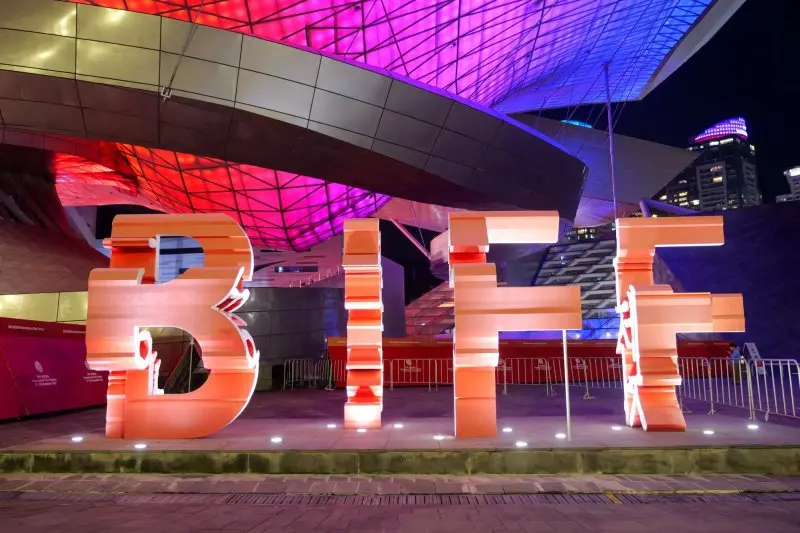

Busan film fest director Jung Hanseok eyes greater global reach
The Busan International Film Festival is looking to build on its growing international stature, festival director Jung Hanseok said ahead of its 31st edition.
The Busan International Film Festival is expanding its global profile, festival director Jung Hanseok said ahead of its 31st edition. File Photo by Thomas Maresca/UPI UPI BIFF director Jung Hanseok speaks at a press conference in Seoul on Sep. 1. File Photo by Yonhap UPI
BUSAN, South Korea, Oct. 5 (UPI) -- The Busan International Film Festival is looking to build on its growing global stature while staying true to its role as a launchpad for Asian filmmakers, festival director Jung Hanseok said ahead of the fest's 31st edition.
With its flagship Competition section entering its second year and new Academy recognition giving its top winner a route to Oscar consideration, BIFF is expanding the opportunities for films showcased in Busan to reach audiences worldwide.
Jung, who took the reins of the festival last year, said confidence in the Competition had "built very quickly" among leading Asian filmmakers.
"The films selected and awarded in the inaugural edition generated considerable attention, and many went on to gain further recognition through releases in their home countries and abroad," he told UPI in a written interview.
The festival opens Tuesday with Kim Jong-kwan's The Table: Day and Night and runs through Oct. 15 in the southeastern port city.
This year's Competition brings together 13 films, including three entries from Korea: Lim Hayeon's Beach Fictions, Kim Jung-hoon's horror film Shaving and Youm Kyubock's animated feature Long Long Night.
Other entries include Iranian director Majid Majidi's Midday Meal; Between Two Lovers by Japanese filmmaker Hirose Nanako, a former assistant director to Koreeda Hirokazu; and Chinese director Gu You's The First Taste of Loneliness.
"As we prepared this year's edition, we were pleased to see that the filmmakers behind the kind of top-level films we hope to attract were approaching the Competition much more proactively and positively than they did last year," Jung said.
BIFF's international standing got a boost this year with recognition by the International Federation of Film Producers Associations as an "A-list festival."
The Academy of Motion Picture Arts and Sciences also designated the Busan Award for Best Film as a qualifying award for international feature film submissions.
BIFF joins Cannes, Berlin, Venice, Sundance and Toronto under the expanded eligibility rules. A qualifying non-English-language film can now be submitted by winning a designated festival award, alongside the longstanding route of selection by a country or region.
For Jung, the section's credibility rests on its films.
"These 13 films should not simply be a collection of titles," he said. "Together, they should represent the leading edge of Asian cinema today."
Jung spent six years as BIFF's Korean cinema programmer before becoming director, and identifying emerging talent throughout Asia remains central to his agenda.
"Even with a Competition devoted to Asian cinema, we felt there needed to be further space for discovery," he said.
The festival's Vision section features 24 films, divided equally between Asian and Korean selections, most of them world premieres. It focuses more closely on emerging and independent filmmakers, Jung said, with many of last year's selections subsequently invited to other festivals.
...