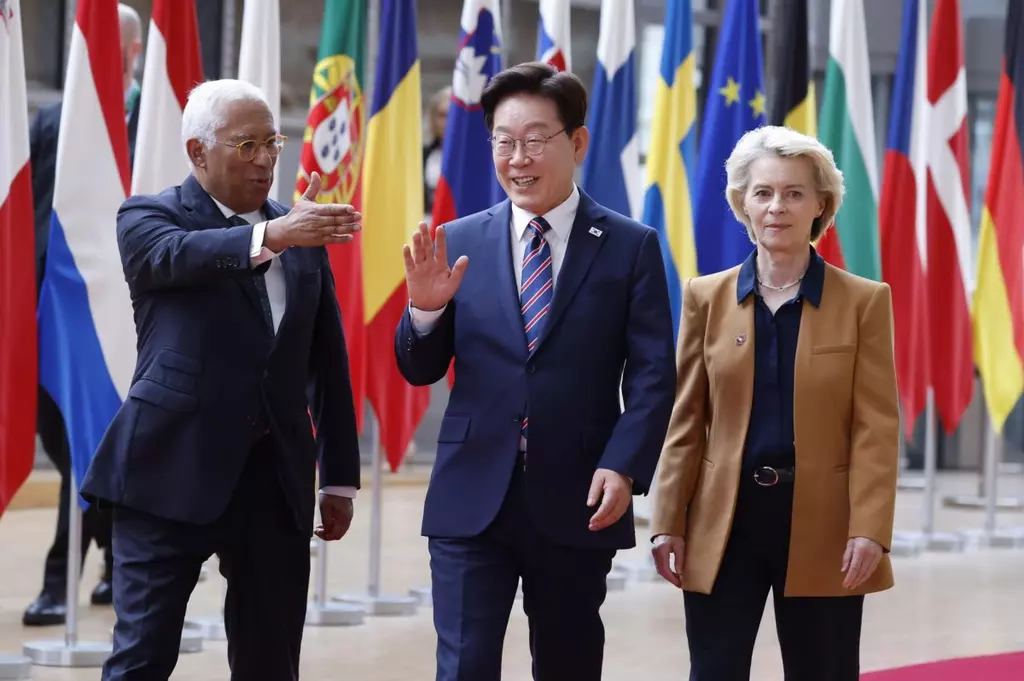

South Korea's Lee, EU leaders reject North Korea nuclear status
South Korean President Lee Jae Myung and leaders of the EU on Tuesday expressed "grave concern" over Pyongyang's nuclear and ballistic missile programs.
SEOUL, June 11 (UPI) -- South Korean President Lee Jae Myung and leaders of the European Union on Wednesday condemned North Korea's military cooperation with Russia and expressed "grave concern" over Pyongyang's nuclear and ballistic missile programs, while also backing Seoul's efforts to resume dialogue with the North.
The statement was issued following a summit among Lee, European Commission President Ursula von der Leyen and European Council President Antonio Costa at the EU headquarters in Brussels.
"We condemn support by third parties, in particular the DPRK, which enable Russia to sustain its war of aggression against Ukraine," the statement said, using the official acronym for North Korea. "We strongly condemn Russia-DPRK illegal military cooperation."
The leaders also expressed "grave concern over the DPRK's nuclear and ballistic missile programs" and reaffirmed their commitment to the complete denuclearization of the Korean Peninsula.
The statement called for North Korea to return to full compliance with the Nuclear Non-Proliferation Treaty as a non-nuclear-weapon state.
North Korea announced its withdrawal from the NPT in 2003 and in 2022 passed a law declaring itself a nuclear state. Leader Kim Jong Un later called the country's nuclear status "irreversible," and Pyongyang amended its constitution to codify the expansion of its nuclear forces.
Last month, North Korea's U.N. envoy said Pyongyang was not bound by the global treaty and described efforts to force compliance with it as a "wanton violation" of international law.
"The DPRK will never be accepted as a nuclear-weapon State under the NPT or have any other special status in that regard," the South Korea-EU statement said.
The statement also backed Lee's efforts to resume inter-Korean dialogue through "proactive de-escalation and confidence-building measures" aimed at achieving "peaceful coexistence and shared growth on the Korean Peninsula."
Lee's administration has sought to reduce tensions with Pyongyang since taking office last year, but the North has consistently rebuffed Seoul's overtures.
The statement additionally called for improvements in North Korea's human rights situation and urged Pyongyang to allow access to international and humanitarian organizations.
The joint statement came as Chinese President Xi Jinping concluded a state visit to North Korea in which he and Kim vowed to deepen cooperation between the longtime allies. Notably absent from the public readouts of the trip was any mention of denuclearization, a silence that some analysts have interpreted as a tacit endorsement of Pyongyang's status as a de facto nuclear state.
Beyond the Korean Peninsula, the statement also addressed tensions in the Taiwan Strait, preserving language that became a regular feature of South Korea's diplomacy with key partners in recent years despite objections from Beijing.
"We stress the importance of preserving peace and stability across the Taiwan Strait and oppose unilateral attempts to change the status quo in the Indo-Pacific," the statement said.
Lee's visit to Europe, which began Tuesday, will continue through June 18 and include stops in Belgium, Italy and the Vatican, where he is scheduled to meet Pope Leo XIV. He is also expected to attend the Group of Seven summit in France from Monday through Wednesday.