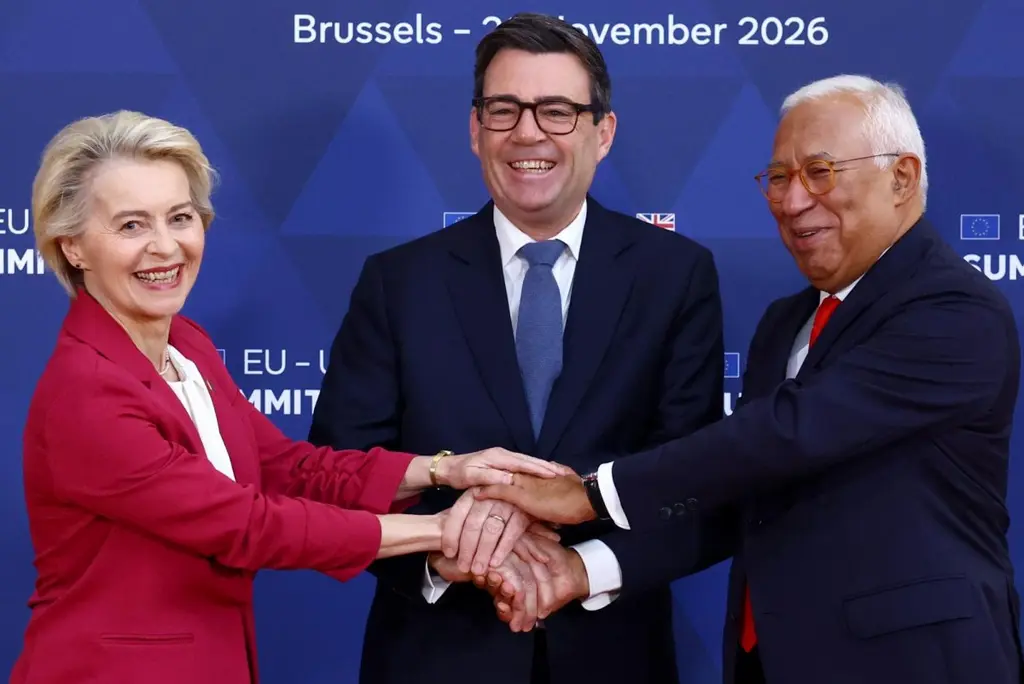

European Union, Britain ink reset deal on food, farming and mobility
EU-U.K. relations entered a new era with a new deal to enable frictionless trade by aligning food and farming standards and a youth mobility scheme.
Nov. 20 (UPI) -- Britain and the European Union announced Friday that a deal resetting the United Kingdom's relationship with the 27-member country bloc was "done," less than an hour after Prime Minister Andy Burnham arrived at the headquarters of the European Council in Brussels for a EU-U.K. summit.
The agreement covering youth mobility, food and farm export rules, carbon emissions pricing and some movement of people aims to reverse a lot of the trade barriers created by Britain's "hard" 2020 Brexit, without going as far as signing up to the customs union, single market or rejoining the EU entirely.
"The deal is done -- negotiations have concluded. Now, both sides will work towards implementation of the youth mobility scheme, the SPS [food and farming] deal and the emissions trading scheme. Both sides have agreed when these will come into force. And those dates are set out in the joint statement, which will be published in due course. As with all international agreements, there is a legal process in each respective country which will now take place. And talks will continue on some areas - these will be set out in the joint statement later," said a Downing Street spokesperson.
However, the EU officials cautioned that the deal, which is due to due to take effect in spring 2028, would not do so unless Britain reduces annual tuition fees for Europeans studying at British universities to the same level paid by British students, currently $12,822 in England and Wales and $2,383 in Scotland compared with $19,650 to $91,700 for overseas students.
Britain has been given six months to agree or work with the EU to come up with an alternative.
"The Council and Commission consider that this agreement is to provide for equal treatment with nationals as regards tuition fees for all students. The Council and Commission acknowledge that these four agreements form a package of the 2026 EU-U.K. summit," the EU Council and EU Commission said in a statement.
U.K. officials rejected that position, saying the issues were separate and that the agreements on food and farming would come into force in March 2028 regardless of whether agreement was reached on the tuition fees issue.
They also said the sides agreed in principle that Britain could join the EU's planned "Made in Europe" law aimed at leveraging the EU's $2.2 trillion procurement budget to give European industries a helping hand in their battle against China's growing economic clout by favoring European-made goods.
Speaking in Brussels, Reform U.K. leader Nigel Farage, who led the "leave" campaign, attacked the agreement struck on Friday, calling it a "very, very expensive and costly error" and said that Burnham had lacked a "democratic mandate to do any of this."
The opposition Conservative Party leader Kemi Badenoch said smoother trading with EU was desirable but "not trade at any cost"
She said leaving the EU but still having to adhere to its rules the "worst of both worlds" -- a reference to the fact British companies could be required to comply with EU rules and standards regardless of whether or not they did business with the EU.